Chinese semiconductor thread II

meedicx

Junior Member
Registered Member
Read an interesting analysis on Ascend 950 DT memory
1780612594465.png
Please, Log in or Register to view URLs content!

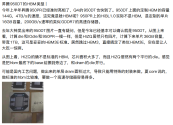
There's an image of an Ascend 950 DT chip going around which shows only 4 memory chips around the compute die, instead of the standard 8 for HBM. Huawei has said they are using a custom designed memory, HiZQ 2.0, for the Ascend 950 series, so not being standard is expected.

If you calculate the specs of each individual memory chips from the announced specs, each die would have 36GB capacity / 1TB bandwith, which is actually HBM3e level. There is also speculation that Huawei sources their DRAM chips from JHICC with a dedicated production line and relaxed design constraints to get HBM3e level specs without meeting the entire standard. Some semi analysts believe the HBM standard is the only path for AI chips, but this may be a faulty assumption with highly integrated in-house memory designs.
 
Last edited:

antiterror13

Brigadier
Please, Log in or Register to view URLs content!

I keep telling people that Chinese chip designers are not necessarily using TSMC process for a lot of the AI stuff. TSMC is fully booked and Samsung is eager for more customers. Also Samsung can provide memory chips. Not saying that BYD is necessarily using Samsung for Xuanji A3, but that both TSMC and Samsung are options.

SMIC's own capacity and future domestic ones are going to be fully booked by Huawei and domestic AI chip producers for a while. I would imagine Huawei by itself will need 150k wpm of 5-7nm capacity.

What is the chance that Samsung and TSMC are banned to make chips for BYD and others? I wouldn't underestimate what the bully would do, especially when the products (e.g Tesla) are losing competitive advantages. So the best approach is to have fully integrated internally
 

tphuang

General
Staff member
Super Moderator
VIP Professional
Registered Member
What is the chance that Samsung and TSMC are banned to make chips for BYD and others? I wouldn't underestimate what the bully would do, especially when the products (e.g Tesla) are losing competitive advantages. So the best approach is to have fully integrated internally
Why does it matter? If it's banned, then it's banned. You just use a domestic chip then. You can always stock up more chips if you need them. auto chips don't have that high requirements.

Read an interesting analysis on Ascend 950 DT memory

View attachment 176142
Please, Log in or Register to view URLs content!

There's an image of an Ascend 950 DT chip going around which shows only 4 memory chips around the compute die, instead of the standard 8 for HBM. Huawei has said they are using a custom designed memory, HiZQ 2.0, for the Ascend 950 series, so not being standard is expected.

If you calculate the specs of each individual memory chips from the announced specs, each die would have 36GB capacity / 1TB bandwith, which is actually HBM3e level. There is also speculation that Huawei sources their DRAM chips from JHICC with a dedicated production line and relaxed design constraints to get HBM3e level specs without meeting the entire standard. Some semi analysts believe the HBM standard is the only path for AI chips, but this may be a faulty assumption with highly integrated in-house memory designs.
Is there any reason we are posting just zhihu speculations here?

I'm not sure why Huawei would source from Jinhua if it can get DRAMs from SK or Samsung or CXMT or maybe even its own affiliated fab Swaysure.

As Huawei has shown, they are very good with advanced stacking of dies. Stacking together a few DRAM dies is far easier than what they are attempting with hybrid bonding.
 

broadsword

Brigadier

China unveils world’s first superfast quantum memory, paving way for practical computing​

Advance establishes core element required for general-purpose quantum computing that can read massive amounts of data​


Published: 1:00pm, 5 Jun 2026Updated: 3:40pm, 5 Jun 2026
Chinese scientists have created the world’s first superfast memory for
Please, Log in or Register to view URLs content!
, solving a critical data-reading bottleneck and paving the way for big-data challenges such as drug discovery and detecting fraudulent financial activities.

While quantum computers are expected to solve complex problems at speeds unattainable by traditional computers, they still need an efficient way to access classical data.

Without a high-speed data interface, even the fastest quantum machine is slowed down when forced to process massive classical data sequentially.

According to the team led by
Please, Log in or Register to view URLs content!
, “quantum random access memory (QRAM) enables efficient access to classical data for quantum computers and is a prerequisite for many quantum algorithms in achieving quantum speed-up”.


Quantum computers use qubits to process information. Unlike traditional computer bits that can represent either a zero or one, qubits can exist in a “superposition” state and represent both zero and one simultaneously.

This peculiar characteristic, along with quantum entanglement, allows quantum computers to perform certain tasks exponentially faster than even the most powerful supercomputers.

Although scientists have proposed theoretical frameworks for QRAM, actual experimental demonstrations of the technology remain limited.

In a study published in the peer-reviewed journal Nature Physics in March, the team said it had implemented a QRAM architecture in a superconducting quantum processor.

The framework allows processors to access and retrieve data in superposition, meaning the computer can look at multiple data points simultaneously.

According to Lu Liqiang, an assistant professor at Zhejiang University’s College of Computer Science and Technology and one of the study’s authors, the team successfully ran a QRAM prototype capable of accessing 4-bit and 8-bit data on a superconducting quantum chip for the first time.

This showed that the QRAM could handle multiple data inputs at the same time, Lu told the official Science and Technology Daily in May.

“While current quantum algorithms are theoretically impressive, running them on quantum computers often requires efficiently accessing massive amounts of classical data,” he said. “Without QRAM, many applications remain purely theoretical.”

In drug molecule simulations, the technology can rapidly extract topological features of molecules from chemical databases containing hundreds of millions of entries in a superposition state, significantly shortening the development cycle for new medications.
In financial risk control, the memory could help quantum algorithms analyse all data features when processing massive amounts of historical transaction records to detect fraudulent activities.

And in
Please, Log in or Register to view URLs content!
, it allows quantum AI to fully leverage its superior processing power when navigating complex big-data challenges, such as natural language processing and image identification, at scales beyond the reach of classical systems.
 

tphuang

General
Staff member
Super Moderator
VIP Professional
Registered Member
Please, Log in or Register to view URLs content!

Axera says it is among the first customer of TSMC's N6C and N4C process.

the process eliminates four mask layers compared to N6, delivering substantial optimizations in PPA (Power, Performance, and Area)—critical metrics for edge-device chips

Axera is a leader in embodied AI chips.
 

tphuang

General
Staff member
Super Moderator
VIP Professional
Registered Member
Please, Log in or Register to view URLs content!

Due to price of optical fiber soaring, there is a huge drive on demand of high purity quartz sand. 6N+ grade high purity quartz sand remains low domestically (also rising, if you see all the posts we have here), so supply is a little tight. It is used in 2 core processes: preform fabrication and fiber drawing.It is also used in ancillary products such as fiber grade quartz sleeves, furnace core tubes and quartz tubes.
 

tokenanalyst

Lieutenant General
Registered Member

Dingtong Technology: 112G high-speed connectors are in full production capacity, and 224G products have been supplied in batches.​


Dingtong Technology reports that its 112G high-speed connectors are currently operating at full production capacity, while its 224G products have successfully passed certification by mainstream customers and entered mass production. Driven by the explosive growth in demand for AI computing power, orders for these series have surged significantly, resulting in saturated order books. The company is actively managing this high demand through strategic capacity allocation to ensure timely deliveries, with plans to further expand shipment scales as additional production capacity is gradually released to meet market needs.

1780670764587.png

Beyond its core connector business, Dingtong Technology is aggressively expanding into the liquid cooling sector and strengthening its global footprint. Currently operating two active liquid cooling production lines, the company aims to add five new lines this year based on robust demand forecasts, with preparations progressing steadily. Simultaneously, its Malaysian subsidiary serves as a critical hub for Southeast Asian operations, maintaining smooth financial conditions and high profitability while increasing capacity utilization through localized manufacturing and delivery capabilities tailored for key overseas clients.

Looking ahead, Dingtong Technology is positioning itself at the forefront of next-generation infrastructure by focusing on CPO/NPO technology evolution. The company has established a dedicated R&D team to conduct forward-looking research into core technologies and is actively collaborating with key clients to drive the iteration of next-gen products. This strategic focus, combined with its current success in high-speed connectors and liquid cooling, underscores Dingtong's commitment to adapting to the rapidly evolving requirements of modern AI computing systems through continuous innovation and capacity expansion.

Please, Log in or Register to view URLs content!
 
Top