Dinglong Technology's high-end wafer photoresist has secured a major order, with a new order from a leading customer for nearly a thousand gallons.
On June 11, Dinglong Technology issued a voluntary announcement disclosing that its holding subsidiary, Yidinglong (Qianjiang) New Materials Co., Ltd., has recently achieved continuous order breakthroughs in the field of high-end KrF/ArF wafer photoresist.
The announcement shows that since its 300-ton-per-year KrF/ArF high-end wafer photoresist production line went into operation on March 20, 2026, the company has delivered hundreds of gallons of immersion ArF and KrF photoresist to two leading wafer foundry customers, and the products have been successfully applied in their mass production lines. Due to the stable performance and good results of the company's photoresist products, the two customers have recently placed additional orders totaling nearly 1,000 gallons.
As of the date of this announcement, the company has secured bulk orders for eight high-end wafer photoresists (four ArF photoresists and four KrF photoresists) from several major domestic wafer foundries, an increase of five products compared to the end of the first quarter of this year. Furthermore, several other products are expected to convert into orders within this year. Product deliveries are projected to increase significantly in the first half of 2026, with commercialization progress accelerating considerably.
Regarding testing progress, the company has cumulatively developed over 40 high-end wafer photoresists, with nearly 30 products sent to customers for verification testing, of which over 10 have entered the gallon sample testing stage. Simultaneously, the company has also developed several supporting photolithography auxiliary materials such as BARC and SOC.
According to the announcement, the company began its foray into the high-end wafer photoresist business in May 2022. It has now achieved a complete production line for high-end wafer photoresists, encompassing product development, pilot line construction, order acquisition, and the establishment of China's first full-process production line for "organic synthesis - polymer synthesis - purification - photoresist mixing," and has achieved stable mass supply of products.
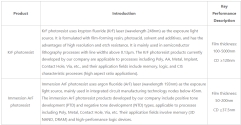
The company's ArF and KrF photoresists are developed and produced using a customized R&D and production model, covering all process technology nodes in domestic wafer fabs and widely used in high-end memory (3D NAND, DRAM) and high-performance logic devices.
In terms of production capacity, the company's Phase I production line in Qianjiang,
with an annual output of 30 tons of KrF/ArF high-end wafer photoresist, is operating stably and has the capacity for mass production and supply; the Phase II production line, with an annual output of 300 tons of KrF/ArF high-end wafer photoresist, was completed and put into operation at the end of the first quarter of 2026 and has entered the capacity ramp-up stage.
View attachment 176556