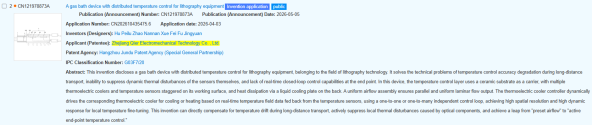
Qier Electromechanical temperature control for a 14nm lithography process.


Defects can be reduced by better metrology and process optimizations. The industry did that for the 7nm and 14nm nodes with multiple patterning with immersion. My guess is, what cannot be overcomed by the fab is the low throughput of a tool, is it to manufacturer to optimize the tools the meet the fab requirements.
So you are confident that if Huawei-SMIC has access to the NXT:2150i or a domestic equivalent one they wouldn't be able to make 5nm to 3nm equivalent nodes with decent yields?Yes but adding 2-4x more steps and being forced to repair/throw out more wafers from tolerance stacking errors also affects throughput. It’s not a clean win.
All I'm concerned about is the bottleneck for HBM3 now that news has come out about CXMT delaying their rollout despite all the good news about the financial side of things.you are making a lot of assumptions here without anything to back them up.
N+3 isn’t a “proper” 5 nm. Huawei and SMIC clearly had to relax density requirements and still had yield problems despite that design concession, so yeah, I would not bet on the idea that having a better DUVi resolves these issues. Let’s be realistic here.So you are confident that if Huawei-SMIC has access to the NXT:2150i or a domestic equivalent one they wouldn't be able to make 5nm to 3nm equivalent nodes with decent yields?
Just a reminder that they are doing 7nm and close to 5nm with possible the NXT:1980i and the NXT:2000i
With NXT:1980i maybe not but with the 2150I I would.N+3 isn’t a “proper” 5 nm. Huawei and SMIC clearly had to relax density requirements and still had yield problems despite that design concession, so yeah, I would not bet on the idea that having a better DUVi resolves these issues. Let’s be realistic here.
That’s a blind bet imo, but I don’t think we’ll ever see that proposition tested.With NXT:1980i maybe not but with the 2150I I would.
So you think stooges are wasting their time banning immersion? What is the obsession of industry stooges to ban scanners above the 1980i?That’s a blind bet imo,
That will require access to 2150i.but I don’t think we’ll ever see that proposition tested.

HW according to its own presentations makes its own HBM standard which I assume it does its own advanced packaging (since it has the patent for that). You are basing projection of their 950DT production on some Korean Media article about CXMT HBM3. How exactly are these things related?All I'm concerned about is the bottleneck for HBM3 now that news has come out about CXMT delaying their rollout despite all the good news about the financial side of things.
Specifically whether or not Huawei can produce enough 950DTs for the supernodes this year because they will need lots of HBM capacity. I'm just assuming that if CXMT cannot produce HBM3 at scale, Huawei will struggle to make their supernodes in reasonable numbers which wouldn't be great.