TCL CSOT Debuts World's First Ultra-High Mobility 50 ARR Display Technology
TCL CSOT has unveiled the world’s first ultra-high mobility (50 cm²/V·s) oxide display technology, integrated with Adaptive Partition Refresh Rate (ARR) capabilities, marking a major advancement in LCD performance and energy efficiency. Designed to overcome the inherent limitations of traditional backplane technologies like amorphous silicon, LTPS, and conventional oxide TFTs, this innovation delivers exceptional electron mobility while maintaining mass-production-grade stability and voltage resilience. By enabling a dynamic refresh rate range from 0.01Hz to 120Hz, the technology reduces display power consumption by up to 50%, positioning it as a foundational solution for next-generation AI PCs, laptops, and high-performance monitors.

The breakthrough is built upon three core engineering advancements. TCL CSOT reengineered its manufacturing process using linked rotating target sputtering and composite repair techniques to achieve highly uniform, defect-suppressed oxide semiconductor films. To tackle the environmental sensitivity of ultra-high mobility devices, the company developed a precise hydrogen-oxygen balance control system for insulating layers, significantly improving leakage current suppression and long-term reliability. Additionally, end-to-end circuit and device optimizations, including a novel GOA architecture and enhanced thermal management, resolve threshold voltage drift and self-heating challenges, fully unlocking the material’s performance potential while paving the way for 2026 mass production.
The ARR technology leverages this oxide platform to deliver intelligent, content-adaptive display performance. Through horizontal and vertical dual-dimensional matrix partitioning, the screen can independently adjust refresh rates across different zones, matching dynamic content to up to 120Hz while dropping static areas to as low as 0.01Hz. This hardware-software synergy is powered by AI scene recognition and AI picture quality compensation algorithms, which intelligently map screen content, allocate refresh rates accordingly, and dynamically optimize brightness, color gamut, and contrast across zones. The result is a flicker-free, visually seamless experience that dramatically cuts power usage without compromising image quality.
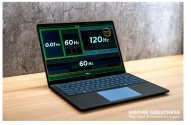
This launch represents the latest milestone in TCL CSOT’s strategic oxide technology roadmap, following commercial deployments of conventional oxide in 2024 and high-mobility 30 oxide in 2025. Premiering at SID with a 14-inch laptop panel, the technology solidifies TCL CSOT’s leadership in semiconductor display innovation. Guided by the company’s “APEX” technology philosophy, the ultra-high mobility 50 oxide and ARR platform directly addresses industry demands for high-resolution, low-power, and AI-ready displays. As the technology scales, it is expected to redefine performance benchmarks across consumer and professional markets, driving the broader display industry into a new era of intelligent, energy-efficient visual experiences.
The breakthrough is built upon three core engineering advancements. TCL CSOT reengineered its manufacturing process using linked rotating target sputtering and composite repair techniques to achieve highly uniform, defect-suppressed oxide semiconductor films. To tackle the environmental sensitivity of ultra-high mobility devices, the company developed a precise hydrogen-oxygen balance control system for insulating layers, significantly improving leakage current suppression and long-term reliability. Additionally, end-to-end circuit and device optimizations, including a novel GOA architecture and enhanced thermal management, resolve threshold voltage drift and self-heating challenges, fully unlocking the material’s performance potential while paving the way for 2026 mass production.
The ARR technology leverages this oxide platform to deliver intelligent, content-adaptive display performance. Through horizontal and vertical dual-dimensional matrix partitioning, the screen can independently adjust refresh rates across different zones, matching dynamic content to up to 120Hz while dropping static areas to as low as 0.01Hz. This hardware-software synergy is powered by AI scene recognition and AI picture quality compensation algorithms, which intelligently map screen content, allocate refresh rates accordingly, and dynamically optimize brightness, color gamut, and contrast across zones. The result is a flicker-free, visually seamless experience that dramatically cuts power usage without compromising image quality.
This launch represents the latest milestone in TCL CSOT’s strategic oxide technology roadmap, following commercial deployments of conventional oxide in 2024 and high-mobility 30 oxide in 2025. Premiering at SID with a 14-inch laptop panel, the technology solidifies TCL CSOT’s leadership in semiconductor display innovation. Guided by the company’s “APEX” technology philosophy, the ultra-high mobility 50 oxide and ARR platform directly addresses industry demands for high-resolution, low-power, and AI-ready displays. As the technology scales, it is expected to redefine performance benchmarks across consumer and professional markets, driving the broader display industry into a new era of intelligent, energy-efficient visual experiences.