Chinese semiconductor thread II

Some1Guy

Junior Member
Registered Member
They have a good point, China has a significant gap in terms of catching up to NVIDIA chips but news outlets don't have latest and accurate information about China. The article would probably be correct if China stands still from now until 2027 but that obviously won't happen.
I don't disagree with the technological gap between domestic chip makers and NVIDIA. The reason i called it cope was because it made it out to be this insurmountable chasm that will only get bigger over time and China has literally no chance to catch up with NVIDIA which is something we have heard before but with different industries.

Experts believe that if the U.S. continues to regulate semiconductors, the gap in AI semiconductor performance between the U.S. and China will widen and hamper China's AI growth. Currently, Nvidia's highest performance products are about five times stronger than Huawei's latest products, and the gap is expected to widen to 17 times in 2027.

Due to this gap, Chinese companies are actually training AI models with U.S. GPUs, not with their own semiconductors. Reuters quoted a senior U.S. official as saying on Sunday that DeepSeek's latest AI model "V4," which will be unveiled next week, has been trained based on Nvidia's latest AI chip, Blackwell. "As AI develops in China, the 'bottleneck' phenomenon' that lacks computing power will intensify," an AI industry source said. "The convenience of these companies to borrow computing resources owned by foreign companies or smuggle Nvidia's GPUs will increase further."

Like how does a US official know that DeepSeek trained it's latest model on Nvidia's latest AI Chip, even crazier how do they know that DeepSeek is gonna release it next week. Also how will the gap widen to 17 times in 2027, who knows China might have EUV by 2027 or the
AI bubble will pop causing a global economic crises, anything can happen including WW3 by 2027.

Also let's not pretend that these export controls are working to hamper China's AI growth and will actually get worst in the future, this is simply not true since it literally accelerated China's self sufficiency drive which by definition was not the intended effect of the export controls in the first place. You can't just make these blind predictions than again this is a shitty article with no journalistic integrity whatsoever.
 

jx191

Junior Member
Registered Member
I don't disagree with the technological gap between domestic chip makers and NVIDIA. The reason i called it cope was because it made it out to be this insurmountable chasm that will only get bigger over time and China has literally no chance to catch up with NVIDIA which is something we have heard before but with different industries.


Like how does a US official know that DeepSeek trained it's latest model on Nvidia's latest AI Chip, even crazier how do they know that DeepSeek is gonna release it next week. Also how will the gap widen to 17 times in 2027, who knows China might have EUV by 2027 or the
AI bubble will pop causing a global economic crises, anything can happen including WW3 by 2027.

Also let's not pretend that these export controls are working to hamper China's AI growth and will actually get worst in the future, this is simply not true since it literally accelerated China's self sufficiency drive which by definition was not the intended effect of the export controls in the first place. You can't just make these blind predictions than again this is a shitty article with no journalistic integrity whatsoever.
For sure, every "expert" in the western hemisphere has underestimated China's R&D capacity for years now. There is plenty to suggest that China has been making big strides towards a full domestic semiconductor supply chain. @tphuang has written some good threads about this whole situation, definitely look over if you are interested, on X or SDF.

For starters, check out Huawei's own roadmap for their Ascend series:
Please, Log in or Register to view URLs content!

You need a very advanced node to reach the 970 specs. Huawei feels confident projecting that information on a big screen, clearly there is reasoning for that confidence and Huawei is one of the biggest players in the EUV situation. They'll probably need EUV for the 970 specs, and that's for 2028.

Coincidentally, Reuters was also throwing around the 2028 date as well in their article you mentioned.

I'm definitely not an expert but over time you can pick out good clues about the whole industry in China.
 

latenlazy

Brigadier
From what Ive seen/heard, he's probably not wrong. But "ramping up to volume production" can mean a lot of things. There are definitely lots of streamlining and testing still to go.

But yes, the western Internet will not contain accurate information about Chinese EUV. Most people online probably don't even know what EUV stands for, let alone what's happening in China.
They will probably want to get high volume production using EUV on smaller chipsets before moving to larger chipsets. In other words if 2027-2028 is when they’re for sure using EUV on AI chips it means they’re probably using EUV on phone chips well before then.
 

vincent

Grumpy Old Man
Staff member
Moderator - World Affairs
The following Youtube videos discussed the development of China's EUV lithography machine.
This is not a production tool. It's still in development. Includes English captions.
If these videos has been posted before, the moderator may remove this post..


The channel is not trustworthy.
 

latenlazy

Brigadier
okay, guys, let's move on from these EUV discussion for today. Nothing new is happening here and we are just discussing YouTube clips that are bad sources.

I’d add that in general try not to share YouTube videos unless there is some very specific claim within them that you think is worth sharing, and if there is highlight the specific claim (preferably with a timestamp) so we have a specific point to structure discussions around. Most YouTube content is just lazy aggregation of the same primary sources we collect here, often with much lazier or less rigorous editorial judgments applied.
 

tokenanalyst

Lieutenant General
Registered Member

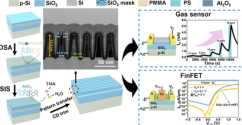
High-Density Sub-10 nm Silicon Nanowires Fabricated via Directed Self-Assembly and Sequential Infiltration Synthesis Synergistic Patterning for Multiple Applications

Abstract​

This study presents a synergistic patterning technique integrating directed self-assembly lithography (DSA) and sequential infiltration synthesis (SIS) to fabricate silicon nanowires with small critical dimension, high aspect ratios, and high density on silicon-on-insulator (SOI) substrates. Through optimization of polystyrene-block-poly(methyl methacrylate) (PS-b-PMMA) guiding templates and SIS cycles, polymer templates were in situ converted into aluminum oxide (Al2O3) hard masks with high etching selectivity. Coupled with a single-layer silicon dioxide (SiO2) intermediate mask strategy, this approach significantly simplifies the device fabrication workflow while leveraging the flexibility of SiO2 etching to achieve progressive scaling of silicon nanowires. Focused ion beam-transmission electron microscopy (FIB-TEM) characterization confirmed nanowire profiles with a top width of ∼6.6 nm, bottom width of ∼14.9 nm, pitch of 28 nm, and height of ∼53.5 nm, which are further used in multiple applications. The exposed sub-10 nm silicon nanowire channels exhibited ultrasensitive gas-sensing capabilities, demonstrating a 49.8% response to 2.5 ppm ammonia (NH3), significantly outperforming conventional NH3 sensors. The silicon nanowire was further combined with a high-k/metal gate process to demonstrate its application in fin field-effect transistors (FinFETs). The device shows a switching ratio exceeding 107 and a subthreshold swing as low as 69.59 mV/dec, demonstrating exceptional electrostatic control of the Fin channel fabricated by the DSA-SIS process. This work not only provides a cost-effective manufacturing solution of high-density silicon nanowires but also demonstrates the application potential of DSA-SIS technology in semiconductor devices with a nanostructure for both sensing and integrated circuit operations​
1771979895901.png

Please, Log in or Register to view URLs content!
 

Wrought

Captain
Registered Member
okay, guys, let's move on from these EUV discussion for today. Nothing new is happening here and we are just discussing YouTube clips that are bad sources.

Sorry to keep the conversation going, but Paul Triolo's new report specifically cites you (among others). It's a deep dive into the current state of the industry—including but not limited to EUV—with repeated caveats that secrecy is tight and speculation is rife. Also talks about how annoyed other companies are with Huawei.

An overall best case EUV development scenario for 2026–27 holds that an EUV light source prototype was functional in 2023, ready to be delivered for testing within a systems platform in 2024. Industry observers at that time believed there was further testing before a functioning EUV system was delivered to SiCarrier in Shenzhen and possibly also to a team in Shanghai. At this point, the thinking goes, by early 2025, this prototype EUV system was delivered to the teams with the goal of integrating with other key tools to develop an end-to-end process capability, catalyzing the evolution of the entire end-to-end process into an HVM-capable system; this could be the same system described in the recent Reuters report. This trajectory aligns with SiCarrier’s stated focus on developing a portfolio of equipment capable of operating at nodes below 7 nanometers and potentially 5 nanometers. Under a still-speculative scenario, 2026 would be devoted to testing and stabilizing a high-volume EUV manufacturing process. If those efforts prove successful, the HSIC could, by 2027, begin producing limited volumes of GPUs, SoCs, and ASICs at sub-5 nanometer feature sizes.

Please, Log in or Register to view URLs content!
 

tphuang

General
Staff member
Super Moderator
VIP Professional
Registered Member
Sorry to keep the conversation going, but Paul Triolo's new report specifically cites you (among others). It's a deep dive into the current state of the industry—including but not limited to EUV—with repeated caveats that secrecy is tight and speculation is rife. Also talks about how annoyed other companies are with Huawei.


Please, Log in or Register to view URLs content!
that's fine. I communicated with Paul on this piece.

But it's fair to note that nothing new has been reported here. And I'm going to delete comments that have just been entirely off topic since my warning.
 

tphuang

General
Staff member
Super Moderator
VIP Professional
Registered Member
Please, Log in or Register to view URLs content!
Semiconductor Manufacturing International Co., Hua Hong Semiconductor and several Huawei-linked chipmakers are all expanding or aiming to start production of chips on the most advanced technology available in the nation, which includes production on the 7-nanometer or even 5-nm performance level, sources briefed on the matter said. The national effort to expand advanced chip production capacity is aimed at feeding the growing local need for AI computing infrastructure, they said.
In chipmaking, generally, the smaller the nanometer the more advanced the chip. Today, the most cutting-edge chips in mass production are 3-nm devices, with 2-nm chips beginning to enter production by leading players such as TSMC. Chips produced at 10-nm, 7-nm or below are generally considered advanced nodes, and only a handful of chipmakers worldwide have the capability to manufacture them at scale.

China aims to boost output of relatively advanced chips to 100,000 wafers in one to two years, from less than 20,000 currently, two people said. One of the people said the country has set an even more aggressive target of adding an additional 500,000 wafers of capacity by 2030. It remains unclear, however, whether output can be ramped up so much given U.S. export curbs have constrained China's access to cutting-edge chipmaking equipment. The country has made progress in building up its own chip tool sector, but foreign-made machines still far outperform local alternatives.
Hua Hong Semiconductor, China's second-largest contract chipmaker, previously focused on mature, or legacy, chip production. It has now joined SMIC's efforts to make advanced chips as central and local governments demand the nation's key chipmakers help ramp up local production, three people told Nikkei Asia.
Huawei has provided some technical support to help Hua Hong in this effort, one of the people said.
Other Huawei-linked chipmakers in southern China are also gearing up to make chips, including advanced ones, needed for building an AI data center ecosystem. One of these, PengXinWei, has become a key research and development base for Huawei's chip development and test production pilot lines. Another, Dongguan Guangmao Technologies, aims to build chips more advanced than 10-nm, Nikkei Asia has learned. The company was founded only in late 2023 and is supported by the Dongguan city government and Huawei.

this is kind of expected. They are probably at more than 20k wpm of 7nm already (and I guess 10km wpm of 12nm). And we know of the SMSC phase 2 or 35k wpm & then another 30km wpm probably in phase 3. Going from 20k to 100k wpm, most of that will be SN1 + SN2 fully ramping up to maybe 60k wpm of 5/7 nm and then maybe 10k at HH & PXW likely get to 20k wpm?
 
Top