A lot of the revenue comes from servicing already installed equipment. Sales of new tools should go to domestic companies. These export controls are not going to go away anytime soon.i can understand the sentiments regarding foreign Semi tools firms still has 30 percent market share in mainland. which should be ZERO right now but things don't work like this. i just give few examples.

You are using an out of date browser. It may not display this or other websites correctly.
You should upgrade or use an alternative browser.
You should upgrade or use an alternative browser.
Chinese semiconductor thread II
- Thread starter vincent
- Start date

yeah. i completely forgot this Service/maintenance sector. this usually around 25 percent of company's total revenue.A lot of the revenue comes from servicing already installed equipment. Sales of new tools should go to domestic companies. These export controls are not going to go away anytime soon.
Btw it's 30% sales of Those companies. In 2025 China SME market share was ~$18B Domestic and ~$33B Foreign. As you guys already know, this was only possible due to the sanctions (the irony). To think in 2020 the domestic share was a mere ~$3B vs ~$18B foreign.China right now have at least 6-7 big companies in all critical Semi tools categories like Metrology/implanter.
----------------------------------------------------------------------------------------------------------------------------------
i can understand the sentiments regarding foreign Semi tools firms still has 30 percent market share in mainland. which should be ZERO right now but things don't work like this. 100 percent market share technically not possible considering China being the largest market in the world.
see the car example. Chinese cars swept across the globe. the quality, features and manufacturing absolute at par with German/Japanese and even surpassed them in many categories. Porsche used to be Golden boy in mainland but in Q1,2026 they reported worst sales crashed since 2009 in China. despite all these Chinese cars never crossed 70 percent market share in mainland. they still at 65 percent to 68 percent.
all this happened in last few years. from Zero to half the market share in almost every high tech category.
------------------------------------------------------------------------------------------------------------------------------------
here is one great example in semiconductor, Silicon Wafers.
we went from zero to 70 percent in this category. this sector used to be the Japanese playground. even Japanese media reported this.
you are seeing the 30 percent revenue share of KLA/LAM/Applied Material but you don't see the remaining large revenue share which currently being held by Chinese firms. Chinese firms significantly reduce their market share but you can't reduce their share suddenly zero. this takes little more time.
Chinese SME firms have historic sales in 2025 and Q1,2026.. if you read my old massages on this thread. i always said one thing, there will be a massacre of foreign SME firms in 2027-28. all these firms will reduce to zero in mainland in coming years.
China's demand of Semi tools are so massive and domestic firms cannot fulfil right now so current problem is related with production and semi tool takes longer time to test and evaluate.
AMEC has two new production plant under construction. Shanghai and Chengdu
ACM current line is expanding in Shanghai
Piotech has two new plant under construction. Shenyang and Shanghai
NAURA aggressively expanding Beijing plant and building new one in Wuhan
Sicarrier building largest production plant in Shanghai, which will only manufacture high end tools.
there are plenty more. i can't name all of them. every single Chinese SME firm expanding production. once all these lines become operational you will see foreign firms will lose market share further.
I'm trying to figure out other then lithography which segments China has completely domesticated. I am well aware of the Etch/Deposition sector. But still in the gray weather these sectors they have "rough" advanced tools capable of producing <7nm or totally polished tools for sub 7nm process.
I know at least in Etching the Chinese companies are acing, at least in 70-80% of etching tools are domesticated. But looks like in terms of deposition specially ALD, China still relies on foreign vendors as of late 2025 (prove me wrong).
There needs to be a detailed article into each segments and how much POLISHED localization in that segments (i.e. Deposition has say 30 different tools, out of them 20 of them are polished localized for sub 7nm node).
Waiting for China to make SME like the EV/Solar/Battery/Phone industry, can't accept AMAT, LAM, TEL trading at high price, make it like WolfSpeed!

Sanan Optoelectronics: Hubei Sanan has a chip production capacity of 125,000 wafers/month.
Sanan Optoelectronics stated in response to investor inquiries on an interactive platform that Hubei Sanan has a chip production capacity of 125,000 wafers/month and a special packaging capacity of 1,000 million wafers/month.
In addition, Hunan Sanan has a supporting production capacity of 1,000 8-inch silicon carbide wafers per month. AnTiFa currently has a production capacity of 2,000 wafers per week, and some of its products have completed verification and entered the risk production stage; Chongqing Sanan currently has a production capacity of 3,000 wafers per month.
Among them, the SiC MOSFETs used in the main drive inverters of Hunan Sanan have been verified by leading domestic electric vehicle manufacturers and have been simultaneously adopted by several overseas Tier 1 customers for verification.
In addition, Hunan Sanan has a supporting production capacity of 1,000 8-inch silicon carbide wafers per month. AnTiFa currently has a production capacity of 2,000 wafers per week, and some of its products have completed verification and entered the risk production stage; Chongqing Sanan currently has a production capacity of 3,000 wafers per month.
Among them, the SiC MOSFETs used in the main drive inverters of Hunan Sanan have been verified by leading domestic electric vehicle manufacturers and have been simultaneously adopted by several overseas Tier 1 customers for verification.
Yitang Group's 2025 annual report: Core breakthroughs and global journey under the foundation of scientific and technological innovation.
Yitang Technology (BEST) released its 2025 annual report on April 29, 2026, showcasing robust financial performance and strategic momentum. The company achieved operating revenue of RMB 5.076 billion, up 9.57% year-on-year, while net profit attributable to shareholders reached RMB 671 million, marking a significant 24.03% increase. Gross profit margin improved to 38.25%, continuing an upward trend for several consecutive years. These results underscore Yitang's resilience and growth potential as a platform-based semiconductor equipment manufacturer, driven by technological innovation, global operational vision, and forward-looking product strategy.
A cornerstone of Yitang's success lies in its sustained investment in research and development. In 2025, R&D expenses totaled RMB 739 million, representing 14.55% of operating revenue. The company employed 397 R&D personnel—31.26% of its total workforce—with 276 based in China, forming the core backbone of its innovation engine. Over half of the R&D team holds a Master's degree or higher, including 37 PhDs, providing high-caliber intellectual support for technological breakthroughs. This talent foundation has enabled Yitang to successfully commercialize advanced products, including the Optima® dry resist stripping equipment, RENA-E® dry etching system, and Escala® plasma surface treatment platform, all of which have passed mass production verification and secured repeat orders from key customers.
A cornerstone of Yitang's success lies in its sustained investment in research and development. In 2025, R&D expenses totaled RMB 739 million, representing 14.55% of operating revenue. The company employed 397 R&D personnel—31.26% of its total workforce—with 276 based in China, forming the core backbone of its innovation engine. Over half of the R&D team holds a Master's degree or higher, including 37 PhDs, providing high-caliber intellectual support for technological breakthroughs. This talent foundation has enabled Yitang to successfully commercialize advanced products, including the Optima® dry resist stripping equipment, RENA-E® dry etching system, and Escala® plasma surface treatment platform, all of which have passed mass production verification and secured repeat orders from key customers.
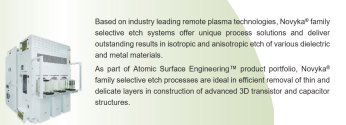
Intellectual property protection remains central to Yitang's competitive strategy. As of end-2025, the company had filed 739 patents, 99.73% of which were invention patents, comprehensively covering core technologies in resist removal, heat treatment, etching, and surface treatment. This robust IP portfolio acts as a strategic "immune system," safeguarding Yitang's global competitiveness and reinforcing its technology moat in an industry where innovation cycles are rapid and barriers to entry are high.
Yitang's "rooted in China, operating internationally" strategy has created a distinctive global footprint. Headquartered in Beijing's Yizhuang district, the company maintains R&D and manufacturing bases in the United States and Germany, enabling integrated global development, production, and market access. This structure allows Yitang to serve all top ten global chip manufacturers alongside leading domestic players. Given the long verification cycles and high switching costs inherent in semiconductor equipment, Yitang's early market entry has translated into strong customer loyalty and a durable competitive advantage.
From a business perspective, Yitang's three core product lines demonstrate a balanced growth trajectory. Its traditional strength—dry resist stripping equipment—maintained a 33.7% global market share in 2025, ranking second worldwide and providing stable revenue. Meanwhile, rapid heat treatment equipment generated RMB 1.481 billion in sales (up 32.85% year-on-year), and dry etching and plasma surface treatment equipment reached RMB 754 million (up 30.73%). Notably, in the dry etching segment—historically dominated by three international giants—Yitang stands among the top ten globally and is one of the few domestic suppliers with advanced mass-production capabilities, positioning it for substantial market share expansion.
China Launches First Domestic TGV 3D Metrology Terminal for Advanced Packaging
Shanghai Ruiguang Zhizhe Technology Co., Ltd. has officially released the "Ruiguang Kongming No. 1" (SemiEye-HB01), China's first intelligent terminal for non-destructive three-dimensional quantitative inspection of advanced packaging TGV (Through Glass Via) processes. This breakthrough addresses a critical gap in the domestic market as the semiconductor industry enters the post-Moore's Law era, where advanced packaging has become essential for enhancing AI computing power. With major players like TSMC, Intel, and Samsung accelerating glass substrate deployment, TGV technology's advantages in low loss, high interconnect density, and cost-effectiveness make it fundamental for 2.5D/3D packaging and co-packaged optics.
Shanghai Ruiguang Zhizhe Technology Co., Ltd. has officially released the "Ruiguang Kongming No. 1" (SemiEye-HB01), China's first intelligent terminal for non-destructive three-dimensional quantitative inspection of advanced packaging TGV (Through Glass Via) processes. This breakthrough addresses a critical gap in the domestic market as the semiconductor industry enters the post-Moore's Law era, where advanced packaging has become essential for enhancing AI computing power. With major players like TSMC, Intel, and Samsung accelerating glass substrate deployment, TGV technology's advantages in low loss, high interconnect density, and cost-effectiveness make it fundamental for 2.5D/3D packaging and co-packaged optics.
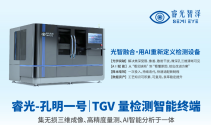
The Ruiguang Kongming No. 1 represents a paradigm shift rather than a simple equipment upgrade, employing an innovative "AI + optics" fusion approach. On the optical side, it utilizes exclusive 3D tomography and topology reconstruction technology with dual-optical-path fusion illumination to achieve subwavelength-level defect visualization, revealing detailed inner walls of deep holes while suppressing substrate scattering. The AI component features multi-GPU parallel high-speed computing to overcome traditional 3D reconstruction delays and incorporates the Zhize multimodal process large model, creating a "detection-analysis-improvement" closed loop that transforms senior process expertise into institutionalized company assets.
The terminal demonstrates comprehensive capabilities, supporting inspection of panels up to 600mm x 600mm and 12-inch glass wafers. It can measure critical parameters including aperture, depth, aspect ratio, taper, roundness, concentricity, and surface roughness, while detecting various defects such as blockages, foreign objects, micro-cracks, misalignment, bubbles, and scratches. With complete independent intellectual property rights, this domestically developed product accelerates both glass substrate industrialization and the localization of China's advanced packaging industry.
I think he said AMAT/LAM/AM derived 30% of their global revenues from China. Not that hey have 30% market share in China .i think their market share in China should be far higher than 30%.u are seeing the 30 percent revenue share of KLA/LAM/Applied Material but you don't see the remaining large revenue share which currently being held by Chinese firms
Agree, that the main point some here don’t understand. They seem to think you can just wake up one morning and kick out all foreign firms and dominate your market. That’s unfeasible and impractical . Especially in semiconductor industry which needs years of test and validation to be viable for mass production and mass orders . So people should be patient. China is actually doing quite well in slowly replacing foreign semi products especially those under sanctions, apart from lithography and EUV which will obviously take even longer (US is already mulling to ban even DUV sales to China). So China will move up the value Chain. I think by 2030 China will be mostly self sufficient in almost every field here, except EUV which will still be in testing or small scale production . So I think China should be fine .China right now have at least 6-7 big companies in all critical Semi tools categories like Metrology/implanter.
----------------------------------------------------------------------------------------------------------------------------------
i can understand the sentiments regarding foreign Semi tools firms still has 30 percent market share in mainland. which should be ZERO right now but things don't work like this. 100 percent market share technically not possible considering China being the largest market in the world.
see the car example. Chinese cars swept across the globe. the quality, features and manufacturing absolute at par with German/Japanese and even surpassed them in many categories. Porsche used to be Golden boy in mainland but in Q1,2026 they reported worst sales crashed since 2009 in China. despite all these Chinese cars never crossed 70 percent market share in mainland. they still at 65 percent to 68 percent.
all this happened in last few years. from Zero to half the market share in almost every high tech category.
------------------------------------------------------------------------------------------------------------------------------------
here is one great example in semiconductor, Silicon Wafers.
we went from zero to 70 percent in this category. this sector used to be the Japanese playground. even Japanese media reported this.
you are seeing the 30 percent revenue share of KLA/LAM/Applied Material but you don't see the remaining large revenue share which currently being held by Chinese firms. Chinese firms significantly reduce their market share but you can't reduce their share suddenly zero. this takes little more time.
Chinese SME firms have historic sales in 2025 and Q1,2026.. if you read my old massages on this thread. i always said one thing, there will be a massacre of foreign SME firms in 2027-28. all these firms will reduce to zero in mainland in coming years.
China's demand of Semi tools are so massive and domestic firms cannot fulfil right now so current problem is related with production and semi tool takes longer time to test and evaluate.
AMEC has two new production plant under construction. Shanghai and Chengdu
ACM current line is expanding in Shanghai
Piotech has two new plant under construction. Shenyang and Shanghai
NAURA aggressively expanding Beijing plant and building new one in Wuhan
Sicarrier building largest production plant in Shanghai, which will only manufacture high end tools.
there are plenty more. i can't name all of them. every single Chinese SME firm expanding production. once all these lines become operational you will see foreign firms will lose market share further.
The mistake the US made is that instead of imposing total blanket bans on semi conductor tools to China so they could bring Chinas industry to a halt, they started by making small piecemeal sanctions which have a lot of time to China to adapt and slowly keep using the vast majority of needed western tools which are not under sanctions while accelerating her own homegrown replacement of those tools under sanctions and those susceptible to future sanctions . So China made use of a lot of time, even if they sanctioned DUV tomorrow China has already purchased enough DUV from ASML/Nikon to get her going for a few years until homegrown ones catch up to mass production .
we might even see lithography I mass production when EUV is in small trial production . Which will be surprising since DUV should be easier to achieve than EUV.
Nankai University team creates ultra-high resolution extreme ultraviolet lithography material by deciphering the microscopic pathways of radiation reactions.
A joint research team from Nankai University and Nanjing University has successfully developed an ultra-high-resolution extreme ultraviolet (EUV) lithography photoresist material, marking a significant advancement for next-generation sub-nanometer semiconductor manufacturing. Led by Professor Zhang Lei at Nankai University and Professor Lu Zhenda at Nanjing University, the researchers tackled a critical bottleneck in advanced chip fabrication: the inability of conventional EUV photoresists to maintain precise patterning at sub-10 nanometer scales due to unstable radiation-driven chemical reactions.
Traditional tin-oxygen cluster photoresists, despite their high EUV absorption and nanoscale uniformity, suffer from excessive atomic aggregation and random migration when exposed to high-energy irradiation. This instability generates micropores and particle defects, causing rough pattern edges that severely limit lithography accuracy. To resolve this, the team introduced an innovative "ion-oxygen-friendly engineering" strategy, incorporating europium ions into the tin-oxygen framework to create stable bimetallic heteronuclear oxygen cluster molecules. By employing time-resolved transmission electron microscopy (TEM), the researchers directly captured the material's dynamic structural changes under irradiation, confirming that the engineered clusters effectively resist excessive aggregation and crystallization.
Traditional tin-oxygen cluster photoresists, despite their high EUV absorption and nanoscale uniformity, suffer from excessive atomic aggregation and random migration when exposed to high-energy irradiation. This instability generates micropores and particle defects, causing rough pattern edges that severely limit lithography accuracy. To resolve this, the team introduced an innovative "ion-oxygen-friendly engineering" strategy, incorporating europium ions into the tin-oxygen framework to create stable bimetallic heteronuclear oxygen cluster molecules. By employing time-resolved transmission electron microscopy (TEM), the researchers directly captured the material's dynamic structural changes under irradiation, confirming that the engineered clusters effectively resist excessive aggregation and crystallization.
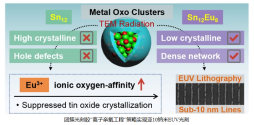
Theoretical modeling and density functional theory (DFT) calculations further elucidated the stabilization mechanism: europium ions act as rigid structural "anchors" that significantly raise the formation energy of tin vacancies and reinforce surrounding Sn-O chemical bonds. This enhanced microstructural integrity suppresses long-range atomic migration and defect formation even after radiation energy absorption, preserving a uniform and densely cross-linked amorphous network. In practical EUV lithography trials at the Shanghai Synchrotron Radiation Facility, the optimized photoresist successfully printed ultra-fine circuit lines with a critical dimension (CD) of just 9.78 nanometers, achieving the highly sought-after sub-10 nm resolution threshold.
Published in the leading nanomaterials journal ACS Nano, this research establishes a practical and scalable technical route for developing cluster-based EUV photoresists tailored for sub-nanometer process nodes. By combining direct observational microscopy with predictive computational modeling, the study not only deepens the fundamental understanding of radiation reaction pathways but also provides a crucial domestic material solution for high-end chip manufacturing. The work was co-authored by early-career researchers from both institutions and funded by multiple national and municipal science initiatives, underscoring its strategic importance for China's semiconductor supply chain independence.