He/she is spreading semi-false information, the reality is 1.56PFLOPS PF4, ~40% H100, while the power is 600 watt, which is quite disappointing considering the power of H100 SXM is around 700 watt; besides, the bandwith is dissppointing as well with 1.4TB/S, ~47% H100 SXM. So we may infer from it that this chip is made with HBM2e or equivalent VRAM chip and its power efficiency is roughly the same as Ascend 910B, which is quite strange because it even cannot match the level of Ascend 910C. I wonder if it is because they are shifting away from NPU so that the version 1 has low power efficiency.

You are using an out of date browser. It may not display this or other websites correctly.
You should upgrade or use an alternative browser.
You should upgrade or use an alternative browser.
Chinese semiconductor thread II
- Thread starter vincent
- Start date

Though I think Nvidia's specs are given in sparse, which means you need to half it to get actual dense FP4 performance. Not really sure if Huawei also gives their performance in sparse.He/she is spreading semi-false information, the reality is 1.56PFLOPS PF4, ~40% H100
Currently, the Huawei 950 is manufactured at the 6nm level and exhibits three times the performance of the H20, but the content suggests that if it is mass-produced using a 3nm process and HBM3, it could immediately reach the level of the H200.Do you have a source for this? I can't find this online and I'm skeptical that Ascend 950 is on a 3nm process considering that it seems SMIC only got to 6nm fairly recently and I'm kinda skeptical Huawei would be able to trick TSMC into fabbing a lot of chips for them again.
Ascend 950 is not meant to compete with Nvidia cards on a card level performance. Instead they are focusing on cluster level performance (ie, bigger clusters than Nvidia). On a single card level it actually has less compute than Huawei's previous product Ascend 910C.
Numbers for Ascend 950 and several subsequent products are in Huawei's public roadmap for next several years. Ascend 950 is most likely 7nm chip with HBM2E for the inference version and HBM3 for the training version. From the roadmap it's very clear they are not trying to match Nvidia cards one-on-one any time soon. Their focus is bigger clusters and better networking.
Numbers for Ascend 950 and several subsequent products are in Huawei's public roadmap for next several years. Ascend 950 is most likely 7nm chip with HBM2E for the inference version and HBM3 for the training version. From the roadmap it's very clear they are not trying to match Nvidia cards one-on-one any time soon. Their focus is bigger clusters and better networking.
Siliconware Precision has achieved mass production delivery of its 12-inch SiC laser lift-off equipment.
Siliconware Precision (Wuhan) Co., Ltd. announced that its third batch of laser lift-off mass production equipment compatible with 12-inch silicon carbide substrates has been successfully delivered to customers. This progress means that the company's laser lift-off technology in the field of ultra-large silicon carbide substrate processing has passed industrialization verification and is expected to bring new development momentum to the silicon carbide industry chain.
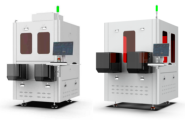
In terms of key processes, SiliconLink, relying on its core R&D team from the laser discipline at Huazhong University of Science and Technology, has independently developed laser lift-off technology for silicon carbide single crystals. For silicon carbide, a material with a Mohs hardness approaching that of diamond, this technology overcomes the efficiency and wear bottlenecks of traditional wire cutting in large-size processing. Taking an 8-inch wafer as an example, the processing time per wafer can be controlled within 15 minutes, with efficiency improved by 20–30 times compared to traditional processes; material loss is reduced by approximately 60%, and no consumables or chemical reagents are required; wafer yield is increased by approximately 30%, and the cost per wafer is reduced by approximately 50%.
In less than six months, the company has shipped dozens of equipment sets, covering several leading domestic silicon carbide enterprises. Leveraging modular design and supply chain collaboration, its equipment has achieved mass production, with a current delivery cycle of approximately 28 days, which is expected to be shortened to 14 days in the future. Simultaneously, the company is expanding into the silicon photonics chip equipment field; its independently developed laser slicing equipment has already been exported, possessing high precision and cost-effectiveness, and is expected to become a new business growth driver.
8-inch gallium oxide homoepitaxial wafers with gallium cores boast superior performance and internationally leading core indicators!
Hangzhou Gallium Core Semiconductor Co., Ltd. received authoritative certification from the Shenzhen Pinghu Laboratory for its new generation of 8-inch gallium oxide (GaO) homoepitaxial wafers. The testing revealed that these wafers possess superior crystal quality and performance indicators, with several metrics reaching international leading levels. This breakthrough lays a solid foundation for the industrialization of high-performance GaO devices.
The certification was validated through rigorous AFM (atomic force microscopy) and XRD (X-ray diffraction) testing on five specific points across the wafer:
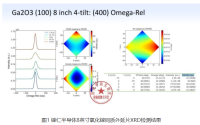
- Crystal Perfection (XRD): The FWHM values were exceptionally low, ranging from 21.18 to 46 arcsec. Notably, the left and right points recorded world-leading figures of 21.18 and 22.18 arcsec, respectively.
- Surface Flatness (AFM): The wafers demonstrated ultra-smooth surfaces with roughness values as low as 0.144nm (Rq) and 0.115nm (Ra), meeting the standards required for high-end device fabrication.
Gallium Core Semiconductor emphasizes that homoepitaxy is the optimal path forward for GaO, overcoming the inherent limitations of heteroepitaxy:
- Perfect Lattice Matching: Eliminates lattice mismatch and stress concentrations found in heteroepitaxy, unlocking GaO's full potential for ultra-high voltage and low-loss applications.
- Overcoming Bottlenecks: Ensures better voltage withstand capabilities and reliability compared to heterogeneous methods.
- Cost Efficiency: Removes the need for complex buffer layers, simplifying manufacturing processes and reducing costs.
This certification confirms GaO homoepitaxy as the only viable route for industrializing wide-bandgap semiconductors. The company plans to further optimize process uniformity and align with China's "15th Five-Year Plan" to enhance technological self-reliance in the semiconductor sector.
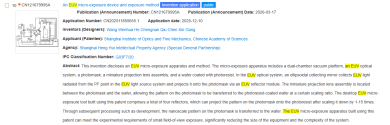
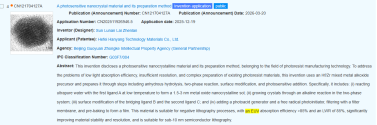

the interesting part is, SIOMP is deeply involved in Non-scanner EUV things like EUV photomask , dark/bright EUV microscope to this exposure device. these things are as important as scanner.
about this patent.
EUV Micro-Exposure Tool is a specialized laboratory-scale lithography system These devices allow researchers to test new photoresists, masks, and processing techniques at the 13.5 nm wavelength before moving them to full-scale production.
New progress has been made on China's first G4.5 LCD glass substrate production line!
Chengdu Zhongguang Optoelectronic Technology Co., Ltd. has successfully ignited the upgraded "cold repair" phase of its first 4.5-generation LCD glass substrate production line, marking a major milestone for China's display industry. This specialized facility, designed to manufacture ultra-thin substrates with a thickness of just 0.5mm, features three lines capable of producing up to 3 million pieces annually. Following the necessary shutdown and technological overhaul required after long-term operation, the plant is now entering its kiln heating phase to resume high-load production under an "intelligent and green" operational model, ensuring a significant boost in efficiency and output quality.
As a domestic pioneer in ultra-thin glass manufacturing, Chengdu Zhongguang has consistently broken records in the sector since 2010, evolving from producing 0.5mm substrates to achieving international advanced standards with their 0.1mm TFT-LCD glass substrate developed in 2023. This specific upgrade represents a crucial step in maintaining its technological leadership against global competition. The company stated that this initiative aims not only to enhance its core competitiveness through innovation but also to strengthen collaborations within the industry, fostering a more complete and resilient ecosystem for new display technologies in the region.
Located within Chengdu High-tech West Zone, the resumption of production reinforces a robust regional industrial chain featuring key partners like BOE and Tianma. By positioning itself as a reliable upstream supplier for local panel manufacturers, the company helps shorten logistics cycles, reduce costs, and accelerate response times across the entire supply network. This development contributes to the broader "World Flex Valley" initiative in Chengdu, which seeks to consolidate over 40 enterprises into a fully integrated ecosystem from raw materials to final terminals driving the localization of China's new display industry toward high-quality growth and global leadership.