If you’re building to harass you’re also probably not building to win. Besides the inherent justification for this idea is that it’s supposed to be some kind of quick fix that avoids the problem of needing to commit to years and years of sustained force buildup necessary to stay symmetrically competitive.I agree that it's not really an operationally feasible strategy today. But keep in mind that our own A2/AD strategy wasn't built in a day either. I see this as the best available strategy they can aspire to given current circumstances, not something that they can realistically execute today. It's very much a "work in progress".

You are using an out of date browser. It may not display this or other websites correctly.
You should upgrade or use an alternative browser.
You should upgrade or use an alternative browser.
PLA Strategy in a Taiwan Contingency
- Thread starter pugachev_diver
- Start date

Going back to the earlier comments regarding the US proposed strategy of "island hopping missile launchers". There were some previous comments about the lack of mass, lack of damage, or other logistical/operational limitations. From a purely operational perspective, I agree with most of these comments about limitations.
However, it's useful to consider the strategic context in which these plans are made & articulated from the US perspective. Here's what I think the high-level strategic picture looks like from the US POV:
1. It's crystal clear by this point that TW can't be "saved" if the Mainland pursues armed reunification; sending in the "great white fleet" in an attempt to "save" TW would be suicidal at this point, & Would be the definitive end of US global hegemony.
2. Since TW can't be saved, the next best available option (from a purely realist perspective) is to maximize the ML's cost of taking TW.
In this context, the "island hopping" missile strike attempts can potentially serve a few purposes:
1. Impose costs by striking critical PRC infrastructure (especially civilian infrastructure along the PRC's east coast);
2. Disrupt PRC maritime trade by making the 1st & 2nd island chains unsafe for civilian maritime shipping;
3. Try to do enough damage to the PRC's industrial capacity to have something of a fighting chance, if the US chooses to engage in a protracted war of attrition vs the PRC over TW.
4. Even if the US chooses not to engage in a protracted war, they can still engage in political damage control by saying "we did our best & we did a lot of damage".
A rough analogy of this strategy is what the Houthis are doing in the Red Sea. The Houthis obviously don't have the ability to stop Israel from committing genocide vs the Palestinians, but they can impose costs on Israel & the West by disrupting maritime trade to a sufficient degree. The US obviously are not as weak as the Houthis, but the fundamental approach is roughly analogous.
One more thing to note is that when US forces are "island hopping", they're not necessarily just going to limit themselves to tiny uninhabited rocks with zero maneuver room & no place to hide, the entirety of Japanese & Filipino territory can be used in such a fashion, where there are plenty of space & plenty of civilian human shields that they give zero fucks about. In fact, Japan & the Philippines are currently the only places from which such a strategy is even feasible, given the relatively limited range of their existing missile arsenal.
Bottom line - we shouldn't overestimate this strategy as something that can stop or even slow armed reunification, but we also shouldn't underestimate it, since it can be part of a broader strategy that we need to counter in a protracted war.
It’s not intended to be survivable. It is a forlorn hope force designed to do as much damage to Chinese coastal civilian centers before they are taken out. Considering the fact that much of the rule based disorder runs their country via literal interpretation of Bronze Age scripture it is not the least bit surprising.

If you’re building to harass you’re also probably not building to win. Besides the inherent justification for this idea is that it’s supposed to be some kind of quick fix that avoids the problem of needing to commit to years and years of sustained force buildup necessary to stay symmetrically competitive.
Let's be real here. Given the current balance of military & economic power, as well as the trajectory of such power balance within the next decade or two, what strategy do they have available to actually "win" instead of "harass"?
That’s not how the military chain of command works. At all.
Question and refuse a direct order coming down the correct chain of command and you can continue the debate with a firing squad while your immediate successor carry out the order.
I don't think the RoK's involvement on the side of the US is as "automatic" as you're suggesting here. But before we go further, I want to point out that I agree that the US ultimately has enough leverage & power to pressgang the RoK forces into compliance.
That said, in the context of a TW reunification scenario, if the RoK side wants to avoid overt involvement, it has the option to drag its feet long enough so that any direct involvement on their part becomes irrelevant, & with enough back channel diplomatic maneuvering, the RoK can perhaps convince the PRC not to bomb the RoK, or at least hold off on taking action vs the RoK for a short period of time, in exchange for the RoK being able to prevent its military from direct involvement during that period.
US command over RoK forces is not automatic, there's a specific process in place such that both presidents must agree to activate such a transition. Until the RoK national command agrees to transition into wartime command, RoK troops wouldn't be under the US chain of command at all. Granted, all this is largely a formality that gives the RoK the veneer of sovereignty. However, if the RoK is governed by a president that takes a relatively more neutral & balanced stance between the US & PRC (like they have now), that president can use these formalities as an excuse to drag his feet for hours if not days. In a more extreme scenario where an RoK president is more firmly independent, it might even take an assassination or coup to remove him/her from power before triggering wartime command. In an armed reunification scenario, where the pace of war is counted in minutes, hours or days could make a substantial difference.
Maybe I'm going too deep, but is there any chance that these island teams are a symbolic gesture? If the US is intending on leaving Taiwan on its own with mostly moral support, this strategy makes sense. By putting a handful of marines on islands they keep the big ticket navy out of harms way. When the shooting starts, they get off their shots and sink a couple of destroyers. They are then counterbatteried and destroyed. They get to claim they tried their best to defend Taiwan, whilst losing relatively little material/men. China gets to claim a win by 'beating the Americans'. No high stakes escalation, but a manageable conflict.

plawolf
Lieutenant General
I don't think the RoK's involvement on the side of the US is as "automatic" as you're suggesting here. But before we go further, I want to point out that I agree that the US ultimately has enough leverage & power to pressgang the RoK forces into compliance.
That said, in the context of a TW reunification scenario, if the RoK side wants to avoid overt involvement, it has the option to drag its feet long enough so that any direct involvement on their part becomes irrelevant, & with enough back channel diplomatic maneuvering, the RoK can perhaps convince the PRC not to bomb the RoK, or at least hold off on taking action vs the RoK for a short period of time, in exchange for the RoK being able to prevent its military from direct involvement during that period.
US command over RoK forces is not automatic, there's a specific process in place such that both presidents must agree to activate such a transition. Until the RoK national command agrees to transition into wartime command, RoK troops wouldn't be under the US chain of command at all. Granted, all this is largely a formality that gives the RoK the veneer of sovereignty. However, if the RoK is governed by a president that takes a relatively more neutral & balanced stance between the US & PRC (like they have now), that president can use these formalities as an excuse to drag his feet for hours if not days. In a more extreme scenario where an RoK president is more firmly independent, it might even take an assassination or coup to remove him/her from power before triggering wartime command. In an armed reunification scenario, where the pace of war is counted in minutes, hours or days could make a substantial difference.
Fair points, but there are a couple of important factors you are not considering.
Firstly, any war over Taiwan with American involvement will not be over quickly. Indeed, the most tricky part of a war between China and America over Taiwan is how to off-ramp and end it before going nuclear. Any foot dragging or procedural shenanigans by SK will not make any material difference.
The second far more fundamental issue is that you are not at all considering what China might want and just automatically assuming that China wants to keep SK out of the war.
While it is indeed true that normally you’d prefer to have to fight fewer enemies at the same time, the geographical and technological realities of today means that SK is directly involved as soon as America is due to the presence of so many American boots and hardware on their soil owning to its geographical location.
If China and America are in a direct shooting war with each other, Beijing is not going to tolerate all those American troops, assets and bases to remain intact in SK just because they pinky swear to not be part of the war effort. Even if they do not directly participate in the shooting part, China will not allow them to exist as invincible intelligence gathering and forward targeting outposts right in the middle of the battlespace. Especially as the war spreads to the Japanese home islands.
The only way SK can avoid being attacked by China and NK is if it is willing and able to expel all US forces from their lands incredibly fast, and open up its entire defence intelligence apparatus to full Chinese inspection and ongoing unrestricted full access monitoring to provide Beijing with sufficient assurance that they are not secretly acting as forward observers for the Americans. But if SK is willing and able to do that, they are liable to get attacked by America for betrayal and all the American blood they will need to spill to facilitate that effective side switch as America and Japan will not be able to tolerate SK flipping to China and acting as the perfect springboard for the invasion of the Japanese home islands.
Simply put, SK is fucked by geography that it will get dragged into the war by one side or the other no matter what it does. Because it is the perfect springboard to allow the PLA to invade the Japanese home islands, and if China needs to drag SK into the war anyway to take out all the American bases on their soil, they might as well go the full length to extract maximum benefits from what will be a sunk cost anyways.
I want some of what you're smoking...China is not going to strike SK unless absolutely necessary, and I mean SK missiles raining down on the mainland. Not only is SK no pushover, but its a completely different diplomatic situation wrt the rest of the world than regarding Taiwan. Opening up a 3rd front just in case of an ISR node is suicidal, and any 'victory' would be pyrrhic at best.Fair points, but there are a couple of important factors you are not considering.
Firstly, any war over Taiwan with American involvement will not be over quickly. Indeed, the most tricky part of a war between China and America over Taiwan is how to off-ramp and end it before going nuclear. Any foot dragging or procedural shenanigans by SK will not make any material difference.
The second far more fundamental issue is that you are not at all considering what China might want and just automatically assuming that China wants to keep SK out of the war.
While it is indeed true that normally you’d prefer to have to fight fewer enemies at the same time, the geographical and technological realities of today means that SK is directly involved as soon as America is due to the presence of so many American boots and hardware on their soil owning to its geographical location.
If China and America are in a direct shooting war with each other, Beijing is not going to tolerate all those American troops, assets and bases to remain intact in SK just because they pinky swear to not be part of the war effort. Even if they do not directly participate in the shooting part, China will not allow them to exist as invincible intelligence gathering and forward targeting outposts right in the middle of the battlespace. Especially as the war spreads to the Japanese home islands.
The only way SK can avoid being attacked by China and NK is if it is willing and able to expel all US forces from their lands incredibly fast, and open up its entire defence intelligence apparatus to full Chinese inspection and ongoing unrestricted full access monitoring to provide Beijing with sufficient assurance that they are not secretly acting as forward observers for the Americans. But if SK is willing and able to do that, they are liable to get attacked by America for betrayal and all the American blood they will need to spill to facilitate that effective side switch as America and Japan will not be able to tolerate SK flipping to China and acting as the perfect springboard for the invasion of the Japanese home islands.
Simply put, SK is fucked by geography that it will get dragged into the war by one side or the other no matter what it does. Because it is the perfect springboard to allow the PLA to invade the Japanese home islands, and if China needs to drag SK into the war anyway to take out all the American bases on their soil, they might as well go the full length to extract maximum benefits from what will be a sunk cost anyways.
plawolf
Lieutenant General
I want some of what you're smoking...China is not going to strike SK unless absolutely necessary, and I mean SK missiles raining down on the mainland. Not only is SK no pushover, but it’s a completely different diplomatic situation wrt the rest of the world than regarding Taiwan. Opening up a 3rd front just in case of an ISR node is suicidal, and any 'victory' would be pyrrhic at best.
In what K-pop fever dream sequence is SK missiles going to be raining down on the Chinese mainland?
If China and America are in an open direct shooting war with each other, diplomatic nuance games will matter about as much as a fart in a hurricane.
During the early stages of WWII, the British made detailed and serious preparations to invade Norway and Sweden to allow them to better fight the Germans. The only thing that stopped that was the Germans beating them to the punch.
It’s honestly kinda hilarious that people who have no problem with the notion that America might coup and do military take overs of allies in the event of a war with China suddenly think it’s beyond belief China could proactively attack sworn American allies in a war without being shot by those U.S. allies first.
China isn’t going to Pearl Harbour SK out of the blue, but it will set functionally impossible conditions for SK to avoid being dragged into any war between China and America by insisting on total and verifiable removal of all US forces from SK territory and active Chinese military presence 24/7 in all key SK military basis and facilities to ensure SK are not providing any form of indirect military assistance to the U.S. or U.S. allies. Do you think those are conditions SK can remotely accept and deliver on? If not, a deadline will pass and they will be in the shit. It’s as simple as that.
In no realistic scenario will SK be able to stay out of a direct fight between China and America.

Not Sweden, Sweden was German idea. And it wasn't tried exactly because Sweden wasn't exactly weak enough to just roll it over instead of other war needs.During the early stages of WWII, the British made detailed and serious preparations to invade Norway and Sweden to allow them to better fight the Germans. The only thing that stopped that was the Germans beating them to the punch.
ROK is absolutely fucked geographically, but it's a highly militarized porcupine...just as militarized as the North frankly. If there's option to let them be, better let them be.
They're about as close to Tokyo, Beijing and Shanghai. There's tacit understanding that their superheavy ballistic missiles have lighter warhead options, to fly way beyond MTCR restrictions.In what K-pop fever dream sequence is SK missiles going to be raining down on the Chinese mainland?
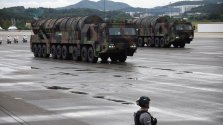
It's indeed regrettably rather likely that ROK won't be able to seat out this conflict, but this is not same Korea which was rolled over by later Jin just to secure their flank.
Also, not sure if North will be enthusiastic, unless SK strikes China first. Mutual treaty is defensive, after all.
Last edited:
Fair points, but there are a couple of important factors you are not considering.
Firstly, any war over Taiwan with American involvement will not be over quickly. Indeed, the most tricky part of a war between China and America over Taiwan is how to off-ramp and end it before going nuclear. Any foot dragging or procedural shenanigans by SK will not make any material difference.
The second far more fundamental issue is that you are not at all considering what China might want and just automatically assuming that China wants to keep SK out of the war.
While it is indeed true that normally you’d prefer to have to fight fewer enemies at the same time, the geographical and technological realities of today means that SK is directly involved as soon as America is due to the presence of so many American boots and hardware on their soil owning to its geographical location.
If China and America are in a direct shooting war with each other, Beijing is not going to tolerate all those American troops, assets and bases to remain intact in SK just because they pinky swear to not be part of the war effort. Even if they do not directly participate in the shooting part, China will not allow them to exist as invincible intelligence gathering and forward targeting outposts right in the middle of the battlespace. Especially as the war spreads to the Japanese home islands.
The only way SK can avoid being attacked by China and NK is if it is willing and able to expel all US forces from their lands incredibly fast, and open up its entire defence intelligence apparatus to full Chinese inspection and ongoing unrestricted full access monitoring to provide Beijing with sufficient assurance that they are not secretly acting as forward observers for the Americans. But if SK is willing and able to do that, they are liable to get attacked by America for betrayal and all the American blood they will need to spill to facilitate that effective side switch as America and Japan will not be able to tolerate SK flipping to China and acting as the perfect springboard for the invasion of the Japanese home islands.
Simply put, SK is fucked by geography that it will get dragged into the war by one side or the other no matter what it does. Because it is the perfect springboard to allow the PLA to invade the Japanese home islands, and if China needs to drag SK into the war anyway to take out all the American bases on their soil, they might as well go the full length to extract maximum benefits from what will be a sunk cost anyways.
Even if the RoK will eventually be gang pressed by the US into becoming cannon fodder (which I agree is a high likelihood occurrence), if we can delay the onset of hostilities vs the RoK by hours/days, it would make a strategic difference in the opening phase of the war.
In this day & age, the primary US advantage in any war vs the PRC is their forward presence & favorable geography. In layman's terms, their forward deployed forces are relatively close to our homeland & industrial centers, whereas ours are nowhere near theirs. Their primary advantage is that they can use these forward deployed forces to try to do as much damage as they can in the opening hours of the war, so as to diminish our industrial capacity to the maximum extent possible. However, we all know that these bases & forward deployed forces won't last long. If none of their infrastructure/forces in the RoK are available for use during the opening hours of the war, by the time they can be used the rest of their forces in APAC might already be devastated beyond repair.
Moreover, in terms of geography, US bases in the RoK are the closest ones to Beijing. Those are the ones that would most likely be used to attempt decapitation strikes & other attacks vs civilian & military infrastructure in the north. Keeping those strikes from happening for a few hours buys us a great deal of extra time to make all kinds of preparations to minimize damage & ready a counterstrike.
There's also the political dimension. We must always prepare for the possibility that the US might not intervene vs armed reunification, however unlikely that might be. The probability of US non-intervention will only grow as the military balance of power becomes ever more lopsided in our favor. If we attack the RoK immediately, we'll force their hand as a treaty ally of the RoK, & escalate a conflict beyond what was originally necessary to achieve our goals.