
You are using an out of date browser. It may not display this or other websites correctly.
You should upgrade or use an alternative browser.
You should upgrade or use an alternative browser.
Miscellaneous News
- Thread starter bd popeye
- Start date

If you want to know how pathetic this country is, this is what passes for plausible deniability in CanadaCreating conditions now are we?
Guy Saint-Jacques, a former Canadian ambassador to Beijing from 2012 to 2016, said China viewed Mr. Kovrig as an espionage agent because of his work at GSRP. But he said Mr. Kovrig, who worked in the embassy from 2012 to 2014 when Mr. Saint-Jacques was envoy, was not a CSIS agent. He acknowledged, though, that any information gathered by Mr. Kovrig would have been valuable to CSIS.
“It was the type of work that would have been of interest to CSIS or people at Privy Council Office who do intelligence analysis because those were very good reports. Well researched, detailed and of course that is why the Chinese were watching him,” he said. “I am sure the Chinese regarded him as a spy.”


That's some interesting body language. Bing bong knows he will be left hanging and is now begging for an off-ramp.
I am still struggling to understand the purpose of Xi's visit to US. As it turns out, US secured concessions from China (resumption of military communications and fentanyl deal) without giving anything in return. To add to the humiliation, Biden called Xi a "dictator" and now U.S. Defense Secretary announced that US will continue to violate China's sovereignty and territorial integrity. I must call it like I see it. APEC summit was an L for China. I hope that Chinese leadership knows what it's doing when it comes to US and that there is an explanation for their timid approach as of late.
Caption "talk bitch!"

Pardon me but this post is deeply hilarious to me. If the country is being hit with nuclear attack, then what happened to the silo is the least of the concern. Most of the missiles are going prioritize the cities first anyway. If the cities are already gone, what happens to the silo contamination cease to matter.Part 2.
HOW FALLOUT AND FATALITIES SHIFT WITH THE WINDS
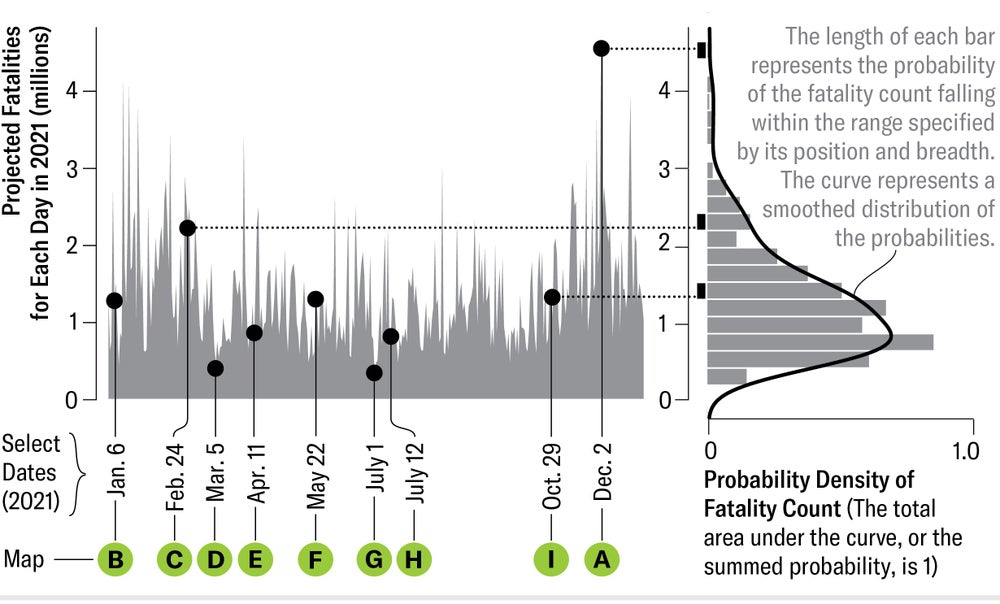
A concerted nuclear attack on the missile silos in the U.S. heartland would generate radioactive dust that travels with prevailing winds. Sébastien Philippe and his colleagues at Princeton University’s Program on Science and Global Security used archived weather data to simulate the paths of the resulting plumes for 48 hours, by when most of the dust settles. Because wind directions change daily, the researchers computed fallout dispersal from an 800-kiloton warhead detonating simultaneously at each of 450 silos on any given day of 2021. The selections below (A–I) demonstrate the variability of wind directions and, consequently, of the doses of outdoor radiation received over four days of exposure to radioactivity. The scientists further combined these simulations with data on population density and building height to calculate the resulting fatalities. Someone absorbing four grays (equivalent to four joules of radiation energy per kilogram of body weight) would have a 50 percent chance of dying, but people sheltering in bigger buildings would receive smaller doses. Depending on wind directions, a nuclear attack on the missile silos could kill several million people.

Credit: Sébastien Philippe, Svitlana Lavrenchuk and Ivan Stepanov
Fatality Count: For a simulated attack on any day of 2021, the scientists computed the resulting fatalities. The chart shows the impact of variable wind directions on the estimated fatalities after four days of exposure. The estimates range from 340,000 (for an attack on July 1) to 4.6 million (on December 2). The average estimated death toll is 1.4 million. The curve shows the probability (technically, probability density) of the number of fatalities specified on the vertical axis.
Credit: Sébastien Philippe, Svitlana Lavrenchuk and Ivan Stepanov
WHICH LOCATIONS ARE THE RISKIEST?
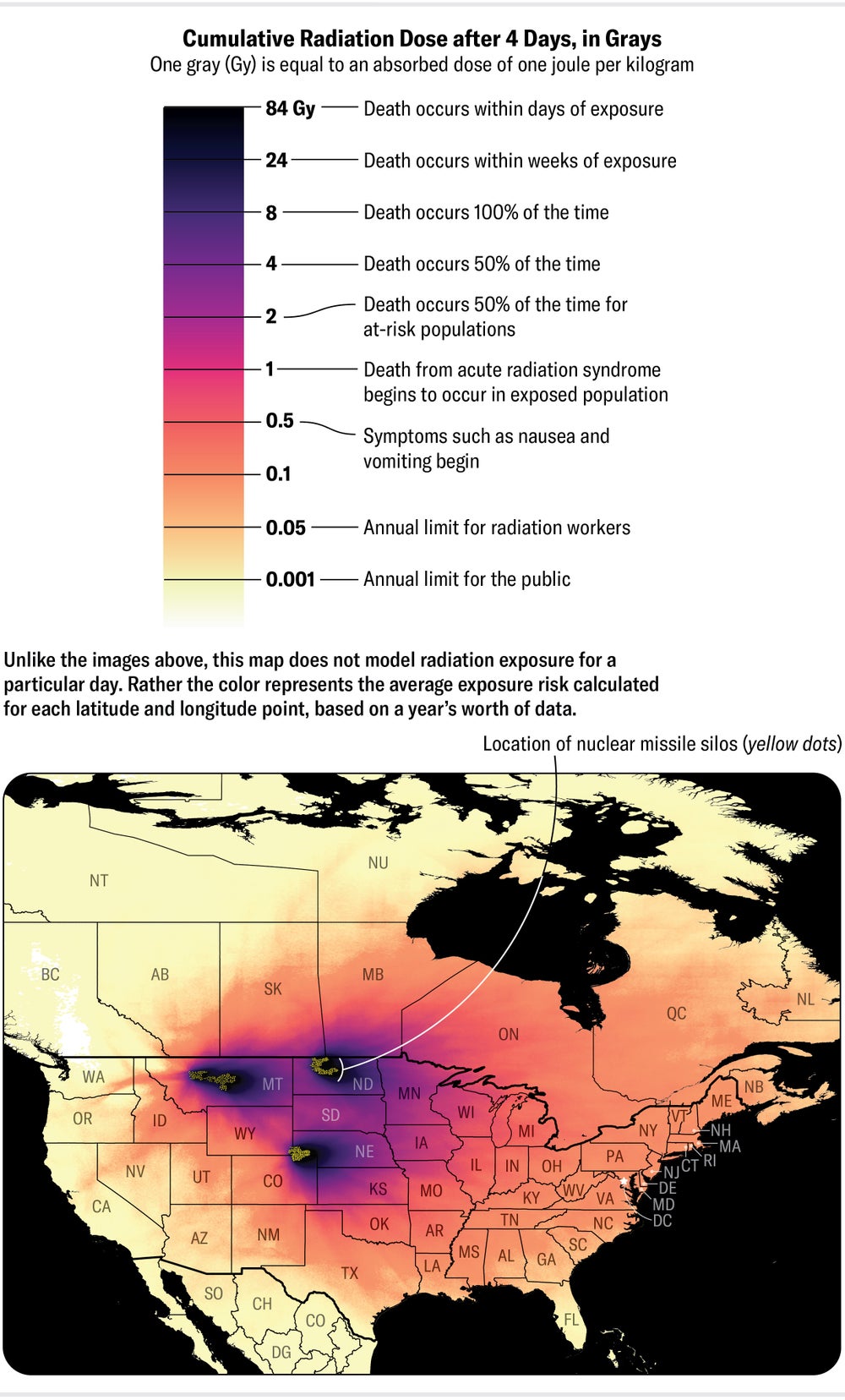
To calculate the average risk of radiation exposure at any given location in North America from a nuclear attack on the silo fields, Philippe and his co-workers summed the simulated outcomes for any day of 2021 (preceding graphic) and divided by 365. They thereby averaged the impact of shifting winds on radioactive fallout across the continent. This map shows the average outdoor radiation dose across North America after four days of exposure. Communities living closest to the silos could receive several times more than 8 Gy, which scientists regard as lethal. Most inhabitants of Montana, North Dakota, South Dakota, Nebraska and Minnesota would get average doses greater than 1 Gy, causing fatalities from acute radiation syndrome, especially among children. The U.S. population would receive average doses greater than 0.001 Gy per year, which is the current annual limit for exposure to the public.
Credit: Sébastien Philippe, Svitlana Lavrenchuk and Ivan Stepanov
THE WORST-CASE SCENARIOS
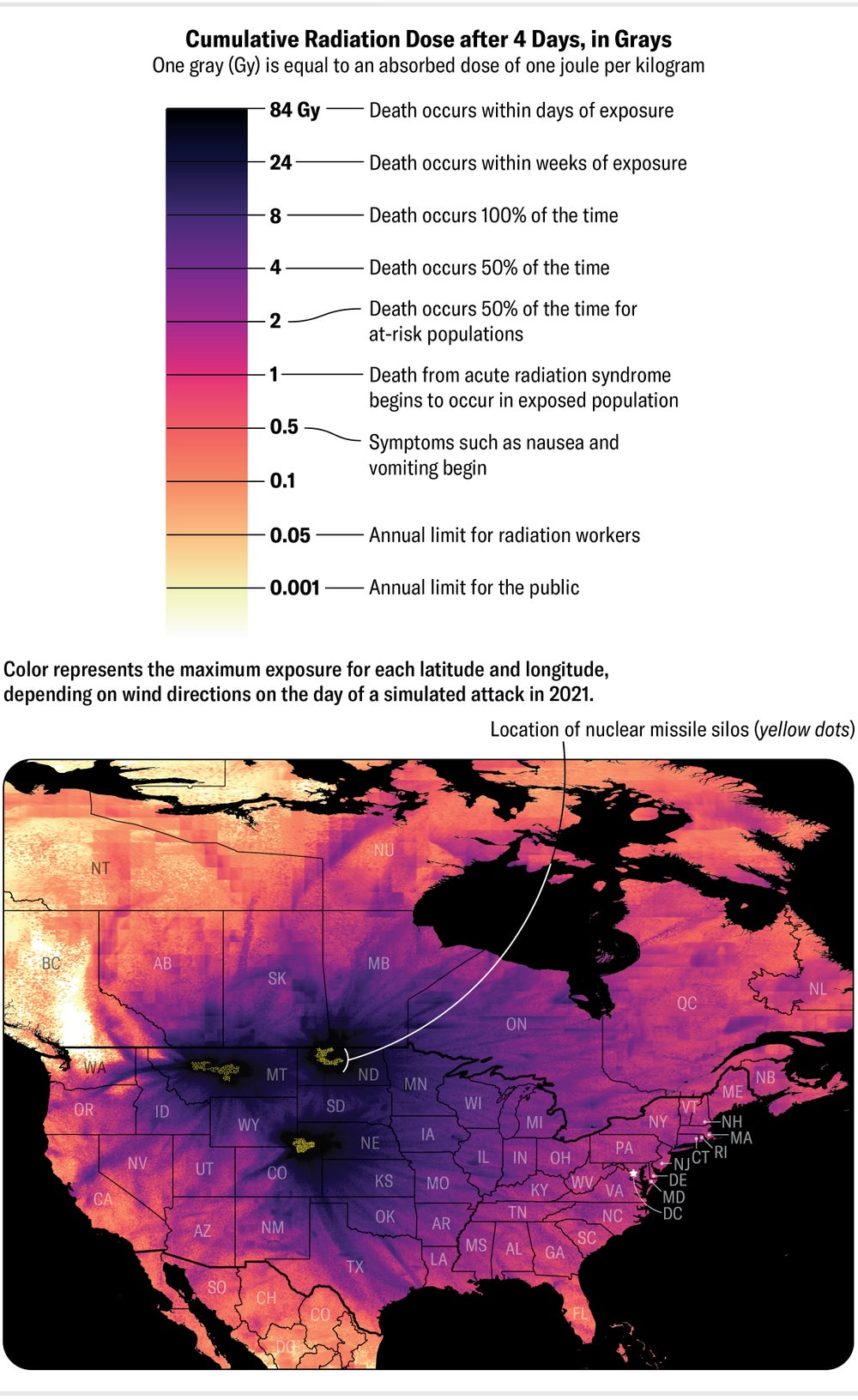
Sifting through simulations for each day of 2021, the Princeton researchers computed the worst possible outcome at each location from a concerted nuclear attack on the missile silos. This map shows all the worst-case scenarios across North America. Not all locations would experience the worst outcome from the same attack; which areas would be impacted depends on wind patterns on the day of the attack. Overall, most people in North America live in areas with about a 1 percent chance of receiving an outdoor dose greater than 1 Gy. The chance of getting a lethal dose escalates closer to the silos, with three million at risk of receiving 8 Gy or more. These simulations make no assumptions about access to health care or emergency services. Nor do they include other sources of exposure such as immediate radiation from nuclear explosions.
Credit: Sébastien Philippe, Svitlana Lavrenchuk and Ivan Stepanov
is a scientist at Princeton University's Program on Science and Global Security. He develops methods for monitoring nuclear weapons and models the impact of nuclear explosions.