Electron-Induced C─F Bond Activation in Sn6-oxo Cluster Resist for Enhanced Sensitivity and Sub-10-nm Patterning.
ABSTRACT
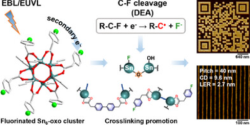
Metal-oxo cluster (MOC) resists are promising candidates for extreme ultraviolet lithography (EUVL), but optimizing the resolution, line-edge roughness (LER), and sensitivity (RLS) trade-off remains challenging. Leveraging dissociative electron attachment (DEA) to activate C─F bonds provides a controllable handle to improve this RLS trade-off, yet remains underexplored. Here, we report a room-temperature, scalable synthesis of a tunable series of Sn-oxo clusters and demonstrate hundred-gram-scale, single-batch production. The fluorinated FPAA demonstrates enhanced sensitivity without compromising resolution or LER. Under electron beam lithography (EBL), FPAA achieves a critical dimension (CD) of 9.1 nm and an LER of 2.2 nm, and enables high-fidelity complex patterning. Additionally, FPAA exhibits robust performance under deep ultraviolet (DUV) lithography and EUVL, achieving a CD of 20.9 nm under EUVL. FPAA also shows exceptional plasma resistance, achieving a high estimated Si:resist etch selectivity of >50:1. Mechanistic analyses indicate that irradiation-generated low-energy secondary electrons (LESEs) promote electron-induced C─F activation, consistent with a DEA-mediated pathway. Concurrently, organic ligand bridging and Sn─O─Sn network densification occur, forming a crosslinked network that drives the solubility switch. This work elucidates the lithographic mechanisms of Sn-oxo clusters and provides design principles for MOC resists, supporting progress toward sub-10-nm lithographic resolution.