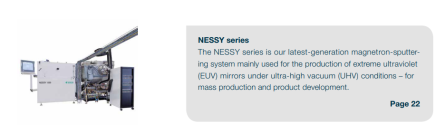
This is magnetron sputter for high precision optic coating, including EUV bragg mirrors.HVAC Ultra-precision optical thin film coating solutions <my guess analog to the Nessy series>
- Extremely high precision in membrane layer control:
- Thickness control : Reaching the sub-nanometer level requires extremely high uniformity and repeatability of film thickness.
- Refractive index control : Precisely control the refractive index and extinction coefficient of the thin film material to ensure that the optical constants are consistent with the design.
- Extremely low loss and scattering:
- Absorption loss : In high-power applications such as lasers, absorption must be reduced to the ppm level.
- Scattering loss : An extremely smooth substrate and film interface is required to minimize scattering loss.
- Excellent environmental stability and reliability:
- It can withstand harsh environments such as extreme temperature, humidity, salt spray, and strong radiation, ensuring that its performance does not degrade over a long period of time.
- Complex spectral characteristics:
- It achieves complex spectral parameters such as ultra-narrowband, ultra-wideband, deep cutoff, and steep transition.
- Large-area uniformity:
- Achieving nanometer-scale film thickness uniformity on large-size substrates.
1. Core coating technology
- Ion beam sputtering
- Principle : The target material is bombarded by an independent ion source, and the sputtered atoms/molecules are deposited onto the substrate at high energy to form a film.
- Advantages:
- The film is dense , exhibiting properties close to those of bulk materials, and has excellent environmental stability.
- Extremely low optical loss : Absorption and scattering losses are extremely low, making it the first choice for high-end laser lenses.
- Precise and controllable : Process parameters are independently controllable and have good repeatability.
- Applications : High-reflectivity mirrors, anti-reflection coatings, filters, especially high-power laser films.
- Ion-assisted deposition
- Principle : In the traditional thermal evaporation process, the growing film layer is bombarded with an ion source.
- Advantages:
- Increase the density of the membrane layer and reduce the loose structure.
- It improves film stress and enhances adhesion.
- With a lower cost compared to IBS, it is a compromise solution for many precision applications.
- Applications : Most precision optical components that require high performance but do not need to be perfect.
- Magnetron sputtering
- Principle : Using a magnetic field to confine plasma, increasing the gas ionization rate, and sputtering the target at high speed.
- Advantages:
- It has a high deposition rate and is suitable for large-area coating.
- The film has good uniformity and better stability than traditional evaporation.
- Applications : Large-area display panels, architectural glass, and optical films for consumer electronics.
2. Precision monitoring and control system
- Optical monitoring:
- Direct light control : Monitors changes in transmittance or reflectance at a specific wavelength in real time during the deposition process, stopping when a preset value is reached. Suitable for applications requiring extremely high precision in the center wavelength, such as ultra-narrowband filters.
- Crystal Control:
- Thickness is indirectly controlled by measuring the quality of the film layer deposited on a quartz wafer. This method is suitable for controlling the thickness of most layers in multilayer films and offers good stability.
- Broadband monitoring:
- Real-time measurement of the spectrum across the entire wavelength range and fitting it to theoretical designs allows for dynamic correction of process parameters. This is a key technology for realizing ultra-complex membrane systems.
3. Ultra-cleanliness and environmental control
- Ultra-high vacuum system : The background vacuum needs to reach 10⁻⁶ Pa or even higher to ensure that the film layer is pure and free of contamination.
- Precise substrate processing:
- This includes ultra-precision polishing, rigorous ultrasonic cleaning, and plasma cleaning to ensure that the substrate surface achieves atomic-level cleanliness.
- Precise temperature control system : controls substrate temperature, affecting film stress and microstructure.
Typical application areas
View attachment 176915
- High-end laser systems:
- Requirements : Extremely high damage threshold and extremely low absorption loss.
- Products : High-reflection mirrors, output coupling mirrors, harmonic separators, etc.
- Gravitational wave detection and astronomical observation:
- Requirements : Achieve extremely low loss and scattering on a single substrate.
- Product : The core lens of the interferometer, whose performance directly determines the detection sensitivity.
- Extreme ultraviolet lithography :
- Requirement : Achieve a multilayer film with a reflectivity of up to 70% at a wavelength of 13.5 nm.
- Technology : Mo/Si multilayer film, with requirements for interface roughness and thickness control at the atomic level.
- Quantum Communication and Computing:
- Requirements : High-precision control of a specific wavelength and extremely low fluorescence background.
- Products : Optical components used in ion traps and single-photon detectors.