Interface quality improvement of extreme ultraviolet multilayer reflective films based on dual-ion beam sputtering deposition process
Abstract
In the fabricatiotivity. To address this challenge, we propose a process portfolio that combines angular deposition with flood ion beam etching to enhance inn of Mo-Si multilayers, achieving smooth and sharp interfaces is critical for realizing high reflectivity in extreme ultraviolet (EUV) light, as atomic intermixing between adjacent Mo and Si layers along with microscopic interfacial fluctuations can significantly degrade EUV reflecterface quality. By utilizing stage modifications in dual ion beam sputtering, the incident angle of the sputtered atom flux during deposition and the parameters of the auxiliary ion beam for polishing can be precisely controlled to suppress intermixing and interfacial fluctuations. Experimental results show that the thickness of the intermixing layer is reduced to 0.6 nm, and interfacial roughness is suppressed to 0.2 nm using this approach. This method fundamentally improves the interfacial quality of Mo-Si multilayers and offers a practical solution for the fabrication of high-reflectance EUV optics.
Equipment Improvement
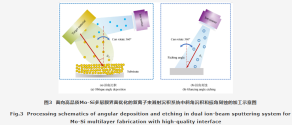
The modified equipment in this paper is the "Tianji" dual-ion beam sputtering deposition system from Boton Optoelectronics Technology Co., Ltd., mainly used for laser film deposition. This system uses a bias sputtering configuration, with the ion beam bombarding the target surface at a 45° angle. The fixture system is a four-planetary motion mechanism capable of swinging at a small angle of ±15° along the vertical axis. To obtain an ultra-smooth, low-diffusion Mo-Si interface for ion beam sputtering deposition, the traditional small-angle swinging planetary fixture in the ion beam sputtering deposition system was modified into a 360° rotating orbital fixture, as shown in Figure 3. The modified fixture's swing axis is more centrally located relative to the auxiliary ion source, ensuring that ion beam irradiation covers the fixture surface at different rotation angles at different etching angles. This fixture motion control system not only enables adjustable deposition angles from 0 to 90° ( see Figure 3 (a)) but also meets the process requirements for 0 to 90° angled ion beam polishing ( see Figure 3 (b)), significantly improving process dimensions and controllability