Chinese semiconductor thread II

sunnymaxi

Colonel
Registered Member
View attachment 174766

Dry series have this plain look like the KrF machine shown in the background. why change it in I-Line, what make this I-Line scanner special that require its own design, why it needs such big housing. If they didn't planned show immersion wouldn't be better to show the ArF dry scanner, even if immersion are usually better paired with KrF scanners but it would just better than showing those two.

Why SMEE can just be a normal SME company. Why Naura has not taken over this company already.
View attachment 174768
View attachment 174771
the problematic part of this entire discussion is SEMICON 2026 whether SMEE talked about immersion scanner or they didn't.

for the sake of conversation, leave a side SEMICON 2026 for a second.

if we actually follow the suppliers and their serial production plans then likely this year Immersion scanner has entered in serial production. there is a strong possibility SMEE might never publish the actual specifications of the machine just like we yet to have WS-10 Engine official specs though its been a decade already.
 

european_guy

Junior Member
Registered Member
Building an independent and controllable integrated circuit industry system: Reflections and suggestions on the development of China's integrated circuit industry during the "15th Five−Year Plan" period

Please, Log in or Register to view URLs content!

View attachment 174749

This paper, published originally on February 13, 2026, (it appears in Volume 44, Issue 3 of Science & Technology Review (《科技导报》), with the article spanning pages 34-49) is more authoritative than any announcement (as long as is not an official announcement by SMEE).

I cannot access the paper, but DeepSeek can make a summary:

# Summary: Building an independent and controllable integrated circuit industry system

## Authors and Publication
This paper was published in the journal *Science & Technology Review* (《科技导报》), authored by nine leading figures in China's semiconductor industry. The author list includes Wang Yangyuan (Honorary Dean of Peking University's School of Integrated Circuits and co-founder of SMIC), Zhao Jinrong (Chairman of NAURA Technology Group), Chen Nanxiang (Chairman of Yangtze Memory Technologies Co., Ltd.), Liu Weiping (Chairman of Empyrean Technology), and other prominent scholars and industry executives.

## Background and Strategic Context

The paper is framed within the context of the 50-year Kondratiev wave economic cycle, identifying the information industry (with integrated circuits at its core) as the engine of the 5th long-wave economic cycle.

The authors argue that accelerating the development of China's information industry should be a top priority for the "15th Five-Year Plan" (2026-2030). They emphasize this is necessary for maintaining GDP growth, improving public welfare, and ensuring national security, especially as modern warfare increasingly depends on electronic systems and chips.

Regarding the external environment, the paper notes that the United States has enacted multiple policies explicitly targeting China as a "strategic competitor," including the CHIPS and Science Act. Europe and Japan have also introduced semiconductor-related legislation. The authors conclude that China must "abandon illusions and prepare for struggle".

## Key Problems Identified

The paper identifies several critical issues plaguing China's IC industry:

### Small, Fragmented, and Weak Structure
- China has over 100 EDA companies, 116 packaging and testing companies, 185 wafer manufacturing equipment companies, 224 packaging equipment companies, and 3,626 design companies.
- Among design companies, 1,769 have annual sales below 10 million RMB, and 87.9% are small businesses with fewer than 100 employees.
- The authors argue that such fragmentation makes it impossible to compete head-on with industry giants like NVIDIA or Qualcomm.

### Lack of Integration Mechanisms
- There is an absence of effective fault-tolerance and trial-and-error mechanisms between upstream and downstream enterprises.
- The "mobilizing the entire nation's resources" approach has not been effectively translated into concrete implementation.

## Core Recommendations

### Create "China's ASML"
- The paper notes that ASML's EUV lithography machine has 100,000 components from 5,000 suppliers, with ASML serving primarily as an integrator.
- While China has achieved breakthrough progress in individual EUV components (laser light sources, moving platforms, and optical systems), the key challenge for the 15th Five-Year Plan period is integrating these into a complete, functional system.
- The authors call for a national-level integration mechanism where "the integrated" must transcend barriers of "fame and fortune" to allow unified coordination of capital and human resources.

### Address the "Three Key Cards"
The paper states that the US primarily restricts China's IC industry development through three leverage points:
1. Electronic Design Automation (EDA)
2. Equipment (especially EUV lithography)
3. Materials (including advanced silicon wafers)

The paper recommends prioritizing the resolution of the EUV, EDA, and silicon wafer issues during the 15th Five-Year Plan period.

## Development Goals for the 15th Five-Year Plan Period

The paper sets specific quantitative targets:

| Area | Target |
|-------|---------|
| Industry Ranking | Rank among top 3 countries globally in the IC industry |
| Self-Sufficiency Rate | 80% of chips demanded by the national economy (excluding re-export products), with gradual reduction of imports for low-to-mid-range products |
| 28 nm | Solidify independent and controllable full industrial chain |
| 14 nm | Achieve stable production capability |
| 7 nm | Initially complete construction and trial operation of a fully domestically produced production line |
| Public Platform | Build an advanced process-capable public R&D platform for new structures, materials, and processes |
| Original Innovation | Seek pioneering breakthroughs in certain areas of basic research |

Source:

## Concluding Statement

The paper concludes with an emphatic statement: "For the next five years, China's chip industry will be five years of 'sleeping on brushwood and tasting gall'; five years of discarding illusions and preparing for struggle; five years of securing a firm foothold in the mid-range and consolidating the domestic circulation market; five years of respecting scientific laws and dedicating efforts to basic research. Since core technologies cannot be bought, begged, or borrowed, then they can only be 'built through hard work.' ... there is no obstacle that can stop the Chinese nation's march toward rejuvenation".

## Significance

This paper represents a rare collective statement from China's top semiconductor industry leaders and academics, calling for a more aggressive, coordinated national strategy to achieve technological self-sufficiency in integrated circuits. According to news reports, it is viewed as a direct response to the US technology blockade and aligns closely with the 15th Five-Year Plan's strategic focus on technological self-reliance.

-----------------------------------------------------------

The summary is worth reading. Regarding timeline I have verified with DS that the targets on 7,14 and 28nm are intended for the end of the period (2030). Not currently achieved.

So by 2030:

- 28nm fully consolidated and mature
- 14nm in production
- 7nm in trial operation


This is the paper.

My speculation for 2026 is:
- 28nm should be in production with several lines by end 2026
- 14 should be in trial by end 2026, with early production 2027
- 7nm still in development

 
Last edited:

tokenanalyst

Lieutenant General
Registered Member
- The authors argue that such fragmentation makes it impossible to compete head-on with industry giants like NVIDIA or Qualcomm.
would won't be, Synopsys(EDA), AMAT (WFE)? Anyways, there a thousand design startups in the world but only few matters. My guess that only companies that matter in China are HiSilicon, Cambricon, Zhaoxin the other big ones. The others will either go to niche markets or disappear.

But even then, 1,000,000 design companies or 1 design company makes no difference because you CAN'T compete with NVIDIA head to head in a fair market they are just too powerful, their tech stack is embedded in the entire AI ecosystem. The same with ASML, there isn't a single lithography company in the world can compete with them in a fair market.

The ONLY reason that Chinese companies are getting sales in China is because export controls has dissuaded domestic companies to localize. SMEE would be selling packaging machines at a discount if wasn't for export controls. No one in his right mind would have ever consider of making a commercial EUV machines but here we are.
 

tokenanalyst

Lieutenant General
Registered Member
From my point, yes, at the early stages in a market there will be a lot companies trying to enter and make their names, happens in every new tech or opportunities like export controls but at the end of the day only a few will matter. The rest either adapt or die.

I think China semiconductor industry will end with a few domestic companies dominating 70 to 80% of the market like ten toolmakers. Some domestic EDA companies and Huawei in the AI processing market. The rest will move to fill the gaps, go to niche markets or die. Of course that will depend on how far export controls go.

1778516945957.png


huemens

Junior Member
Registered Member
the problematic part of this entire discussion is SEMICON 2026 whether SMEE talked about immersion scanner or they didn't.
For the sake of record here's the Interview of the SMEE employee from SEMICON posted by the Korean newspaper at that time.
They didn't mention immersion, but they did say the machine could be used for 10nm, which could be interpreted in different ways.
*Original Korean text and machine translation.

Please, Log in or Register to view URLs content!

Q: (웨이퍼 이동 장치를 움직이는 방식이) 볼스크류 방식인가요?
A:
아닙니다. 직구동 방식*입니다.
*ASML이 사용하는 방식. 볼스크류 방식보다 빠르고 정밀도가 높다.

Q: Is the method of moving the wafer transport device a ball screw type?
A:
No. It is a direct drive system*.
*The method used by ASML. It is faster and more precise than the ball screw method.

Some people speculated immersion, mostly due to this bit. But it could also mean it can be used for non-critical layers of a 10nm process. Or they could have even meant "100s of nm to 10s of nm", in which case it could mean nodes like 65nm, 90nm, etc.
Q: 몇 나노미터(nm, 1nm=10억 분의 1m)까지 사용할 수 있나요?
A:
100~10나노까지 커버합니다.

Q: Down to how many nanometers (nm, 1 nm = 1 billionth of a meter) can it be used?
A:
It covers up to 100~10 nanometers.
Q: 렌즈 종류가 많은 거 같은데, 몇 개나 달렸나요?
A:
30개 있습니다.

Q: It looks like there are many types of lenses. How many are attached?
A:
There are 30.
Q: 장비의 강성*은 높나요?
A:
네. 상당히 좋은 소재를 사용했습니다.
*강성이 높을수록 미세 진동이 줄어드는 고정밀 구조다.

Q: Is the equipment's rigidity* high?
A:
Yes. We used very good materials.
*It is a high-precision structure where micro-vibrations are reduced as rigidity increases.
Q: 12인치 웨이퍼당 샷 수는 어느 정도입니까?
A:
그건 공정과 다이(Die, 칩의 기본 단위) 크기에 따라 달라집니다.

Q: What is the number of shots per 12-inch wafer?
A:
That depends on the process and the die size.
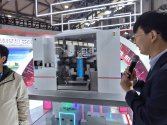
SMEE는 EUV 직전 단계인 DUV(심자외선) 노광 장비를 자체 개발했다고 주장했다. 이날 전시회에서 만난 SMEE 직원은 “이 장비(DUV)는 이미 양산해서 고객사들에 판매하고 있다”라고 했다. 이 직원은 관람객을 향해 자신만만한 표정으로 외쳤다.

SMEE claimed to have independently developed DUV (deep ultraviolet) lithography equipment, which is the stage immediately preceding EUV. A SMEE employee met at the exhibition that day stated, “We have already mass-produced this equipment (DUV) and are selling it to our clients.” The employee shouted this to the visitors with a confident expression.
“이건 우리가 100% 자체 개발한 듀얼 스테이지 스캔(두 개의 웨이퍼 스테이지를 번갈아 스캔하며 노광) 방식의 노광 장비입니다. 불화아르곤(ArF) 엑시머 레이저가 위쪽으로 빛을 쏘고, 광학 시스템으로 정밀하게 맞춘 뒤 웨이퍼에 회로 패턴을 그리는 거죠.”

“This is a dual-stage scan lithography system that we developed entirely in-house. An argon fluoride (ArF) excimer laser shoots light upward, and after precise alignment with an optical system, it draws circuit patterns on the wafer.”

Semicon_2026_SMEE_litho_demo.jpeg
 

tokenanalyst

Lieutenant General
Registered Member
For the sake of record here's the Interview of the SMEE employee from SEMICON posted by the Korean newspaper at that time.
They didn't mention immersion, but they did say the machine could be used for 10nm, which could be interpreted in different ways.
*Original Korean text and machine translation.

Please, Log in or Register to view URLs content!


Some people speculated immersion, mostly due to this bit. But it could also mean it can be used for non-critical layers of a 10nm process. Or they could have even meant "100s of nm to 10s of nm", in which case it could mean nodes like 65nm, 90nm, etc.


View attachment 174780
The only you are making 10nm FinFets is either with immersion with good overlay, EUV or magic.
The no critical layers are made with KrF. Barely anyone is buying dry ArF tools
 

sunnymaxi

Colonel
Registered Member
The only you are making 10nm FinFets is either with immersion with good overlay, EUV or magic.
The no critical layers are made with KrF. Barely anyone is buying dry ArF tools
thanks to @huemens for the summary.

i believe more on Korean media since they have nothing to do with China. so this is the indirect announcement of immersion scanner which also matches with suppliers production plan.. even before the SEMICON 2026 there were strong rumors about 2026 is the year of mass production.. Great
 

sunnymaxi

Colonel
Registered Member
This is the big news.

Another Chinese DRAM Maker Breaks Into DDR5 Memory, Mass Producing 64GB RDIMMs​


In all of this, Chinese DRAM manufacturers are boosting their production capacities rapidly. We have seen how
Please, Log in or Register to view URLs content!
, aiming to double their wafer output by spending billions in building additional production hubs across the country. But there are more DRAM suppliers than just these two.

Back in 2021, Jiahe Jinwei announced that it was going to
Please, Log in or Register to view URLs content!
. Now, its subsidiary, SINKER, which is a brand under POWEV, has announced the launch of its latest DDR5 RDIMM memory solutions..

As per
Please, Log in or Register to view URLs content!
, the company is now offering its DDR5 DIMMs in two variants, one of which is purely focused on the domestic Chinese markets, and one that is supplied globally. The company's DDR5 memory comes in UDIMM, SODIMM, and RDIMM variants with up to 64 GB capacities and speeds of up to 5600 MT/s.

Please, Log in or Register to view URLs content!
 
Top