Im just curious, are fully domestic end to end 7nm and 5nm chips possible as of now?

You are using an out of date browser. It may not display this or other websites correctly.
You should upgrade or use an alternative browser.
You should upgrade or use an alternative browser.
Chinese semiconductor thread II
- Thread starter vincent
- Start date
Longtu Photomask plans to raise no more than 1.46 billion yuan through a private placement to invest in the construction of a 40-28nm semiconductor photomask production line.
Longtu Photomask (Stock Code: 688721) announced on April 28, 2026, its plan to raise no more than 1.46 billion yuan through a private placement to no more than 35 specific investors. The proceeds, after deducting issuance expenses, will be fully allocated to constructing a 40nm-to-28nm semiconductor photomask production line via its wholly-owned subsidiary, Zhuhai Longtu Photomask Technology. The offering will issue no more than 40.05 million shares (capped at 30% of pre-offering share capital), with pricing set at no less than 80% of the 20-day average trading price prior to the benchmark date, and a 6-month lock-up period for subscribers.
The project represents a total investment of 1.954 billion yuan, with a 36-month construction timeline focused on building facilities and acquiring advanced equipment—including electron beam lithography machines, dry etching systems, and high-end testing and repair tools. Upon reaching full capacity, the new line will add an annual output of 15,000 photomasks, expanding the company's portfolio beyond existing binary and phase-shifting masks to include higher-process KrF PSM, ArF PSM, and OMOG products. Financial projections estimate an internal rate of return of 12.05% and a payback period of 8.85 years (including construction).
Strategically, the initiative aligns with surging domestic demand for chips in AI, new energy vehicles, and intelligent driving, which is driving 12-inch wafer fab expansions at companies like SMIC and Hua Hong Semiconductor—creating significant need for 40–28nm photomasks currently reliant on U.S. and Japanese imports. Longtu Photomask cites its existing certifications with major domestic customers, progress on 90nm mass production and 65nm sampling, and shared technological foundations between process nodes as key enablers. However, the company also acknowledges risks: intense global competition from oligopolistic leaders (Toppan, Photronics, DNP), dependence on imported raw materials and equipment, and recent margin pressure from price competition and new plant ramp-up costs.
The project represents a total investment of 1.954 billion yuan, with a 36-month construction timeline focused on building facilities and acquiring advanced equipment—including electron beam lithography machines, dry etching systems, and high-end testing and repair tools. Upon reaching full capacity, the new line will add an annual output of 15,000 photomasks, expanding the company's portfolio beyond existing binary and phase-shifting masks to include higher-process KrF PSM, ArF PSM, and OMOG products. Financial projections estimate an internal rate of return of 12.05% and a payback period of 8.85 years (including construction).
Strategically, the initiative aligns with surging domestic demand for chips in AI, new energy vehicles, and intelligent driving, which is driving 12-inch wafer fab expansions at companies like SMIC and Hua Hong Semiconductor—creating significant need for 40–28nm photomasks currently reliant on U.S. and Japanese imports. Longtu Photomask cites its existing certifications with major domestic customers, progress on 90nm mass production and 65nm sampling, and shared technological foundations between process nodes as key enablers. However, the company also acknowledges risks: intense global competition from oligopolistic leaders (Toppan, Photronics, DNP), dependence on imported raw materials and equipment, and recent margin pressure from price competition and new plant ramp-up costs.
JCET Group Achieves Major Breakthrough in Glass-Based TGV RF IPD Technology
JCET Group has successfully completed wafer-level verification for its Radio Frequency Integrated Passive Device (IPD) process, utilizing a glass through-via (TGV) structure and photosensitive polyimide redistribution. This milestone confirms the manufacturability and superior performance of creating 3D integrated passive devices on glass substrates to meet demands in System-in-Package (SiP) technology.
3D Inductor Design by constructing vertical conductive channels on glass, JCET developed a 3D inductor structure that replaces traditional planar designs. This creates the shortest signal transmission path between chips and substrates, crucial for high-frequency applications like 5G and future 6G networks. The new 3D architecture significantly reduces signal loss and improves the device's quality factor (Q value). Testing shows this glass-based TGV IPD achieves a Q value nearly 50% higher than traditional silicon-based IPD technology with the same inductance value. Glass substrates were selected for their low dielectric constant, low loss factor, and excellent thermomechanical stability.
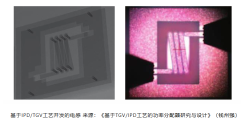
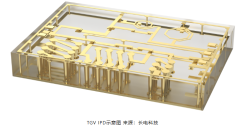
This breakthrough is vital for China's semiconductor industry, helping to fill a global technological gap in advanced packaging. By transitioning from following to keeping pace with the world, JCET's innovation supports the independent development of next-generation communication technologies. It is expected to drive upgrades across the domestic supply chain, including glass materials and equipment, injecting new momentum into high-quality industrial growth as bandwidth requirements continue to rise.
Di'er Laser: Small-batch repeat purchase of TGV equipment orders
Wuhan Di'er Laser Technology Co., Ltd. (hereinafter referred to as "the Company") has been deeply involved in the field of micro-nano laser precision processing for many years. Its main business is the design of laser precision micro-nano processing solutions and the research, development, production and sales of supporting equipment. At present, its downstream application fields mainly cover the photovoltaic industry in all application scenarios. It is the first national high-tech enterprise in China to introduce laser technology into the photovoltaic solar cell route.
The company targets the vast market opportunities brought by the new infrastructure initiative, with intelligent manufacturing equipment as its main business. It focuses on the core equipment needs of photovoltaics and information infrastructure as the core of intelligent computing, actively develops a "second growth curve," and continuously researches and develops laser processing equipment in fields such as advanced packaging, compound semiconductors, and new displays. It builds a sustainable business system based on the photovoltaic main business, extended by the semiconductor business, continuously developing forward-looking technologies and products, and supported by supporting services.
The company focuses on the entire process of photovoltaic cell and module processing, covering all technology routes including BC, TOPCon, HJT, perovskite, and PERC, and is a core equipment supplier for leading photovoltaic companies. The company continuously innovates in technology, including local junction, TCP, TCI, and laser sintering technologies in TOPCon; laser crystallization technology in BC, in addition to mass-produced laser micro-etching and copper electroplating technologies; laser full-plate welding and backsheet interconnection technologies in module technology; laser transfer and laser sintering equipment in HJT; and P1-P4 technologies in perovskite.
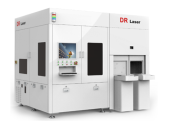
Leveraging its accumulated expertise in ultrafast laser technology, the company has made continuous progress in fields such as advanced semiconductor packaging. It has completed the shipment of panel-level glass substrate through-hole equipment, achieving comprehensive coverage of wafer-level and panel-level TGV packaging laser technology, and customers have already expressed repurchase requests . Addressing the application needs of novel functional composite materials based on electronic-grade resins for PCBs in ultra-high-speed applications, the company is collaborating with several leading enterprises to rapidly advance the R&D project for PCB ultrafast laser precision processing equipment. Material verification has been completed, and delivery to customers for mass production verification is imminent. The company has also conducted forward-looking R&D and business layout in the fields of compound semiconductors and laser micro-nano processing for novel displays.
[/
The remaining pieces to full self sufficiency may not be EUV.
What happened to commercial EUV production by 2027? I thought Huawei will be relying on advanced nodes from EUV machines by 2028 with their 970 series.
The remaining pieces to full self sufficiency may not be EUV.
Not enough people realize this.[/
The remaining pieces to full self sufficiency may not be EUV.
Even if China has EUV, that doesn't mean they are fully self sufficient, there's a whole supply chain that needs coverage.

Exclusive: US orders chip equipment companies to halt some shipments to Hua Hong, China's second-largest chipmaker
NEW YORK, April 28 (Reuters) - The U.S. Department of Commerce last week ordered numerous chip equipment companies to halt certain tool shipments to China's second-largest chipmaker Hua Hong, according to two people familiar with the matter.
The department sent letters to at least a handful of companies informing them of the new restrictions on tools and other materials destined for Hua Hong (688347.SS) facilities that U.S. officials believe will make China's most sophisticated chips, the people said.
Top U.S. chip equipment companies Lam Research (LRCX.O), Applied Materials (AMAT.O) and KLA (KLAC.O), each of which has significant business supplying China, were among those believed to have received a letter, the sources added.
The Reuters Iran Briefing newsletter keeps you informed with the latest developments and analysis of the Iran war. Sign up here.
Reuters exclusively reported in March that Hua Hong Group had developed advanced chip manufacturing technologies that could be used to produce artificial intelligence chips, a milestone in Beijing's efforts to boost tech self-sufficiency. The group's contract chipmaking business, Huali Microelectronics, was preparing a 7-nanometer chipmaking process at its Shanghai plant, sources said.
SMIC, China's largest contract chipmaker, is the only domestic company that can currently make chips with 7-nm technologies, the report said. The letters from the Commerce Department also aim to prevent shipments to Huali, sources said.
U.S. AIMS TO PROTECT LEAD ON AI CHIPS
In recent years, the Commerce Department has restricted U.S. companies from shipping equipment to Chinese factories producing advanced chips as part of an effort to safeguard the U.S.' technological lead in making AI and other advanced chips on national security grounds. The recent letters carry this policy forward, but could increase tension with China ahead of President Donald Trump's scheduled meeting with Chinese President Xi Jinping in Beijing in May.
U.S. chip equipment companies and other suppliers could lose billions of dollars in sales, one of the people said, especially if they were supplying a chipmaking plant that is under construction, or one that is retooling to begin making more advanced chips. The restrictions could slow China's domestic chipmaking drive, though Hua Hong may be able to replace the tools with ones from foreign or Chinese companies.
A Commerce Department spokesperson declined to comment. Hua Hong did not immediately respond to a request for comment. Lam Research, Applied Materials and KLA did not immediately respond to requests for comment.
Well, no surprise there. I expect more such measures with each passing year. As China keeps growing , it will increasingly be seen as more of a threat to the US, so more political pressure will be exerted in Washington to impose more of such measures not less. Well, at least now China seem to be aware and prepared compared to a decade ago when the trade war started

this was expected. Hua Hong has now reached at 7nm (Biren is using them to manufacture their GPUs).Well, no surprise there. I expect more such measures with each passing year. As China keeps growing , it will increasingly be seen as more of a threat to the US, so more political pressure will be exerted in Washington to impose more of such measures not less. Well, at least now China seem to be aware and prepared compared to a decade ago when the trade war started

Huate says its specialty gas products are used in 3D NAND production.
from its 2025 report. It's production is used in DRAM, HBM, 3D NAND advanced logic.
另一方面,下游产业技术迭代正推动特种气体需求向“质”升级。随着晶圆尺寸扩大、制程技术精细化, 电子特气的精细化程度与稳定性要求持续提高,先进逻辑制程、存储技术(如 DRAM/HBM、3D NAND)对中 高端气体材料的需求尤为迫切;同时,显示市场的持续增长、“双碳”目标下光伏产业的扩张,进一步拓宽了 特种气体的应用边界,推动需求结构从传统领域向高附加值领域优化。