Chinese semiconductor thread II

supersnoop

Colonel
Registered Member
Amd ryzen 5 4500 is equivalent to intel i7 from 2018. If kx-7000 was released in 2023, that's a 5 year gap in performance when it comes to laptop/desktop cpu. This much worse than domestic mobile cpu and ascend gpu.

I wonder why laptop desktop cpu do not get the same attention as gpu or mobile soc are getting. People do need these to run pretty much any professional applications and run things like cad software. Or is it considered a given that US will never ban these to be exported to China.
Simple answer, PC demand is low relative to mobile.
A lot of people are fine with a 5+ year old PC, but not so with a phone.
 

tokenanalyst

Lieutenant General
Registered Member

Tianma Launches Mass-Produced 185Hz Ultra-Sensitive High Refresh Rate Screen​


Tianma has achieved a major milestone in display technology by launching the world’s first mass-produced 185Hz AMOLED ultra-high refresh rate screen, pushing mobile visual performance to new heights. Building on its prior success with 165Hz displays, this breakthrough delivers an unmatched blend of speed, precision, and efficiency — particularly for gaming and fast-motion content.
  • Dual-Track Pixel Architecture: Tianma’s proprietary discrete pixel circuit design decouples data writing from DTFT threshold compensation, solving the longstanding trade-off between speed and image accuracy. This improves first-frame brightness by 13.4% and reduces image retention by 61%.​
  • Ultra-Fast Response: With a 5.4ms per frame response time and intelligent touch latency optimization, the screen enables “point-and-shoot” precision in e-sports — eliminating ghosting and enhancing detail in fast-paced scenes like FPS games.​
  • Power Efficiency: Despite the high refresh rate, the screen uses low-power light-emitting tech (award-winning) and a smart power model to reduce energy consumption, extending battery life without sacrificing performance.​
  • Eye Comfort & Uniformity: Features full-scene flicker-free dimming and pixel-level calibration for consistent color/brightness, ensuring long-term visual comfort and image quality.​
Tianma leverages its Tiangong Screen platform, backed by world-class R&D facilities and four core research platforms (panels, optics, driving, materials). The company is already developing 240Hz technology and holds leadership in LTPO, foldable, and SLOD innovations.

Tianma aims to make cutting-edge displays accessible beyond labs — integrating them into everyday experiences from gaming to browsing. With the tagline “Good screen, illuminating the beauty of life,” the company positions its tech as enhancing not just performance, but overall visual well-being.​

Please, Log in or Register to view URLs content!
 

tokenanalyst

Lieutenant General
Registered Member

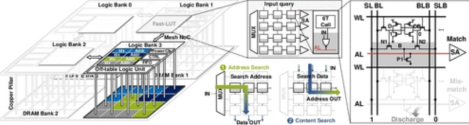
3D-PATH: A Hierarchy LUT Processing-in-memory Accelerator with Thermal-aware Hybrid Bonding Integration.​


LUT-based processing-in-memory (PIM) architectures enable general-purpose in-situ computing by retrieving precomputed results. However, they suffer from limited computing precision, redundancy, and high latency of off-table access. To address these challenges, we present 3D-PATH, a novel PIM architecture that employs 3D hybrid bonding to integrate a DRAM-LUT, enhancing system capacity and reducing access latency. To further optimize efficiency, 3D-PATH introduces a hierarchical fast-LUT design that reduces storage redundancy and accelerates computation. Additionally, 3D-PATH extends computing precision by efficiently supporting floating-point operations via representation transformation and parallel interleaving banks. While hybrid bonding offers significant benefits, it induces heat dissipation challenges. To address this, we implement thermal-aware hardware that ensures the DRAM Die temperature maintains below the threshold of 85°C. Evaluations on arithmetic and AI workloads demonstrate that 3D-PATH achieves up to 12.68 × higher throughput than GPUs and 2.27-7.54 × over prior LUT-PIMs, while delivering a 12.24 × improvement in floating-point energy efficiency over GPU and 2.13 × over a 3D baseline.

1766853974308.png

Please, Log in or Register to view URLs content!
 

Michael90

Senior Member
Registered Member

Huawei Reportedly Plans 2026 Ascend 950 Sales in South Korea, Targeting Cluster-Level Deployments​


As Huawei steps up its AI ambitions, South Korea is emerging as an unexpected focal market, with the company reportedly preparing to bring its AI chips to Korean customers. According to
Please, Log in or Register to view URLs content!
, Valian Wang, CEO of Huawei Korea, said at a press briefing on the 26th during Huawei Day 2025 that the company plans to officially roll out AI computing cards and AI data-center solutions in South Korea in 2026.

The product slated for launch is expected to be Huawei’s latest AI accelerator, the Ascend 950. As the report notes, the company aims to position the product as an alternative to NVIDIA for Korean customers.

Huawei Plans to Push Cluster-Based AI Strategy in South Korea

Unlike NVIDIA, Huawei does not plan to market its AI chips as standalone products, instead focusing on cluster-level deployments, the report notes. Wang explained that Huawei’s strategy goes beyond selling individual AI cards or servers, aiming to enhance competitiveness by delivering end-to-end (E2E) solutions that integrate infrastructure hardware, such as networking and storage, with software, as the report highlights.

Under this approach, Huawei may not need to rely on third-party partners for either supply or sales, as it is pursuing a strategy of direct integration and service delivery, Wang said. The report adds that Huawei Korea is currently in talks with several companies over potential supply arrangements.

Huawei also plans to supply its self-developed, open-source operating system, Harmony, to South Korean companies next year as part of its efforts to build a broader ecosystem, the report indicates. Meanwhile, the company has no plans to introduce smartphones in South Korea in 2026, the report adds.

Huawei Reportedly Builds Export-Ready AI Chips With In-House HBM

Huawei’s overseas AI chip ambitions are being bolstered by its progress in internalizing key components. According to
Please, Log in or Register to view URLs content!
, Huawei has reportedly brought HBM in-house in response to U.S. export restrictions, enabling a more stable supply without relying on external vendors such as Samsung Electronics or SK hynix. The report adds, citing sources, that at Huawei Connect 2025 the company said its Ascend 950 series will be equipped with Huawei’s proprietary HBM solutions—“HiBL 1.0” for inference and “HiZQ 2.0” for training.

Huawei’s Ascend AI Chips Set for Global Expansion

Beyond South Korea, Edaily notes that Huawei has emphasized plans to market its Ascend AI chips not only in Korea but also globally. The company also disclosed plans to launch the chips in Malaysia next year. According to
Please, Log in or Register to view URLs content!
, citing sources, its overseas expansion plan is significant, as it indicates that Huawei—previously focused largely on the domestic market—has now secured sufficient volumes to support exports abroad.

Please, Log in or Register to view URLs content!
lol There is zero chance the US will allow this. I’m surprised they think they can do this in a close US ally country instead of looking at countries who don’t have that much closed ties with the US. Moreover, I think it’s about too early for exports no? I believe they should focus on first dominating the Chinese market first, with Nvidia now allowed to sell their H200 chips to China, many Chinese companies will now be going back to Nvidia for obvious reasons. So huawei should’ve more focused on the Chinese market where they have more of a chance of better competing than in foreign countries where Nvidia is almost omnipotent/omni present . It will be a very tough battle for them to even have a chance to get a little market share outside China, given Nvidia quasi dominance monopoly and their tech stack/ecosystem which they have locked all customers into using their CUDA system for training. It’s for this reason even Chinese companies still prefer Nvidia than Huawei if giving the choice to choose. So it will be a tough battle for Huawei.
 

justinlee

Just Hatched
Registered Member
Please, Log in or Register to view URLs content!

Novosense has launched the MT932x linear position sensor, featuring ultra-low power consumption of 700μA and high bandwidth of 5kHz.

Can be used for gaming joysticks/controllers, 3D printers and cloud platform control.
I'm a FPS gamer, I wonder if it could be used for magnetic keyboard like wooting. It's power consumption is even lower than some low-end TMR which doesn't need power hungry amplifier stage and biasing.
 
Top