Chinese semiconductor thread II

playmaker1478

New Member
Registered Member
Please, Log in or Register to view URLs content!

Please, Log in or Register to view URLs content!

"the Mate 70 series saw huge demand and early sales exhausted the stock, resulting in a short supply. The supply chain restraints also created problem in increasing the production. The momentum then surged toward Xiaomi 15 series, and surpassed the Huawei Mate 70."

Please, Log in or Register to view URLs content!

"Simply put, there was no additional stock capacity for the Mate 80 Pro Max due to its first-time appearance in the market. The company prepared only a few units, which sold out immediately, owing to its surprising features."


---

Mate 60 pro also saw huge demand but short supply. Huawei faced supply shortage for its flagships rather than demand shortage.

I think there is enough "patriotic demand" to sell huge flagship volume for Huawei but they have been constrained by supply for flagship chips. This happens everytime since Huawei usually uses a new chip utilizing a new process for its Mate phones and has trouble ramping up chip production. By the time they ramp up production next year, Mate phones are already old and Huawei starts releasing its Pura phones.
Maybe I'm reading this wrong but isn't this just an issue of capacity constraint from SMIC? Huawei has multiple products, competing against domestic designers (of ASICs, CPU, GPU) or even cloud providers like Alibaba for SMIC allocation; so I don't think it is a simple matter of increasing production.

Other factors may also play a role, such as excessively high demand, limitations in equipment or stock needed to produce the chip, or actual yield issues. Without definitive information, it is unwise to speculate that yield is the primary problem in this equation.

It is not a secret that SMIC lag behind TSMC or other producers in term of capacity; this is just the nature of using DUV and importing equipment. Hopefully this will change the next year with more domestic equipment producers/their increase production, fab expansion, and maybe EUV progress. I guess I'm a bit of an optimist, lol.
 

JPaladin32

New Member
Registered Member
Please, Log in or Register to view URLs content!

anyhow, Huawei is introducing MatePad 11.5 2026 version and this will use new CPU Kirin T82B and T82. Claims 30% improvement overall compared to 2024 version

It seems like they designed a new CPU for pads rather than just reusing 8000 or 9000 series. They also have the X90 series iirc for PCs. Basically, they are completely off Intel and QCOM chips now. So, everything they produce needs to be fabb'd in China.
Actually T82 and T82B are just Kirin 8020 without baseband.
 

tphuang

General
Staff member
Super Moderator
VIP Professional
Registered Member
Please, Log in or Register to view URLs content!

Please, Log in or Register to view URLs content!

"the Mate 70 series saw huge demand and early sales exhausted the stock, resulting in a short supply. The supply chain restraints also created problem in increasing the production. The momentum then surged toward Xiaomi 15 series, and surpassed the Huawei Mate 70."

Please, Log in or Register to view URLs content!

"Simply put, there was no additional stock capacity for the Mate 80 Pro Max due to its first-time appearance in the market. The company prepared only a few units, which sold out immediately, owing to its surprising features."


---

Mate 60 pro also saw huge demand but short supply. Huawei faced supply shortage for its flagships rather than demand shortage.

I think there is enough "patriotic demand" to sell huge flagship volume for Huawei but they have been constrained by supply for flagship chips. This happens everytime since Huawei usually uses a new chip utilizing a new process for its Mate phones and has trouble ramping up chip production. By the time they ramp up production next year, Mate phones are already old and Huawei starts releasing its Pura phones.
Huawei Central is a Huawei fanboy website.

There were huge supply issues for Xiaomi 15 and 17 as well as all the iPhone series also. That's what happens in the first 2 weeks.

Pura 80 came out in June 11th of this year. I was at a Huawei store in Beijing less than 2 months later and there was almost nobody in the store. I went to several Huawei stores in Beijing in August and very few people in any of the stores. You could have bought any phone you wanted to.

If the supply is so limited for Kirin chips, then why do you think they launched Mate X7 in Dubai a couple of weeks later?
Please, Log in or Register to view URLs content!

Do you know how many Mate flagship phones were sold back in its hey-days and how many Mate 60 and 70 phones haven't been sold in the past couple of years?

At its peak, Huawei was selling about 20m Mate flagship phones. That's the most they ever sold when they had full access to TSMC.

Mate 60 had a little over 10m sales IIRC and Mate 70 sold less than that (under 10m IIRC). Pura 80 was just a few million.

In fact, they had so many K9020 left over that they are putting them in Mate TV by this summer. And same thing with 9010 series, they just had too many in stock, so they had to put it in other phones and pads.

So no, Kirin chip production is not the main issue for Huawei. The main issue is that China's high end phone market is only so large and iPhone continue to dominate the market share and Xiaomi 15/17 is also in there now, so it is not possible for Huawei to actually sell 20 million of flagship Mate/Pura phones per year right now.
 

tokenanalyst

Lieutenant General
Registered Member

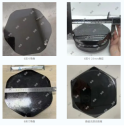
Zhenjing Semiconductor and Nanchang University are jointly tackling key challenges in the low-cost fabrication of 8-inch thick SiC single crystals.​


Zhenjing Semiconductor and Nanchang University have launched a strategic collaboration to advance the low-cost, large-scale production of 8-inch thick silicon carbide (SiC) single crystals using liquid-phase crystal growth technology.

Zhenjing Semiconductor, led by Dr. Lu Min a veteran with over 30 years in compound semiconductors—has developed proprietary, damage-free seed bonding and crystal growth technologies. It successfully produced an 8-inch SiC crystal in 2025, achieving stable p-type crystals ≥5mm thickness without macroscopic defects, validating its industrial scalability.

1766504647566.png

Nanchang University’s International Institute of Materials Innovation, under Professor Wu Jian who has led multiple national R&D projects brings strong theoretical and applied research expertise in semiconductor materials. The university will contribute cutting-edge scientific insights to address key technical challenges in SiC crystal growth.

The partnership aims to combine Zhenjing's industrial experience with Nanchang University’s academic innovation, accelerating the transition of lab-scale technology into commercial applications. Their joint effort seeks to provide cost-effective, high-performance SiC substrates for critical sectors like new energy vehicles, smart grids, data centers, and AR devices enhancing national self-reliance in semiconductor materials.

This collaboration establishes a new "industry + academia" model: Zhenjing provides proven engineering processes; Nanchang University drives fundamental research. Together, they aim to foster technological breakthroughs, drive industrialization, and cultivate high-level, practice-oriented talent.

Please, Log in or Register to view URLs content!
 

huemens

Junior Member
Registered Member

Nvidia aims to begin H200 chip shipments to China by mid-February, sources say​

Please, Log in or Register to view URLs content!
Nvidia has told Chinese clients it aims to start shipping its second-most powerful AI chips to China before the Lunar New Year holiday in mid-February, three people familiar with the matter told Reuters.

The U.S. chipmaker plans to fulfil initial orders from existing stock, with shipments expected to total 5,000 to 10,000 chip modules - equivalent to about 40,000 to 80,000 H200 AI chips, the first and second sources said.

Nvidia has also told Chinese clients that it plans to add new production capacity for the chips, with orders for that capacity opening in the second quarter of 2026, the third source said.

Significant uncertainty remains, as Beijing has yet to approve any H200 purchases and the timeline could shift depending on government decisions, the sources said.
 

spaceship9876

New Member
Registered Member

10 people, including former Samsung executives and employees, indicted on charges of leaking a 10-nanometer DRAM process to CXMT​


Ten people, including former Samsung executives and employees, were put on trial for leaking the world's first 10-nanometer (nm, 1 nm=billionth of a meter) DRAM national core technology developed by Samsung Electronics.

The Seoul Central District Prosecutors' Office's Information Technology Crime Investigation Department (Chief Prosecutor Kim Yun-yong) announced on the 23rd that it arrested and charged Mr. A, head of China's Changshin Memory Technology (CXMT) development office, with violating the Industrial Technology Protection Act (such as leaking national core technologies overseas). A is a former Samsung Electronics company who oversaw the development of 10-nanometer DRAM technology at CXMT. Four key development workers were also arrested and indicted along with Mr. A. Five people in charge of development for each part were indicted without detention.

source:
Please, Log in or Register to view URLs content!
 

tphuang

General
Staff member
Super Moderator
VIP Professional
Registered Member
Please, Log in or Register to view URLs content!

It's not just the memory chips that are seeing price rise, logic process is seeing that too. Here, SMIC is raising prices by 10% for part of its production. I'm glad to see this. China's leading fab needs the funding to invest in more capacity.

Please, Log in or Register to view URLs content!
well, I initially expected 1 million over 2026 and first half of 2027. At this pace, I don't think they will get there. Maybe 500k spread over the next year or so. That should be enough stash for standalone AI labs like DeepSeek, Zhipu and Moonshot to get enough chips to maybe speed up the training. Who knows. At least, it's enough where they would be de-incentivized from switching to Ascend for training.

Even 10k H200s for each of these players could potentially help their training in non-trivial ways.
 

tokenanalyst

Lieutenant General
Registered Member

Two Dinglong Technology produced high end photoresists have passed verification by major domestic wafer foundries and secured orders.​


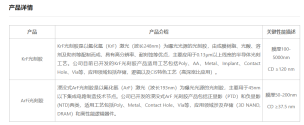
Dinglong Technology has achieved significant progress in domestically produced high-end wafer photoresists, with two KrF and ArF photoresists passing verification by major Chinese semiconductor foundries and securing orders. This marks a critical step toward reducing reliance on imported materials amid global supply chain decoupling.

With over 30 high-end photoresist products covering KrF and immersion ArF processes, Dinglong has established an independent R&D and manufacturing system from raw materials to finished goods, underpinned by a "self-developed R&D + vertical integration" strategy. Its Qianjiang Phase I factory currently supports annual production of 30 tons, with plans to scale up to 300 tons via a 910 million yuan convertible bond issuance (480 million yuan allocated for industrialization).
1766508109433.png
Beyond photoresists, Dinglong is a leader in semiconductor CMP materials the only domestic company fully mastering the core technology and process of CMP polishing pads, with strong growth in polishing slurries and cleaning fluids. In H1 2025, its CMP segment revenues rose by over 59% year-on-year, including first-time orders for copper polishing slurry.

This breakthrough strengthens China’s semiconductor supply chain security, demonstrating Dinglong's capability to provide stable, high-performance domestic alternatives in key bottleneck materials.​

Please, Log in or Register to view URLs content!
 
Top