Chinese semiconductor thread II

Blitzo

General
Staff member
Super Moderator
Registered Member
What happened to commercial EUV production by 2027? I thought Huawei will be relying on advanced nodes from EUV machines by 2028 with their 970 series.

I have no specific comment about when Huawei (or anyone else for that matter) will be using EUV, but I will note that "fully domestic 28nm-7nm tech stack" is not a prerequisite for "EUV tech stack".
It isn't a real time strategy game where one needs to unlock all of a precursor capability to make progress with the next step of the tech stack.
An analogy that we may be most familiar with for example, is J-10C still using Al-31s up to the late 2010s, but that didn't stop them developing, testing and commissioning J-20 during that same period.


(I also observe that this letter doesn't seem to include comments from Huawei)


edit: also, isn't this guy just repeating something that was already mentioned by SCMP a month or so ago (not to say they're reliable, but point being that this letter itself isn't new), and even posted in this very thread?
Do we have short term memory loss or something...
 
Last edited:

henrik

Captain
Registered Member
Even if they manage to build a fully functioning operational EUV machine (even if it’s 10years from now) that matches even ASML OLDER EUV machines, it will still be a major achievement . In fact I believe it will be even more monumental than achieving a moon landing to be honest. For one country to be able to make a viable functioning EUV machine independently is a monumental achievement

It sounds like it takes many countries to do it, so it must be a formidable job. But all the countries involved are much smaller countries than China, which has big market and comprehensive expertise.
 

antiterror13

Brigadier
What happened to commercial EUV production by 2027? I thought Huawei will be relying on advanced nodes from EUV machines by 2028 with their 970 series.

I think what the story tell us by 2030 100% domestic and supply chains for 7nm and EUV. Thats monumental achiement, no other country could achieve that. ASML is only an integrator and core technologies from many companies and countries. There is no way ASML could do it only by themselves, no other country except China can

I think EUV machine will be ready in 2027 and mass produced in 2028, but it might not 100% domestic, but all core technologies will be domestic at that time.

China has already achived 7nm in 2021 but with ASML DUV lithography. Also achieved 5nm in 2025, and SMIC is aimed to get to 3nm with old DUV machine in 2027

It is also a likely possibility that 7nm will be achived by SMEE SSA800 or SSA900 in 2027/28 (but doesn't mean 100% domestic and supply chain yet)

100% domestic supply chain is not only lithography, there are much more than just lithography

From this, indirecly saying that SSA900 is in mass production mode
Please, Log in or Register to view URLs content!
 
Last edited:

tphuang

General
Staff member
Super Moderator
VIP Professional
Registered Member
btw, per forum policy, you cannot just post one-liners without commentary, so please be mindful when you are just leave a link, especially to a guy with like 100 followers on X.

Having said that, I haven't verified whether what this person said it's true. Nor, do I think it is in important. But it's a very stupid thing to think they won't have trial operation of fully domestic 7nm by 2030, when they already have it being tested out right now, likely not reach HVM until 2027. This is pretty widely reported inside China. They also have fully domestic production line of 3D NAND in production and DRAM.
 

tphuang

General
Staff member
Super Moderator
VIP Professional
Registered Member
Please, Log in or Register to view URLs content!

深圳平湖实验室 announces its 100V GaN MPW & PDK platform's launching on 8-inch GaN wafer. Allowing for different designs of 100V die on 1 wafer. 100V GaN PDK design tool using mainstream EDA to validate. First taping out to happen by July and 2nd round of taping out by November.
 

tphuang

General
Staff member
Super Moderator
VIP Professional
Registered Member
Please, Log in or Register to view URLs content!

AAC Tech is working with 广东广电 to develop a nation wide liquid cooled data center in Guangzhou. The rack supports ATAHORAN liquid cool solution. It supports chips from Kunlunxin, Moore Thread, MetaX, Enflame and Huawei Ascend.

Please, Log in or Register to view URLs content!
Smartsens unveils new 50 MP CMOS SC575X using 22nm stack tech.

Please, Log in or Register to view URLs content!
C-Core/National chip comes out with new RISC-V based AI MCU CCRC4XXX series. It also uses 22nm RRAM platform.
 

jx191

Junior Member
Registered Member
So according to this twitter they are targeting trial operation of fully domestic 7nm by 2030 and they also don't expect fully functional EUV by 2030.
That doesn't mean anything.

EUV is rarely publicly mentioned and any significant news isn't coming from a guy on X with barely any followers or inside news.

For example, Zephyr is much more active and he says Chinese EUV will be ready in some initial form by 2027 to 2028, complete opposite to the other guy.

I'm not saying he's 100% correct, but there are many different commentators on western social media and none of them are 100% accurate.

Next time you see something like that on X, don't worry about it. The real news is not coming from western media.
 

tokenanalyst

Lieutenant General
Registered Member
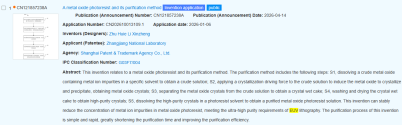
What people and stooges in the US are underestimating is that China has a long time developing EUV lithography and without access to ASML EUV everyone from the government, to SMIC to Huawei have all the incentives to move faster and put more resources in this technology. At the end the will not only a have a "EUVL machine" but an entire ecosystem for EUV lithography. Good luck entering the Chinese market after that.

1776438297380.png
 

tokenanalyst

Lieutenant General
Registered Member

Design and Implementation of High-Capacity DDR3 Micro-Module Based on 3D TSV Advanced Packaging.​

School of Electro-Mechnical Engineering, Xidian University
The 58th Research Institute of China Electronics Technology Group Corporation

Abstract​

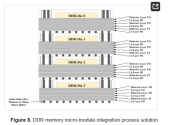
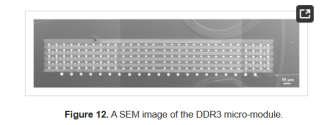
To meet the demands for miniaturization, lightweight design, and high performance in modern electronic systems, advanced 3D TSV technology enables a substantial increase in storage capacity even within physically constrained form factors. This paper proposes a schematic design methodology and system-level integrated modeling approach for a four-layer stacked micro-module based on wafer-level packaging. By leveraging heterogeneous chip fan-out technology and TSV-based vertical stacking, the fabricated DDR3 micro-module achieves a compact footprint of 14 × 9 × 3.5 mm, a storage capacity of 4 GB, and a 64-bit bus width. Compared to conventional board-level mounting, the module reduces the footprint area by 95%. Following comprehensive multi-level testing, the micro-module fully complies with standard protocol requirements, enabling a paradigm shift in form factors for mobile computing devices while enhancing computational density and energy efficiency in data center server applications.​

1776440981653.png1776440999537.png

Please, Log in or Register to view URLs content!
 
Top