Chinese semiconductor thread II

Kalum Pupeter

Junior Member
Registered Member

US Lawmakers Propose Crackdown on Sales of Chip Tools to China​

MATCH act.PNG
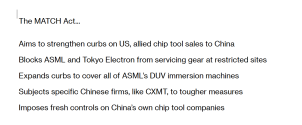
US lawmakers unveiled legislation that seeks to crack down on exports of chipmaking tools to China, especially from allies including the Netherlands and Japan, in a bipartisan effort to help Washington further constrain Beijing’s technology ambitions. The draft bill, introduced in the House on Thursday, would strengthen existing restrictions on semiconductor manufacturing equipment sales from firms like
Please, Log in or Register to view URLs content!
and
Please, Log in or Register to view URLs content!
. A companion version is expected to be released in the Senate later this month, according to people familiar with the matter.

The goal is to subject these companies to the same, tougher curbs their American rivals currently face. That includes banning their engineers from maintaining and repairing tools at certain facilities in China, which US persons are already barred from doing — one of most
Please, Log in or Register to view URLs content!
of export control debates.The bill would also introduce new controls that affect both foreign and US firms — namely
Please, Log in or Register to view URLs content!
,
Please, Log in or Register to view URLs content!
and
Please, Log in or Register to view URLs content!


Tools from these companies, along with ASML and Tokyo Electron, are essential to make everything from
Please, Log in or Register to view URLs content!
’s AI chips to simpler components that go into all types of electronics. For years, the US has worked with Japan and the Netherlands to stop China from getting the best gear, which has been a major chokepoint for the Asian country’s AI chip production.

But China hawks in Washington have long thought the rules could be more effective. The bill — dubbed the Multilateral Alignment of Technology Controls on Hardware, or MATCH, Act — aims to “ensure that America and our allies move in lockstep to close these gaps, defend our technological edge, and safeguard the supply chains that power everything from our weapons systems to our critical infrastructure,” Representative Michael Baumgartner, who’s leading the House version, said in a statement. Senator Pete Ricketts, who’s spearheading the companion bill, added that the legislation would help create a “level playing field for US companies.” NBC News reported earlier on the House measure’s introduction.

Aligning existing measures across American and foreign firms is one matter. Beyond that, the legislation would also broaden the scope of technologies covered, which in some cases would tighten restrictions for US firms, too. Lawmakers largely leave the scope of that expansion to the Trump administration’s discretion — but there are some key chokepoints and companies that would be subject to mandatory control.

Among the most significant would be curbs on all of ASML’s deep ultraviolet immersion lithography, or immersion DUV, machines. That would build on existing controls of the most-advanced extreme ultraviolet lithography, or EUV, machines — which have never been permitted for export to China — as well as some DUV measures imposed by the Netherlands.The Hague currently requires ASML to seek licenses for its more advanced immersion DUV tools, but not all such products — and only for certain end users rather than all potential buyers in China. That means the legislation would significantly curtail the Dutch company’s access to its largest market. ASML declined to comment. A Dutch Trade Ministry spokesperson said that “it is not our place to comment on draft legislation proposed by lawmakers from other countries.”

Then there would be even tougher constraints for sales to specific Chinese companies — including memory chip champion
Please, Log in or Register to view URLs content!
— to essentially stop them from buying any American and allied production gear.

These measures go beyond controls imposed on China writ large. In some cases, Washington has already slapped more aggressive curbs on US companies’ sales to the facilities in question, and the bill would force allies to match. But the provisions would also level up the measures faced by Lam, Applied Materials and KLA. Lam and Tokyo Electron declined to comment, while the other two companies didn’t respond to requests for comment.

Finally, the MATCH Act calls for similarly comprehensive restrictions targeting the Asian country’s own chip equipment sector, a fast-growing industry Beijing
Please, Log in or Register to view URLs content!
as vital for its technological future. Lawmakers didn’t name specific companies. The biggest Chinese tool firms include
Please, Log in or Register to view URLs content!
and
Please, Log in or Register to view URLs content!


The path forward is tricky. New chip equipment restrictions would be hugely provocative to China, and President Donald Trump is keen to maintain a trade truce between the world’s two largest economies. That’s a primary reason why Trump officials — many of whom have themselves
Please, Log in or Register to view URLs content!
specific policies outlined in the bill, including in the White House’s official AI action
Please, Log in or Register to view URLs content!
— have struggled to execute those priorities, according to people familiar with internal administration dynamics.

The MATCH Act takes a diplomacy-first approach. It directs the administration to push allies to adopt their own tighter measures — and if that fails after 150 days, with an option to extend the deadline once, the US would move forward on unilateral restrictions of technology made overseas. The idea is that the threat of curbs from Washington, viewed by some foreign leaders as a major diplomatic overreach, will compel Tokyo and The Hague to impose their own.

To be sure, the US has tried that before: President Joe Biden’s administration made
Please, Log in or Register to view URLs content!
to little avail. Trump’s team did the same during their first few months, people familiar with the matter said, but never followed through on the threat. The Commerce Department’s Bureau of Industry and Security, which oversees chip export controls, didn’t respond to a request for comment. Foreign officials have always been reluctant to hurt their own national champions. They’ve also faced
Please, Log in or Register to view URLs content!
from China to
Please, Log in or Register to view URLs content!
. And in interviews over the past year, some have questioned the Trump administration’s seriousness about semiconductor equipment controls, citing the president’s focus on tariffs, his desire to not provoke Beijing, and a decision to
Please, Log in or Register to view URLs content!
restrictions on sales of Nvidia’s AI processors.

But while Trump’s about-face on Nvidia’s China sales has deeply divided his administration, even those who pushed for that change have expressed general
Please, Log in or Register to view URLs content!
for curbs on manufacturing gear. Indeed, the logic behind allowing Nvidia to sell chips to China — that it would stall the growth of Chinese AI chip champion
Please, Log in or Register to view URLs content!
— is, while controversial, similar to the motivation behind restricting sales of tools that Huawei needs to expand. And there are signs of renewed interest in equipment curbs from Trump’s team. A couple of senior officials visited ASML in the Netherlands in February, where they discussed export controls, according to people familiar with the matter. Lawmakers, meanwhile, are hoping that a strong show of congressional support will aid in ongoing diplomatic talks.
Please, Log in or Register to view URLs content!

Please, Log in or Register to view URLs content!
 
Last edited:

Wrought

Captain
Registered Member
Record revenue across the board for domestic firms last year.

Chinese semiconductor firms have reported record revenue last year driven by AI demand, a shortage of memory chips and U.S. export restrictions that have pushed Beijing to bolster its homegrown tech industry.

Please, Log in or Register to view URLs content!
(SMIC), China’s largest chip manufacturer, said revenue for 2025 rose 16% from a year ago to a record $9.3 billion. Revenue could top $11 billion in 2026, according to LSEG analyst estimates.
Please, Log in or Register to view URLs content!
, another Chinese chipmaker, said fourth-quarter revenue came in at a record $659.9 million and forecast sales of between $650 million and $660 million.
Please, Log in or Register to view URLs content!
, which is aiming to rival
Please, Log in or Register to view URLs content!
, guided that 2025 revenue would be between 1.45 billion yuan ($209.8 million) and 1.52 billion yuan, a 231% to 247% year-on-year increase.

Please, Log in or Register to view URLs content!
 

tokenanalyst

Lieutenant General
Registered Member

Kema Technology, deeply rooted in advanced ceramics, has commenced its second-phase project with an investment of 600 million yuan.​


Kema Technology, a leading domestic enterprise in advanced ceramic materials and components for the semiconductor industry, has officially launched its second-phase expansion project in Suzhou High-tech Zone with a total investment of 600 million yuan. Covering approximately 46 acres, the project aims to centralize and upgrade production lines for structural functional modular ceramic components, strengthen the company's technological leadership, and accelerate the localization of key products to support domestic substitution efforts. As one of the few Chinese companies certified by international semiconductor equipment manufacturers, Kema has demonstrated robust growth, listing on the Shenzhen Stock Exchange's ChiNext board in 2024 and establishing its headquarters operations in 2025. Chairman Liu Xianbing emphasized that over its seventeen-year history, the company has evolved into a national-level specialized "little giant" enterprise, breaking foreign technological monopolies and contributing significantly to the independent control of China's semiconductor industry chain.

The commencement of this expansion aligns with Suzhou High-tech Zone's strategic focus on building a competitive innovation cluster in photonics and integrated circuits, which now hosts over 350 upstream and downstream enterprises and 11 listed companies. Beyond the current Phase II project, Kema Technology plans to initiate its Phase III expansion later this year, further deepening its core business, enhancing R&D innovation, and broadening its industrial footprint. This continued investment underscores the company's commitment to advancing China's new materials industry while supporting the high-quality development of the regional high-tech ecosystem. Through sustained innovation and capacity expansion, Kema is positioned to reinforce its role as a critical supplier in the global semiconductor supply chain.​

Please, Log in or Register to view URLs content!
 

tokenanalyst

Lieutenant General
Registered Member

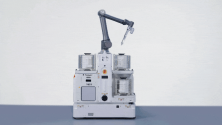
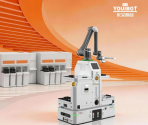
UAI Smart OW12-300 Robot Accelerates 12-inch Wafer Intelligent Manufacturing​

UAI (Youai Zhihe), a global leader in industrial embodied intelligence, has launched the OW12-300, a new-generation semiconductor embodied intelligent mobile operation robot designed to advance intelligent manufacturing for 12-inch wafer production. This launch aligns with China's national strategy highlighting "embodied intelligence" as a key driver for industrial upgrading and global competitiveness.​

1775232556455.png1775232649752.png
  • Achieves empty-to-full wafer exchange in just 25 seconds, matching OHT (Overhead Hoist Transport) performance standards​
  • Omnidirectional movement enables flexible navigation through narrow factory passages​
  • Overall transport capacity increased by 29% compared to previous solutions​
  • Equipped with wireless charging and high-capacity dual batteries​
  • Supports continuous 24/7 operation to maintain uninterrupted production line efficiency​
  • Designed specifically for the full 12-inch wafer fabrication process​
  • Compatible with industry-standard carriers: FOUP, FOSB, and Metal CST​
  • Meets ISO Class 3 cleanroom requirements with vibration levels ≤0.5g​
  • Features 360° sensor coverage for comprehensive safety protection​
The OW12-300 creates a closed loop between material flow and information flow, significantly improving intelligence, informatization, turnover efficiency, and product yield in semiconductor production. UAI's industrial logistics solutions integrate industry-specific software and expert knowledge bases to enable efficient, unmanned handling across the entire production chain from raw materials to finished chips.

UAI Smart Technology now provides comprehensive industrial logistics solutions across the entire "silicon to chips" value chain. The company has already served more than 10 domestic and international wafer fabrication plants and established multiple benchmark projects with leading customers in substrate manufacturing, photomask production, and packaging/testing sectors

With embodied intelligence gaining prominence in national policy frameworks, the OW12-300 represents a strategic step toward autonomous, intelligent semiconductor manufacturing. By combining high precision, flexibility, and seamless integration with existing production systems, UAI aims to empower the global semiconductor industry with next-generation logistics automation that enhances both efficiency and adaptability in an increasingly competitive landscape.​

Please, Log in or Register to view URLs content!
 

tokenanalyst

Lieutenant General
Registered Member

Research Progress In The National Key Laboratory of Integrated Circuit Manufacturing Technology​

Multi-Threshold GAA Transistors
Demonstrates atomic-level LaOx dipole flipping control to achieve ~66 mV/level multi-VT tuning within 330 mV range in CMOS GAA nanosheet FETs. Proposed dipole-last hybrid integration enables scalable low-power design.

Ultra-Thin EOT Gate Dielectric
Reports quasi-single-crystal HfZrON gate dielectric (κ=67) achieving sub-5 Å EOT with 4×10⁻³ A/cm² leakage—enabling continued Si NSFET scaling.

Monolithic 3D In-Memory Computing
Presents vertically stacked Si-FinFET/CNT-FET 3D CIM architecture with reconfigurable memristor transistors for mixed-signal vision processing.

Voltage-Driven Magnetoelectric Memory
Introduces CMOS-compatible, Si-substrate magnetoelectric memory using HZO/Pt nanoclusters, achieving 0.46 pJ/μm² energy at 400°C process budget.

FeFET Analog CIM Chip for On-Chip Learning
Validates a 520 Kb dual-layer FeFET-based analog CIM chip (1763.9 TOPS/W) achieving 84.1% accuracy in FFN learning tasks using BEOL HZO capacitors.

Organic Phototransistor Array for In-Sensor Computing
Demonstrates gate-tunable, wide-spectrum (405–850 nm) organic phototransistor array with 1.7% linearity error, enabling convolution, night monitoring, and image inpainting on one platform.

MEMS-CMOS Wearable Ultrasound Sensing
Co-designs 70%-bandwidth PMUT array with 5V programmable CMOS transmitter for wearable brachial artery imaging and blood pressure monitoring.

Please, Log in or Register to view URLs content!
 
Last edited:

tokenanalyst

Lieutenant General
Registered Member

Fudan Microelectronics: FPAI chip completes tape-out testing and is ready for productization​


Fudan Microelectronics released an investor relations activity record, disclosing that its FPAI chip has built a heterogeneous integrated intelligent chip design and application development software platform, and is deploying a product series ranging from 4TOPS to 128TOPS. The first 32TOPS computing power chip is progressing well, while the 8TOPS and 128TOPS computing power chips have completed tape-out and testing, and are preparing for productization
. The company's FPAI chip manufacturing processes cover 1xnm FinFET advanced and mature processes, integrating SoC, FPGA, and NPU into one unit, targeting customized edge and converged inference applications. In addition, the company launched RF-FPGA and RFSOC series products, integrating RFADDA technology at the 1xnm node. In 2025, the FPGA product line achieved sales revenue of approximately RMB 1.316 billion, with the high-reliability field contributing approximately RMB 1.2 billion in sales. The company's first-quarter operating performance was good, maintaining a steady year-on-year growth trend, and new businesses and new customers are actively expanding.

Please, Log in or Register to view URLs content!
 

tokenanalyst

Lieutenant General
Registered Member
Please, Log in or Register to view URLs content!

Please, Log in or Register to view URLs content!
There is nothing more the Chinese domestic semiconductor equipment, sub-systems, components and EDA companies wants more is to see US companies disappear from their home market leaving China own market to grow and the global market to conquer.
 
Top