Chinese semiconductor thread II

tokenanalyst

Lieutenant General
Registered Member

OFILM achieved revenue of 22.15 billion yuan in 2025, representing a year-on-year increase of 8.38%.​


On April 2, O-Film released its 2025 annual report. The report shows that the company achieved total operating revenue of RMB 22.15 billion in 2025, an increase of 8.38% year-on-year; net profit attributable to shareholders of the listed company was RMB 41.6342 million, a decrease of 28.69% year-on-year.

During the reporting period, the company's net profit attributable to shareholders of the listed company after deducting non-recurring gains and losses was -29.8877 million yuan, and the net cash flow from operating activities was 276 million yuan, representing a year-on-year increase of 249.92%. Basic earnings per share were 0.0126 yuan.

By product category, revenue from smartphones was RMB 16.579 billion, up 2.39% year-on-year, accounting for 74.85% of total revenue; revenue from smart cars was RMB 2.743 billion, up 14.3% year-on-year, accounting for 12.38% of total revenue; and revenue from new product categories was RMB 2.776 billion, up 58.73% year-on-year, accounting for 12.53% of total revenue.

By region, domestic sales revenue was RMB 19.505 billion, a year-on-year increase of 9.71%, accounting for 88.06% of total revenue; overseas sales revenue was RMB 2.645 billion, a year-on-year decrease of 0.48%, accounting for 11.94% of total revenue.

Please, Log in or Register to view URLs content!
 

tokenanalyst

Lieutenant General
Registered Member

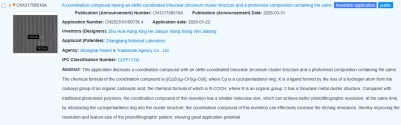
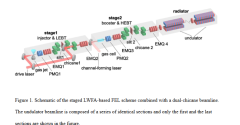
Staged Laser Wakefield Acceleration for Saturated Lasing of Bandwidth-Tunable Free-Electron Lasers from EUV to X-ray​


Free-electron lasers (FELs) provide a revolutionary tool for capturing the structure and dynamics of matter in real time at the atomic scale. The size and cost of FELs can be substantially reduced by using laser wakefield acceleration (LWFA), which offers acceleration gradients orders of magnitude beyond radiofrequency technology, producing multi-GeV electron beams within tens of centimeters. This compactness opens the possibility of integrating multiple operating modes - from the EUV to X-rays including broadband operation - into one facility. Realizing this vision, however, faces key challenges: current LWFA bunches are too short to sustain sufficient radiation slippage, limiting FEL pulse energy at EUV wavelengths, while the large energy spread and emittance make X-ray lasing even more demanding. Here we present a LWFA-driven FEL scheme that addresses these challenges, enabling multi-mode operation spanning different wavelengths and bandwidths within a single facility. The scheme employs staged acceleration to reach multi-GeV energies while preserving beam quality, combined with a dual-chicane beamline that stretches the bunch to mitigate the radiation slippage for EUV FEL and tailors the energy chirp for diverse FEL bandwidth modes. Simulations demonstrate that the scheme can generate high-quality electron beams with energies up to 7 GeV and tunable energy chirp, enabling both FEL saturation from the EUV to X-ray wavelengths and large bandwidth operation with a bandwidth of up to 11%. This work provides a roadmap for compact, multi-mode FELs based on plasma acceleration, and the high-energy, high-quality beams achieved also point toward compact injectors for next-generation storage-ring light sources.​

1775146961713.png
Please, Log in or Register to view URLs content!
 

tokenanalyst

Lieutenant General
Registered Member

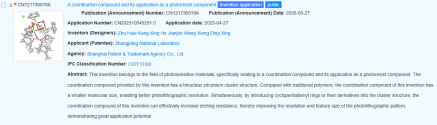
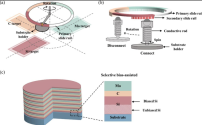
Improving the performance of Mo/Si/C multilayers through selective substrate bias-assistance​

Abstract​

Substrate bias-assisted magnetron sputtering enables effective regulation of multilayer microstructures. However, investigations into selective bias-assisted deposition for extreme ultraviolet (EUV) multilayer coatings incorporating barrier layers have yet to be conducted. In this study, we develop a selective bias-assistance device that applies a controlled fraction of substrate bias to designated material layers in Mo/Si/C multilayers. By jointly analyzing crystallization and diffusion, we show that bias applied only to the Si layers triggers a self-accelerating intermixing–amorphization–enhanced-diffusion cycle at the Si-on-Mo interface, whereas bias on the Mo and C layers densifies these layers, enhances crystallization, and suppresses this cycle. By applying bias to both the Mo and C layers and optimizing the bias-assistance fraction during Si-layer deposition, the EUV reflectivity is increased by 2.6% compared with the unbiased multilayer. In summary, by considering the influences of bias on different material layers and optimizing the applied bias ratio, it is possible to engineer the interfaces and enhance the optical performance of multilayers.​

1775147038276.png

Please, Log in or Register to view URLs content!
 

tokenanalyst

Lieutenant General
Registered Member

Caitong Capital invests in Che Yitian, boosting the localization process of strategic emerging industries.​


Recently, Caitong Capital completed a strategic investment of tens of millions of yuan in Shanghai Cheyitian Technology Co., Ltd. (hereinafter referred to as "Cheyitian"), a core semiconductor component company, to help it accelerate breakthroughs in technological innovation and market expansion.

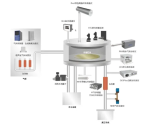
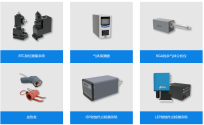
Cheyitian, a leading domestic supplier of key subsystems and core components for online measurement and control, is committed to providing integrated hardware and software online detection and control solutions for semiconductor manufacturing and related equipment. From endpoint detection and temperature measurement systems to gas analysis systems, heating belts, ozone systems, and vacuum valves, Cheyitian has built six core product lines, precisely sensing and controlling every critical step in semiconductor manufacturing processes. Its product performance rivals that of leading overseas companies and is widely used in key processes such as semiconductor etching and resist removal, and thin film deposition. Currently, some of the company's products are widely used by leading domestic semiconductor equipment manufacturers, building a product matrix of key online measurement and control analysis components.

1775147355397.png1775147412959.png

Caitong Capital stated that Cheyitian's product portfolio precisely aligns with the industry trend of domestic production of core semiconductor components, and it has already established core competitive advantages in its niche markets. This investment will leverage industry resource synergy to help the company continuously strengthen its technological R&D capabilities, expand application scenarios, and promote the creation of a globally competitive domestic semiconductor component platform. By ensuring the independent control of key components, it aims to solidify the foundation of new-quality productivity and strategic emerging industries, contributing to the construction of a modern industrial system with advanced manufacturing as its backbone.

Please, Log in or Register to view URLs content!
 

tokenanalyst

Lieutenant General
Registered Member

Zhuhai Hemei Precision Semiconductor New Project Commences​


According to the official WeChat account of Guangzhou Installation Group, the groundbreaking ceremony for the new Zhuhai Hemei Jingyi Semiconductor project was successfully held recently in Fushan Industrial Park, Doumen District, Zhuhai City, marking the official start of the project's full-scale construction phase.

It is understood that Zhuhai Hemei Precision Semiconductor Co., Ltd. is a wholly-owned subsidiary of Shenzhen Hemei Precision Semiconductor Technology Co., Ltd. This project aims to build a leading domestic production base for high-end integrated circuit packaging substrates. Upon completion, it will significantly increase Hemei Precision's production capacity in the high-end packaging substrate field (achieving several-fold growth), better meet the needs of major global customers, and powerfully promote the import substitution process of the domestic high-end packaging substrate industry.

Please, Log in or Register to view URLs content!
 

tokenanalyst

Lieutenant General
Registered Member
Once upon a time a guy in the industry told me that the three things that would be "too difficult" to China to conquer are in order, lithography, metrology tools and implanters. Is pretty much safe to say that metrology and implanters are pretty much a done deal with lithography heading to a deepseek moment sooner than expected.​

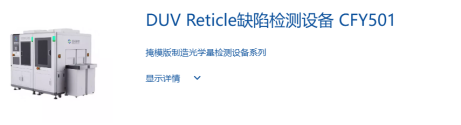
Chengfeng Technology completes nearly 100 million RMB Series B financing.​

Recently, Zhuhai Chengfeng Electronics Technology Co., Ltd., a semiconductor optical inspection equipment manufacturer, completed a nearly 100 million RMB Series B financing round, led by Qianhai Ark. Founded in 2015, Chengfeng Technology focuses on the R&D, production, and sales of semiconductor optical inspection equipment. It has independently developed multiple optical microscopy imaging technologies and mastered the core algorithms for image inspection across the entire stack. Its products are already in mass production and applied in wafer manufacturing, mask manufacturing, and optical module manufacturing. It is a specialized and innovative "little giant" enterprise.

1775151925218.png
1775151988564.png

Please, Log in or Register to view URLs content!
 

Kalum Pupeter

Junior Member
Registered Member

Bill to ban sale of key AI chipmaking equipment to China introduced in House​

The MATCH Act would tighten existing restrictions on a critical choke point for the AI industry, banning exports of certain manufacturing tools across China. A bipartisan group of lawmakers introduced a bill in the House of Representatives on Thursday morning that would severely limit the sale of advanced semiconductor manufacturing equipment to China and a selection of other countries, closing what experts say are critical loopholes in America’s AI export controls.

Led by Rep. Michael Baumgartner, R-Wash., the Multilateral Alignment of Technology Controls on Hardware (MATCH) Act would tighten existing export controls for semiconductor manufacturing equipment — the specialized tools used to create AI chips — if it were to become law. The new restrictions, along with cooperation from allies to implement similar rules, would be likely to curtail China’s ability to build a fully domestic AI supply chain.

China’s imports of semiconductor manufacturing machinery have surged in recent years in tandem with soaring demand for AI chips in China and around the globe. China's imports of the equipment grew from $10.7 billion in 2016 to about $51.1 billion last year, according to analysis from Silverado Policy Accelerator, a Washington, D.C., think tank that focuses on national security and AI. “China has made it abundantly clear that it intends to dominate the technologies that underpin both our economy and our national defense,” Baumgartner said in a statement. “The United States cannot afford to leave open back doors that allow the Chinese Communist Party to acquire the tools it needs to leap ahead in semiconductor manufacturing.”

The act would expand the types of chipmaking machines that are banned from being sold to China, further restrict sales of associated services and tools to China’s most important chip companies and engage key allies to implement similarly stringent restrictions to ensure the new rules have global force. “This is about protecting American workers, American innovation, and American security for the long haul,” Baumgartner said.

The bill, co-sponsored by the chairman of the House Select Committee on China, Rep. John Moolenaar, R-Calif., is the latest move in a yearslong push from officials and experts in Washington to limit the sale of chipmaking machines to China. Export controls on the sale of finished AI chips have also been
Please, Log in or Register to view URLs content!
, although the Trump administration has recently
Please, Log in or Register to view URLs content!
to China. Sen. Pete Ricketts, R-Neb., and Sen. Andy Kim, D-N.J., are set to introduce a similar bill in the Senate when it is next in session.

A handful of companies make the cutting-edge semiconductor manufacturing equipment needed to produce today’s leading AI chips, and most of them are based in the U.S., the Netherlands and Japan. As a result, semiconductor manufacturing equipment is a critical lever and source of power for the U.S. and its allies in the race to build powerful AI systems. “China has a stated intent to indigenize its semiconductor industry in the coming years, and what it lacks is the technology and the knowledge to produce the most advanced chips,” said Sarah Stewart, CEO of Silverado Policy Accelerator. “The United States, Japan, the Netherlands and a pocketful of other countries do have that knowledge.”

Chinese leaders have repeatedly singled out chip manufacturing as a pivotal issue for national security. In April,
Please, Log in or Register to view URLs content!
China should pursue “self-reliance and self-strengthening” for the country’s AI sector and called for renewed “focus on overcoming challenges regarding core technologies such as high-end chips.” Despite years of similar calls from top Chinese officials and
Please, Log in or Register to view URLs content!
to create their own chipmaking machines, China’s domestic chipmaking industry remains years behind American, Dutch and Japanese chipmaking abilities, according to experts.

Jeff Koch, a semiconductor manufacturing analyst at SemiAnalysis, a leading AI and chip research firm, said China’s industry lags “more than five years behind in terms of the equipment they’re able to produce” compared with leading Western companies. Chip designers and manufacturers try to squeeze as much computing power as possible onto each individual chip, fabricated on silicon wafers in a manufacturing process that relies on highly specialized equipment and requires thousands of intricate steps.

One part of the chipmaking process, called lithography, in which fine circuit patterns are transferred to silicon wafers, largely relies on machines from the Netherlands-based company ASML, according to
Please, Log in or Register to view URLs content!
from the House Select Committee on China. The U.S. has already implemented a China-wide export ban on the most advanced type of lithography machines, called extreme ultraviolet immersion lithography (EUV), that can manufacture the world’s most advanced AI chips. In May, then-
Please, Log in or Register to view URLs content!
the countrywide restrictions preventing any company within China from obtaining an EUV machine were the “single most important export control” related to AI.

However, previous rounds of export controls allowed sales of older, lower-grade machines that perform deep ultraviolet immersion lithography (DUV), which are capable of manufacturing very advanced — but not the most advanced — chips.
China has acquired hundreds of DUV machines from ASML over the past several years, and China was
Please, Log in or Register to view URLs content!
, representing 36% of net system sales, according to ASML’s figures. With those machines, Chinese chip manufacturers like Semiconductor Manufacturing International Corp. can
Please, Log in or Register to view URLs content!
of AI chips.

Experts like Stewart of Silverado argue that without stronger controls like those proposed in the bill, DUV tools could allow China to overcome restrictions on its ability to buy the highest-quality chips by simply creating more chips of lower quality, which could yield the same overall amount of computing power.

“If we are giving them the ability to scale technology just behind the cutting edge, we are doing as much of a disservice as we are if we just give them the most advanced manufacturing technology,” Stewart said.

At a minimum, the MATCH Act would enact a China-wide ban on the export of DUV machines and tools required to etch the pattern drawn by the machines. The act would also direct the secretary of state and officials in the Commerce Department to identify other critical "chokepoints" within 60 days after the bill's passage.

The bill would apply the same countrywide restrictions to other countries of concern, including Russia and Iran, though China’s AI industry stands out as the obvious target, according to experts.

Please, Log in or Register to view URLs content!
 

sunnymaxi

Colonel
Registered Member
Once upon a time a guy in the industry told me that the three things that would be "too difficult" to China to conquer are in order, lithography, metrology tools and implanters. Is pretty much safe to say that metrology and implanters are pretty much a done deal with lithography heading to a deepseek moment sooner than expected.​

Chengfeng Technology completes nearly 100 million RMB Series B financing.​

Recently, Zhuhai Chengfeng Electronics Technology Co., Ltd., a semiconductor optical inspection equipment manufacturer, completed a nearly 100 million RMB Series B financing round, led by Qianhai Ark. Founded in 2015, Chengfeng Technology focuses on the R&D, production, and sales of semiconductor optical inspection equipment. It has independently developed multiple optical microscopy imaging technologies and mastered the core algorithms for image inspection across the entire stack. Its products are already in mass production and applied in wafer manufacturing, mask manufacturing, and optical module manufacturing. It is a specialized and innovative "little giant" enterprise.

View attachment 172832
View attachment 172833

Please, Log in or Register to view URLs content!
literally China have 5-6 optical inspection tools manufacturers. and many of these companies tools currently verifying on advance nodes.

Jingce , Yiwu and Skyverse from Shanghai

Sicarrier and Angstrom-E from Shenzhen

one is from Suzhou city
 

Eventine

Senior Member
Registered Member
News like the MATCH Act simply illustrates the degree to which US government intelligence & deep area expertise have diverged from facts on the ground. A sweeping ban on DUVs would have been effective a decade ago, and may still have slowed down China five years ago, but doing it today is way too late and will only strengthen the hand of Chinese equipment makers. The EUV ban still has teeth, since China has yet to fully commercialize EUV technology, but the boat on DUV has sailed. It's like some of these US politicians and their "expert" consultants are operating with a five years' lag in intelligence, which you cannot afford to do in a high stakes sanctions game.
 
Top