Chinese semiconductor thread II

sunnymaxi

Colonel
Registered Member
There is currently no reliable news that Huahong/HLMC has completed a 16/14nm process. The only related incident was a mix-up last year when someone misheard 40nm as 14nm.
even in 2026 SMIC don't share their 7nm process and its revenue. we can only confirm their chips through techinsight and breakdown. officially there is no reliable info..

this is confirmed news that, they were working on FinFet process but October 2022 sanctions disrupted everything.

last year they hired Dr. Peng Bai from Intel, a veteran with 30 years old experience developing several nodes in Intel.
Please, Log in or Register to view URLs content!

actually Biren Technology and even Huawei working with them. we can verify once Biren release their chip. so wait till then.
 
Last edited:

tokenanalyst

Lieutenant General
Registered Member

Research on Multi-Frequency Vibration Dynamic Compensation Scheme for Electron Beam Inspection Equipment​

Abstract​

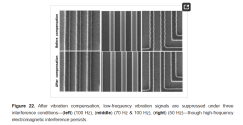
In the manufacturing process of advanced integrated circuits, electron beam inspection equipment is crucial for yield assurance, while vibration poses a core challenge affecting its precision and speed. Vibrations in production line equipment are mostly multi-frequency; However, research findings in this field remain limited. Moreover, existing compensation schemes often struggle to meet industrial-grade precision and real-time requirements. This paper presents the design and implementation of a high-speed electron beam vibration compensation system based on positioning. The system incorporates state-of-the-art laser positioning and electrostatic scanning deflectors, and features an integrated signal processing and compensation signal output module. The study involved improvements and optimizations to the positioning processing analysis and compensation module, control software and algorithms, and calibration software and algorithms, demonstrating superior performance compared to existing methods. System validation data demonstrates that the proposed scheme effectively compensates for both single-frequency and multi-frequency disturbances at frequencies below 200 Hz, achieving an average attenuation of 50% to 90% and a repetitive compensation accuracy of less than 0.3 nm. These metrics meet the industrial application requirements for electron beam inspection equipment. The overall error in long-term repeatability tests complies with the stability demands of industrial production lines, confirming its practical applicability in production environments.​

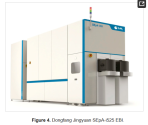
The experiments were conducted using Dongfang Jingyuan’s SEpA-i525 electron beam inspection (EBI) system (Dongfang Jingyuan Electron Co., Ltd., Beijing, China). This equipment, based on scanning electron microscope (SEM) technology, is designed for direct wafer pattern inspection in front-end integrated circuit (IC) manufacturing. A focused electron beam scans the wafer surface, and the resulting secondary and backscattered electrons are detected and converted into grayscale images that convey both topographical and electrical property information. Defects are identified by comparing image contrasts between different regions on the wafer.

In contrast to optical inspection, EBI provides superior resolution for identifying physical defects and possesses the unique capability to detect electrical defects, such as open circuits and leakage currents.
1773705253483.png1773705307950.png

Please, Log in or Register to view URLs content!
 

sunnymaxi

Colonel
Registered Member
even in 2026 SMIC don't share their 7nm process and its revenue. we can only confirm their chips through techinsight and breakdown. officially there is no reliable info..

this is confirmed news that, they were working on FinFet process but October 2022 sanctions disrupted everything.

last year they hired Dr. Peng Bai from Intel, a veteran with 30 years old experience developing several nodes in Intel.
Please, Log in or Register to view URLs content!

actually Biren Technology and even Huawei working with them. we can verify once Biren release their chip. so wait till then.
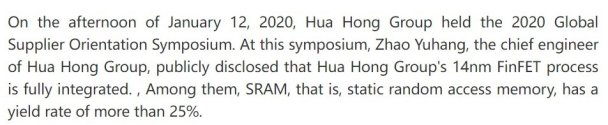
Huahong Group chief engineer back in 2020. 14nm development has completed. so it absolutely technical feasible for HH to develop 7nm node in 2025-26.

but they were unable to mass produce 14nm chips due to sanctions. but this issue has resolved now.

i don't know why some people think this is the big of a deal. no its pretty normal and down the line development process.

655555555555555555555555555.jpg
 
Last edited:

gotodistance

Junior Member
Registered Member
"The rise of semiconductors in China is the '虛張聲勢'. It looks plausible now, but as time goes by, you will get to know the real thing. The Chinese industry just waits and sees, but the semiconductor industry doesn't grow that way."

Yoo Hoi-joon, president of KAIST's Graduate School of Artificial Intelligence, was confident. Although there is a widespread sense of crisis that China will overtake Korea in as early as three to five years, Yoo flatly said, "For the time being, it will not surpass Korea's semiconductor technology." His view is that the technology gap between the two countries has been more than five years.

Regarding China, Yoo said, "Once I went to China's semiconductor industrial complex, I left all the lights on late at night, but when I went deep to go to the bathroom, I turned off all the lights inside," he said. "Be careful not to catch up but be scared." "When you meet the president of a Chinese semiconductor company, you think of semiconductors as products, not technologies. There are many people who try to sell them after doing enough," he added.


Please, Log in or Register to view URLs content!
 

tokenanalyst

Lieutenant General
Registered Member

Puyu Technology, a domestic high-end lithography equipment manufacturer, announced the completion of a financing round of hundreds of millions of yuan.​

On March 16, Puyu Technology, a domestic high-end lithography equipment company, announced the completion of a financing round of hundreds of millions of yuan. It is understood that the current shareholder lineup includes market-oriented investment institutions such as 01VC, BlueRun Ventures, Yuanhe Capital, Tsinghua Venture Capital, Qifu Capital, and Pufeng Capital, as well as several government investment platforms such as Yuanhe Holdings, Shanghai Science and Technology Innovation Fund, Science City Venture Capital, and State Development Venture Capital.
1773761890636.png

Public information shows that the company was founded on July 22, 2024. It is a high-tech enterprise that focuses on the research, development, production and industrialization of nanoimprint lithography equipment and is committed to providing high-quality micro-nano manufacturing solutions for the integrated circuit and semiconductor industries.

Wintop Semiconductor is a high-tech company integrating R&D, manufacturing, and sales of core semiconductor equipment. The company's products focus on the development and manufacturing of semiconductor process equipment, and are widely used in power devices, optoelectronic devices, MEMS, microwave RF, and other semiconductor and related manufacturing fields. The company has over 2,000 square meters of R&D and production facilities in Shenzhen, including dry-grade assembly and testing cleanrooms, and Class 100 and Class 10 laboratory cleanrooms.​

Please, Log in or Register to view URLs content!
 

tokenanalyst

Lieutenant General
Registered Member

With over 100 million yuan in funding, Jingjia Semiconductor is accelerating the industrialization of gallium nitride substrates.​

Recently, Shandong Jingjia Semiconductor Co., Ltd. successfully completed its Pre-A round of financing. This round of financing was supported by several well-known industry and investment institutions, including Shandong New Energy, Xingcheng Capital, Yuanchuang Duoying, Licheng Finance and Investment, and Beijing Xinqihang. The three existing shareholders, Jinan Industrial Development Venture Capital, Shenzhen Hechuang, and Jinan Industrial Development Integrated Circuit, continued to invest.
The funds raised in this round of financing will be primarily invested in expanding the production capacity and upgrading the technology of gallium nitride substrates, injecting strong core capital momentum into the localization process of wide bandgap semiconductor materials.
Breaking through the entire chain of technological challenges to disrupt the international monopoly.
Jingjia Semiconductor has long focused on the field of gallium nitride (GaN) self-supporting single crystal substrates. With the profound scientific research foundation of the National Key Laboratory of Crystal Materials of Shandong University, it has successfully developed a complete independent technology system, from large-size high-quality HVPE growth equipment to crystal growth and precision processing.
1773785547539.png
In its technological research and development journey, Jingjia Semiconductor has successfully overcome numerous key industry challenges. Currently, the company has achieved stable mass production of 2-inch gallium nitride (GaN) substrates, with product performance reaching international leading levels. Furthermore, Jingjia Semiconductor has successfully broken through 4-inch substrate technology, becoming one of the few domestic companies with mass production capabilities for 2-4 inch GaN substrates. These achievements have powerfully propelled China's rapid progress in breaking the international monopoly on large-size, high-quality GaN substrate technology.

Please, Log in or Register to view URLs content!
 

Kalum Pupeter

Junior Member
Registered Member
The sector, which provides the key material for
Please, Log in or Register to view URLs content!
, was expected to enter a critical stage of “accelerated breakthroughs and large-scale application” over the coming years, according to Fu Zhiwei, chairman of Xuzhou B&C Chemical, a major domestic supplier of photoresist. Fu, also a deputy to the National People’s Congress, told the South China Morning Post during the “two sessions” annual political gathering last week that the company aimed to achieve mass production of several core photoresist materials used in advanced processes within five years.

Photoresist, used in processes such as photolithography and photoengraving to form patterned coatings on surfaces, is a key input in chip manufacturing. The material is classified by exposure wavelengths, including broadband UV, G-line, I-line, KrF, ArF, EUV, and electron beam types. KrF, ArF, and EUV are the most advanced. While China has achieved a self-sufficiency rate of more than 20 per cent in older G-line and I-line photoresist used for power chips and LEDs, the
Please, Log in or Register to view URLs content!
including JSR, Tokyo Ohka Kogyo, Shin-Etsu Chemical, Fujifilm Electronic Materials and DuPont.

These foreign companies jointly accounted for nearly 95 per cent of the domestic market, with localisation rates for KrF and ArF photoresist as low as 3 per cent and less than 1 per cent, respectively, according to a Caitong Securities note citing data from the China Electronics Materials Industry Association.

For Xuzhou B&C Chemical, the primary objective was to achieve key breakthroughs in bottleneck areas – specifically KrF and ArF photoresist, according to Fu. “We will mobilise our most formidable resources to launch an all-out offensive in the development of high-end photoresist for more advanced process nodes,” he said. Fu said the company had achieved full-chain autonomy – spanning monomers, resins, photoacids, and end-product photoresist. Its KrF and ArF mid-to-high-end products had already “passed verification at leading foundries” and were beginning to scale up, he added. The company, with its research and development centre in Shanghai and production facilities in Xuzhou city, eastern Jiangsu province, is among a handful seen as China’s best hopes for achieving self-reliance in advanced photoresist. Nata Opto-electronic Material, which focuses on ArF photoresist, said in February that it had an annual production capacity of 50 tonnes and could maintain stable supply for its early-stage orders.
Other competitors in the sector include Shanghai Sinyang, Red Avenue, and Suzhou-based Jingrui. Most have made progress in entry-level materials and are now eyeing a share of the high-end market.

Please, Log in or Register to view URLs content!
 
Top