Chinese semiconductor thread II

tokenanalyst

Lieutenant General
Registered Member

The Rongke Technology Semiconductor Equipment R&D Project, with a total investment of 1 billion yuan, has commenced construction.​


The R&D and Intelligent Manufacturing Headquarters Project for Key Semiconductor Equipment of Rongke Technology is located east of Yaoxin Road and north of Dongtaihu Road in Hengjing Street, Wuzhong Taihu New City. It has a total investment of 1 billion yuan and covers an area of about 30.27 acres. It is expected to achieve an annual output value of 1.5 billion yuan after reaching full production capacity.

Please, Log in or Register to view URLs content!
 

tokenanalyst

Lieutenant General
Registered Member

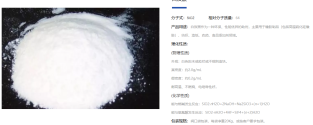
Do-Fluoride Chemicals: Current semiconductor-grade hydrofluoric acid production capacity is 40,000 tons/year​

Do-Fluoride Chemicals stated on its interactive platform that the company currently has an annual production capacity of 40,000 tons of semiconductor-grade hydrofluoric acid, and will release capacity according to market demand. The company's lithium hexafluorophosphate production line is currently operating at full capacity, with strong market demand, which is expected to continue its upward trend next year. In terms of demand, the market demand for lithium hexafluorophosphate is highly certain. The company's electronic-grade hydrofluoric acid, electronic-grade silanes, and other electronic chemicals, as well as boron isotope-related products, can meet the needs of high-end semiconductor applications.

Data shows that semiconductor-grade hydrofluoric acid is a high-purity aqueous solution of hydrogen fluoride (HF), and is one of the core wet electronic chemicals in semiconductor manufacturing. The unique characteristic of hydrofluoric acid lies in its selective etching ability towards silicon and silicon oxide (SiO₂)—it can rapidly dissolve SiO₂, but its etching rate towards elemental silicon is extremely low. This characteristic makes it an indispensable key material in semiconductor manufacturing. It is mainly used in core processes such as wafer cleaning, photoresist stripping, etching processes, silicon wafer fabrication, and advanced packaging.

1764602172000.png

Please, Log in or Register to view URLs content!
 

tokenanalyst

Lieutenant General
Registered Member

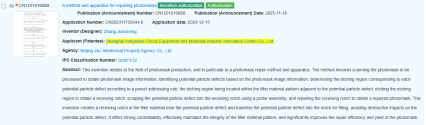
Qingyi Optoelectronics: The high-precision flat panel display photomask project at its Foshan Nanhai base is about to enter the mass production stage.​


Qingyi Optoelectronics stated on its interactive platform that the company's Foshan Nanhai production base held a production launch ceremony on November 14, 2025. The high-precision flat panel display mask project is about to enter the mass production stage, and the high-end semiconductor mask project is also in full swing preparing for mass production.

The high-precision flat panel display mask base mainly produces 8.6-generation and below high-precision FPD masks, especially filling the gap in domestic AMOLED high-precision masks and meeting the high-definition and flexible display needs of the 5G and AI era; the high-end semiconductor mask base focuses on the production of 180nm-28nm process semiconductor masks. The commissioning of the Foshan Nanhai production base will further expand the company's production scale.

According to public information, Qingyi Optoelectronics is a leading company in China's photomask industry. Founded in August 1997, it was transformed from Qingyi Precision Optoelectronics (Shenzhen) Co., Ltd., and was listed on the Shanghai Stock Exchange's Science and Technology Innovation Board on November 20, 2019. The company primarily engages in the R&D, design, production, and sales of photomasks. Its products are mainly used in flat panel displays, semiconductor chips, touch screens, and circuit boards, with downstream applications covering consumer electronics, automotive electronics, artificial intelligence, and other fields.

Please, Log in or Register to view URLs content!
 

tokenanalyst

Lieutenant General
Registered Member

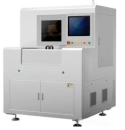
First Laser's TGV equipment is delivered in batches: a domestic packaging revolution on 1.8mm glass.​

Shoulai Laser has achieved a major industrial breakthrough with the mass delivery of its domestic TGV (Through-Glass Via) equipment, enabling high-precision processing of 1.8mm BF33 glass substrates a critical material for next-generation advanced packaging. Previously dominated by foreign suppliers, this technology has been a global challenge due to the extreme hardness and brittleness of BF33 glass, particularly when drilling micron-scale vias (6μm diameter) with a 10:1 depth-to-diameter ratio.

1764603802931.png

Key Technological Breakthroughs:
  • Ultra-high peak power lasers reduce crack rates to <0.01%.​
  • Innovative laser-chemical step etching achieves ±0.5μm dimensional accuracy and surface roughness Ra≤0.1μm — finer than a dust particle.​
  • Large-format 510×515mm processing system enables simultaneous processing of up to 200 chips, with 3x higher efficiency than imported machines.​
Competitive Advantages Over Imports:
  • Yield: >98% (2% higher than foreign equivalents).​
  • Cost: Unit processing cost reduced to 1/3 of imported equipment — now cheaper than a smartphone per hour.​
  • Delivery: Lead time slashed from 6 months to 45 days, with 24-hour on-site commissioning.​
1.8mm BF33 glass is now the industry benchmark for high-end applications like AI chip HBM stacking and MEMS vacuum packaging offering superior mechanical stability and thermal expansion matching compared to silicon-based TSVs, which suffer from high dielectric loss and thermal mismatch.

Shoulai Laser’s success marks China’s first complete closed-loop innovation in TGV core equipment breaking decades of foreign technological and supply chain dominance. This milestone transforms China’s advanced packaging industry from “import-dependent” to “self-reliant,” accelerating domestic semiconductor development and positioning China as a key player in the global race for next-gen chip packaging.

Please, Log in or Register to view URLs content!
 

swcc

New Member
Registered Member
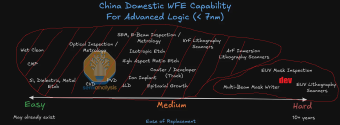
SemiAnalisys, yikes, they are the worst source for this kind of stuff.
SiCarrier Alone Already make most of the stuff in that list, let alone the other players.

View attachment 165490
What about GDDR SDRAMs? any generation, i've searched in this forum and it seems no chinese companies produce them? I've also searched elsewhere. Lisuan's GPU only use GDDR6. They need to make GDDR7, GDDR6, etc. Will cxmt produce them?
 

tphuang

General
Staff member
Super Moderator
VIP Professional
Registered Member
What about GDDR SDRAMs? any generation, i've searched in this forum and it seems no chinese companies produce them? I've also searched elsewhere. Lisuan's GPU only use GDDR6. They need to make GDDR7, GDDR6, etc. Will cxmt produce them?
As a new member on this forum, please understand that this is a heavily moderated thread to keep content quality high and your quality of posts have been pretty low so far. And you have explicitly responded to my post that have bolded red. That is a big no no to do so on this forum.

I would advise you at this point to take a pause from posting here and do a little more reading if you do not want to face further actions.
 
Top