2026 Iran War Strategy and Analysis

CasualObserver

Senior Member
Registered Member
Yes, beyond the West only China produces commercial TRMs available for Iran (Russian ones likely aren't for sale really, and in any case they would be more expensive). Chance Iran manufacturers its own TRMs, let's be frank, are very low.
I was under the impression that it was well established that Armenia's YerNIISS is the actual source of the TRMs used in Iranian AESA radar sets. That said, this could soon change as Armenia continues its rapprochement with the US, particularly given the trouble those radars have caused the USM, even if they have generally underperformed during the war and were easy to suppress...
 

Gloire_bb

Colonel
Registered Member
I was under the impression that it was well established that Armenia's YerNIISS is the actual source of the TRMs used in Iranian AESA radar sets. That said, this could soon change as Armenia continues its rapprochement with the US, particularly given the trouble those radars have caused the USM, even if they have generally underperformed during the war and were easy to suppress...
YerNIISS developed Najm-802 radar (MES-5). That line of evidence doesn't go any further than that.

They weren't and couldn't be a source of TRMs for either this or other Iranian radars,- that is not just beyond YerNISS, it's beyond Armenia itself, as it takes an industry which Armenia doesn't have at all. Iran does, and low power UHF TRMs aren't really inconceivable for local production.
The problem is demanding fire control ones, which Iran still produces a lot.
 

Anlsvrthng

Captain
Registered Member
.

Yes, Iran produced dozens/hundreds AESA sets across multiple families of its modern SAMs (Bavar, Arman, Zoubin, and some others without known name). Majid search radar, btw, is AESA too.

Yes, beyond the West only China produces commercial TRMs available for Iran (Russian ones likely aren't for sale really, and in any case they would be more expensive). Chance Iran manufacturers its own TRMs, let's be frank, are very low.

One fire control S band TRM will cost you several hundred bucks each, X band can be up to 8-10k each.
S band vol search radar will use several thousand, X band fire control - even for SHORAD will take at least high hundreds; multirole X band radars will also take thousands of X band ones.

Now please do some simple some math, and add that's just TRMs alone - while they're the major cost, there's also rest of the radar and SAM system, and it isn't free of charge.
Well, target for a radar maker is NOT to make AESA radar that can make weapon quality track, but to make ANY radar that is capable for it.

AESA benefit is after you mastered the GaN or GaAs is relativly simple : if you have mobile g4/g5 base and handset manufacturing capability OR you can order components from companies that has similar capability THEN you can fire the TWT technicians whom training takes years , and can orangise worker's union.

The taiwanese supliers will be happy to receive same rice to ship the AESA modules,and the unionised workers will be used as as energy absorbers for radar testing.
 

Black Wolf

Junior Member
Registered Member
The UAE's plan for "Zero Hormuz Dependency" — can it realistically be achieved?

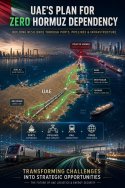
The infographic below outlines a strategy aimed at minimizing the UAE's reliance on the Strait of Hormuz by strengthening alternative export & logistics routes through the Gulf of Oman.

Key components include:

• Expansion of Fujairah, Khor Fakkan, and Dibba ports
• Additional oil and energy pipeline capacity
• Greater rail connectivity across the country
• Enhanced trade and logistics infrastructure linking energy hubs to eastern ports

If successfully implemented, these measures could improve the UAE's resilience against disruptions in the Strait of Hormuz. However, can they fully replace the strategic importance of one of the world's most critical maritime chokepoints?

What are the biggest obstacles—economic, logistical, or geopolitical—to achieving true "zero Hormuz dependency"?


1781961366378.jpg
 

tamsen_ikard

Captain
Registered Member
The UAE's plan for "Zero Hormuz Dependency" — can it realistically be achieved?

The infographic below outlines a strategy aimed at minimizing the UAE's reliance on the Strait of Hormuz by strengthening alternative export & logistics routes through the Gulf of Oman.

Key components include:

• Expansion of Fujairah, Khor Fakkan, and Dibba ports
• Additional oil and energy pipeline capacity
• Greater rail connectivity across the country
• Enhanced trade and logistics infrastructure linking energy hubs to eastern ports

If successfully implemented, these measures could improve the UAE's resilience against disruptions in the Strait of Hormuz. However, can they fully replace the strategic importance of one of the world's most critical maritime chokepoints?

What are the biggest obstacles—economic, logistical, or geopolitical—to achieving true "zero Hormuz dependency"?


View attachment 176947

Those UAE ports are equally close to Iran compared to Hormuz. Iran can easily blockade these ports using drones and mines. They can destroy port facilities with Missiles.

The Issue is not Hormuz, the issue is proximity to Iran. They can see ships coming using drones and satellites and they can sink them. That is the blockade. Doesn't matter whether there is a chokepoint or not.
 

Black Wolf

Junior Member
Registered Member
Those UAE ports are equally close to Iran compared to Hormuz. Iran can easily blockade these ports using drones and mines. They can destroy port facilities with Missiles.

The Issue is not Hormuz, the issue is proximity to Iran. They can see ships coming using drones and satellites and they can sink them. That is the blockade. Doesn't matter whether there is a chokepoint or not.

That's a valid perspective & one of the reasons I posed it as a question rather than a conclusion.

While the UAE may be able to reduce its reliance on the Strait of Hormuz as a chokepoint, that doesn't automatically eliminate the broader security challenge posed by proximity to Iran.

The real question may be whether "zero Hormuz dependency" translates into meaningful strategic resilience, or whether Iranian missile, drone & maritime capabilities simply shift the vulnerability elsewhere.
 

Nilou

New Member
Registered Member
The pipelines are already economically viable as they reduce shipping costs. If UAE oil can skip the strait it increases the costs of iran stopping uae oil shipments drastically, as they will need to actively bomb uae territory. They will not have worldwide support, as they would clearly be aggressors in that situation.
 

another505

Junior Member
Registered Member
While ports outside of the strait and pipes help reducing reliance, as other member noted. Drones and rockets can shut them down.

However, it is a lot harder to do it than just closer the strait and I imagine GCC will be more prepared next time, hence Iran really needs to push for their best deal for this war. The advantages of drone attack will balance out over time as defenses and tactics improve.
 

Nilou

New Member
Registered Member
Problem for Iran now is that any further strait closing actually annoys the rest of the world too. The first closing was justified, as the US started it by bombing Iran. But any further closings of the strait need to be properly justified. Lebannon alone as a cause is insufficient, and as it is going, Iran is rapidly consuming the credibility they gained in the past few months.
 

tamsen_ikard

Captain
Registered Member
Problem for Iran now is that any further strait closing actually annoys the rest of the world too. The first closing was justified, as the US started it by bombing Iran. But any further closings of the strait need to be properly justified. Lebannon alone as a cause is insufficient, and as it is going, Iran is rapidly consuming the credibility they gained in the past few months.
And what the annoyed rest of the world is gonna do to Iran??

Bomb them more? Kill more leaders? Destroy more infra?

You people dont realize that there is absolutely nothing the world can do to Iran anymore that they have not already suffered. They have seen the abyss.

Its now time for the world pay back.

Iran will make sure the rest of the world suffers for not doing anything to stop US from attacking it.

I dont think Iran will stop until they create a real crisis due to oil shortage. Only then they will get what they want. Real concessions this time
 
Top