Chinese Economics Thread

abenomics12345

Junior Member
Registered Member
Lmao do you people not check the YoY comparable figures? Very simple questions to ask when looking at monthly data:

- When did the food delivery fight kick off in 2025? Now that the food delivery fight has eased, what does that do to underlying demand now that coupons are not as plentiful (i.e higher prices)?
- When did the car purchase subsidies kick off?
- When did tax breaks get taken away?
- Do car purchases 'invent new demand' or just pull forward demand?

("Hmm I'm thinking of buying a car in the next year or two oh nice there's a subsidy let me buy it now")

The monthly data thus far is pretty meaningless given all the one time adjustments, but that being said there is no mental gymnastics around the
Please, Log in or Register to view URLs content!
that took a negative turn in the recent months.

The issue is right now is that the people who are minting money (whoever yolo'd into Zhongji Innolight a year ago) are absolutely minting whereas the people not doing so great (
Please, Log in or Register to view URLs content!
) are not getting better. The K-shaped economy that you all vividly experience outside of China is not....significantly better inside.

Real estate is perhaps the only thing that's seeing some stabilization at the edges.

The economic growth target has been set - take the export growth and contribution to GDP growth as an input, then government will use fiscal policy to backfill the rest to solve for the target.

The most effective policy is enforcing a higher national minimum wage, even if they lose some jobs to outsourcing it would be worth it. China still has many options, they are aiming to become a developed country by 2050, Im excited to see how it turns out
If you enforce a national minimum wage, what's going to happen is that firms especially small firms will start to hire less and less formal workers and more and more temporary workers. If you actually study what happened in Japan this is actually the wrong medicine for the right issue (wages need to grow).

They really need to do something about their stock market or they will (or may be planning to?) forgo any viable wealth building in the country. Bonds suck because the currency is kept low and even if they let it appreciate, it won't give as good returns. Real estate is off the list. There's two choices left: Invest in the Chinese stock market which sucks and is super risky, or funnel your money out of China to invest in the West. China keeps putting more and more capital controls so it seems like they're looking to force people to invest in the Chinese stock market. But they're doing this without making the stock market investible before hand. So really there is nothing. If China does not figure out a reliable and efficient way to build wealth then people will only continue to funnel there money out no matter what. It is simply much better to grow your money outside of China than inside and people will ALWAYS find a way. Hard decisions will have to be made like relaxing government interference.

Since Sept 2024 the CSI300 is up 52%, 1 year its up 26%, and YTD is up ~3% despite heavy national team selling to keep the market from going up too much.

ChiNext +100% in 1 year and +26% YTD due to heavy technology/export exposure.

I would expect more QDII quota to be opened up while shutting down grey channels of offshoring money.
 
Last edited:

zbb

Senior Member
Registered Member
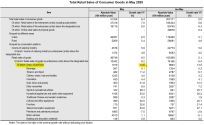
If you further breakdown consumer demand to each segment, the result is not good at face value:

In May, among the retail sales of enterprises above the designated size, the year-on-year growth rates for grain, oil and food was 1.9% (-2.2%), beverages 6.1% (+2.5%), tobacco and alcohol 4.8% (-6.9%), and daily necessities 1.6% (-1.9%) respectively.

The most concerning part for me was grain, oil and food consumption drawback, which may indicate reduce of calories intake.
Retail sales of grain, oil, and food grew 1.9% YoY in May 2026. That is growth, not reduction. The negative numbers you showed in parentheses appear to be the differences in the YoY growth rates of
Please, Log in or Register to view URLs content!
and
Please, Log in or Register to view URLs content!
.

YoY growth rates in retail sales in May 2026 are low because of the very high retail sales in May 2025 due to the consumer stimulus. For example, the YoY growth of 1.9% for grain, oil, and food in May 2026 comes on top of a YoY growth of 14.6% in May 2025. Many categories had YoY growth above 20% in May 2025, which makes further growth in 2026 difficult due to the very high base.

1781659528484.png
 
Last edited:

tokenanalyst

Lieutenant General
Registered Member
They really need to do something about their stock market or they will (or may be planning to?) forgo any viable wealth building in the country. Bonds suck because the currency is kept low and even if they let it appreciate, it won't give as good returns. Real estate is off the list. There's two choices left: Invest in the Chinese stock market which sucks and is super risky, or funnel your money out of China to invest in the West. China keeps putting more and more capital controls so it seems like they're looking to force people to invest in the Chinese stock market. But they're doing this without making the stock market investible before hand. So really there is nothing. If China does not figure out a reliable and efficient way to build wealth then people will only continue to funnel there money out no matter what. It is simply much better to grow your money outside of China than inside and people will ALWAYS find a way. Hard decisions will have to be made like relaxing government interference.
There is a lot development that is being done. In the interior winch is growing as fast a coastal cities or even faster in cases. places the use to be villages now are cities and industrial hubs. Then is technological upgrade in their industry and services that China is unprecedented and is enormous. China is creating new industries that didn´t existed in the country 10 years ago at a pretty high rate. Even agriculture has totally change that is even attracting young people in the field again.
 

tokenanalyst

Lieutenant General
Registered Member
Lmao do you people not check the YoY comparable figures? Very simple questions to ask when looking at monthly data:

- When did the food delivery fight kick off in 2025? Now that the food delivery fight has eased, what does that do to underlying demand now that coupons are not as plentiful (i.e higher prices)?
- When did the car purchase subsidies kick off?
- When did tax breaks get taken away?
- Do car purchases 'invent new demand' or just pull forward demand?

("Hmm I'm thinking of buying a car in the next year or two oh nice there's a subsidy let me buy it now")

The monthly data thus far is pretty meaningless given all the one time adjustments, but that being said there is no mental gymnastics around the
Please, Log in or Register to view URLs content!
that took a negative turn in the recent months.

The issue is right now is that the people who are minting money (whoever yolo'd into Zhongji Innolight a year ago) are absolutely minting whereas the people not doing so great (
Please, Log in or Register to view URLs content!
) are not getting better. The K-shaped economy that you all vividly experience outside of China is not....significantly better inside.

Real estate is perhaps the only thing that's seeing some stabilization at the edges.

The economic growth target has been set - take the export growth and contribution to GDP growth as an input, then government will use fiscal policy to backfill the rest to solve for the target.


If you enforce a national minimum wage, what's going to happen is that firms especially small firms will start to hire less and less formal workers and more and more temporary workers. If you actually study what happened in Japan this is actually the wrong medicine for the right issue (wages need to grow).
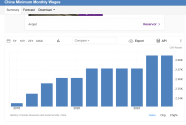
China minimum wages has been rising and that couple with lower inflation and lower overall costs.

1781660238277.png
 

abenomics12345

Junior Member
Registered Member
China minimum wages has been rising and that couple with lower inflation and lower overall costs.

View attachment 176731
You're mistaking the index of minimum wage used for calculating social security contribution with an actual legal minimum wage where you get fined if you don't pay. Very different things.

very high retail sales in May 2025 due to the consumer stimulus.
Not consumer stimulus. Food delivery fight launched by JD...
 

zbb

Senior Member
Registered Member
Dude before writing crap you should put some facts in your words.
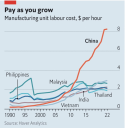
China wages has increased steadily year by year much much higher than India or even Mexico that is why Western media believed that China manufacturing was not going to survive because manufacturing wages has risen constantly.
View attachment 176726
China did the largest manufacturing upgrade ever from clean tech to semiconductors to high tech services, China has consistently risen in the innovation index that no only measure academic output but also high tech high quality industrial output. Why you think the Europeans feel so threaten by China. For toys? is cars, ICs, bio tech, high end chemicals made in China.
View attachment 176727

Housing prices in the US have to fall 40% just to be affordable again, the US have two options, they can continue with the bubble injecting money into a money pit and seeing the US cities becoming Fabelas OR they can take the economic hit now. There are no good options because the problem has continue for too long. The Chinese government decided that the bubble was too dangerous and was better to take the hit when their economic grow is higher than later.
You cant price out and ruin future generations <if you want women to have more kids> just to keep some old people rich. House prices should be determined by market demand and no Central Bank money.
View attachment 176728
Landspace and other space companies in China have platforms assigned their platforms in regions to make sure that their endeavors is done safety and without polluting people lands. Chinese government doesn´t
1781660763329.png
 

zbb

Senior Member
Registered Member
Not consumer stimulus. Food delivery fight launched by JD...
Food delivery fight contributed to the high growth in food in May 2025 but does not explain the 53% increase in retail sales of household appliances and audio-video equipment in May 2025 (as well as large increases in many other categories not related to food).
 
Last edited:

tokenanalyst

Lieutenant General
Registered Member
You're mistaking the index of minimum wage used for calculating social security contribution with an actual legal minimum wage where you get fined if you don't pay. Very different things.
Minimum wage is the legal wage as far I understand, IF you can find people willing to work for that and even if not centralized the average is around the graph. China economy is not as centralize as many people think.
 

lockedemosthenes1

New Member
Registered Member
I'm just asking a question to those people on this forum who frequently discuss minimum wage standards, residents' living standards, and "sluggish consumption": Before 1941, would it really have been rational for the United States to keep pouring resources into improving the national standard of living?

Similarly, given that regional conflicts will soon come knocking at the door, is it truly rational for China to devote massive resources to stimulating births, boosting consumption, improving labor conditions, and raising residents' living standards?

Or, to put it bluntly and offensively: Even if no regional conflicts were coming, why not take certain measures (such as the previous sanctions on Japan), just like how the United States cut off strategic material trade with Japan before 1941, to deliberately create regional conflicts — enabling China to expand into a world empire? This way, it could avoid the "dynastic cycle," the very problem that ensures the goals of those who constantly clamor to solve economic difficulties by improving domestic living standards and labor protections can never be achieved.

Why should a country put the short-term well-being of its people first?
 

Mar ling

New Member
Registered Member
I'm just asking a question to those people on this forum who frequently discuss minimum wage standards, residents' living standards, and "sluggish consumption": Before 1941, would it really have been rational for the United States to keep pouring resources into improving the national standard of living?

Similarly, given that regional conflicts will soon come knocking at the door, is it truly rational for China to devote massive resources to stimulating births, boosting consumption, improving labor conditions, and raising residents' living standards?

Or, to put it bluntly and offensively: Even if no regional conflicts were coming, why not take certain measures (such as the previous sanctions on Japan), just like how the United States cut off strategic material trade with Japan before 1941, to deliberately create regional conflicts — enabling China to expand into a world empire? This way, it could avoid the "dynastic cycle," the very problem that ensures the goals of those who constantly clamor to solve economic difficulties by improving domestic living standards and labor protections can never be achieved.

Why should a country put the short-term well-being of its people first?
Not to mention, an explosion in the AI bubble would make all of these efforts go to zero. Using one country's force to combat the global downward cycle is unreasonable.
 
Top