Having cheaper education or health care is not nearly good enough. They need to give real safety nets, safe methods to build wealth, and increase wages. I don’t see another way. Stimulus is just a temporary treatment like painkillers. It can make you feel like you’re healing for the short term but won’t fix the actual problem.

You are using an out of date browser. It may not display this or other websites correctly.
You should upgrade or use an alternative browser.
You should upgrade or use an alternative browser.
Chinese Economics Thread
- Thread starter Norfolk
- Start date

manqiangrexue
Brigadier
LOL Half jokingly, this might be the solution to the West bragging about being so important as consumers. Heavily jack up everybody's tax in China and make everything free! Been 8 years, you get your free family car upgrade! New generation of refrigerators/TVs/Laptops come out? Free upgrades for everyone at a pace dependent on your taxable income bracket. Every Chinese New Year, people get their free New Years bundle; just go the the government website and pick your X number of items, X being dependent on your tax bracket. On top of that, convert a modest portion of the taxed income into credits each month that expire in 30 days if not spent. See how long it takes for the West to realize that being able to buy Chinese goods with their fiat money was their honor and privelige, not their irreplacable role.No good. Chinese people are pathological savers. Poor Chinese people doubly so because they need to be.
Better IMHO for the govt to mandate or subsidize larger housing for larger families, bigger cars for bigger families, free education including after class tuition, completely free health care, increased pensions and a state funded bride price at a fixed rate while banning the acceptance of bride price from the groom or anyone else. If there are no essentials to save for, every cent earned is pure spending money. Then people will stop saving. Maybe.
Yeah, they're pathological savers because people who experienced extreme famine are still very much alive, not to mention those who lived through less severe poverty. And even all that saving won't save them from shit like this.No good. Chinese people are pathological savers. Poor Chinese people doubly so because they need to be.
Better IMHO for the govt to mandate or subsidize larger housing for larger families, bigger cars for bigger families, free education including after class tuition, completely free health care, increased pensions and a state funded bride price at a fixed rate while banning the acceptance of bride price from the groom or anyone else. If there are no essentials to save for, every cent earned is pure spending money. Then people will stop saving. Maybe.
The Chinese parents dancing on live streams to help their children fight cancer
Parents of young cancer patients are learning to dance while live-streaming so they can earn money to help cover astronomical treatment costs.
Every night, a group of parents in Shandong live-stream themselves dancing for hours until they can no longer keep going. Their children are patients at Shandong Cancer Hospital, and many are in an advanced stage of their illnesses. Cancer treatments in China can often cost hundreds of thousands of yuan. So, for these parents, dancing for an online audience at night has become one of the few ways they can raise money and still be able to spend most of their daytime hours tending to their sick kids.
Last edited:

manqiangrexue
Brigadier
Not really; this is the Western economist's preferred excuse to make their financial irresponsibility look good. Chinese people everywhere, including in the West, people who earn top salaries, typically save more because Chinese culture considers it irresponsible to spend frivolously (except on special occasions). Even ABCs who have never lived in China in households supported by doctors like to shop for the best deals, re-use zipper bags, use grocery bags instead of buying trash bags, etc... As Russel Peters once said, Indians are cheap because they don't hear "cheap," they hear, "smart." That's a Chinese thing too. As a matter of fact, I think a survey showed that the cheapest Americans are those who are knocking in the millionaire range; any lower and they've given up accumulating wealth and any higher and savings won't be significant compared to earnings. The just around millionaire range are the people who want to accumulate wealth and living cheap does a noticeable part.Yeah, they're pathological savers because people who experienced extreme famine are still very much alive, not to mention those who lived through less severe poverty.
What's the point of this remark? Life-changing disease is destructive to deal with anywhere. Most Americans can't even foot a surprise $1K bill.And even all that saving won't save them from shit like this.

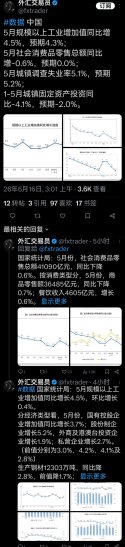
If you further breakdown consumer demand to each segment, the result is not good at face value:View attachment 176713
Consumer demand went down after going up a bit in Apirl while fixed asset investment in cities and town crashed -4.1 percent while unemployment rate reached 5.1 percent.
In May, among the retail sales of enterprises above the designated size, the year-on-year growth rates for grain, oil and food was 1.9% (-2.2%), beverages 6.1% (+2.5%), tobacco and alcohol 4.8% (-6.9%), and daily necessities 1.6% (-1.9%) respectively.
The most concerning part for me was grain, oil and food consumption drawback, which may indicate reduce of calories intake.
You need to look at the food prices before drawing the conclusion.If you further breakdown consumer demand to each segment, the result is not good at face value:
In May, among the retail sales of enterprises above the designated size, the year-on-year growth rates for grain, oil and food was 1.9% (-2.2%), beverages 6.1% (+2.5%), tobacco and alcohol 4.8% (-6.9%), and daily necessities 1.6% (-1.9%) respectively.
The most concerning part for me was grain, oil and food consumption drawback, which may indicate reduce of calories intake.
When I was in China in May, I noticed that the mom and pop eateries were pricing their dishes almost exactly the same as they did two years ago. For 12 yuans, I got a large bowl of my favourite rice noodles in broth with beef slices for breakfast. I could also choose lamb or chicken instead. For extra noodle or a braised egg, 2 yuans. To add a big chunk of pork rib, 6 yuans. Boiled soy juice and pickles were free and unlimited for all. For what I saw, they, and their next door neighbours on both sides, had plenty of local patrons during the morning hours.
Same as in many other Chinese cities, the good old days have been long in the past for the fancier, more expensive restaurants in downtown area. They have been relying on heavy discounts to keep the business going. For example, my local family members were using coupons they bought on Mei Tuan every time they took me out for dinner. On a weekday we were at a Quan Ju De for the roasted duck, they got like 40% off of the listed price on the bill. The place was perhaps two thirds full.
I heard the locals whining about things from the abandoned high rise constructions to their lying flat kids, but food affordability was not never a topic.
Please dont ban me for this rant.If you further breakdown consumer demand to each segment, the result is not good at face value:
In May, among the retail sales of enterprises above the designated size, the year-on-year growth rates for grain, oil and food was 1.9% (-2.2%), beverages 6.1% (+2.5%), tobacco and alcohol 4.8% (-6.9%), and daily necessities 1.6% (-1.9%) respectively.
The most concerning part for me was grain, oil and food consumption drawback, which may indicate reduce of calories intake.
A large part of consumer behavior depends on people’s perception of the economic outlook. In China, the government has struggled to maintain confidence and optimism among consumers and investors. When it has intervened in the economy, it has often done so to restrain the expansion of private enterprises such as Alibaba and Ant Financial. While some of the concerns behind these interventions were understandable, they also created the perception that there is a ceiling on what private companies can achieve. As a result, entrepreneurial confidence and investment enthusiasm have been dampened.
Many Chinese citizens themselves have come to believe negative narratives about the country’s future, including concerns about the property bubble, demographic decline, involution, and the perceived inferiority of Chinese products. However, one of the largest drags on confidence is the persistent undervaluation of Chinese companies. Chinese firms generally trade at much lower price-to-earnings ratios than comparable Western firms because investors remain uncertain about the security of their assets, supply chains, and market access.
Part of this problem stems from geopolitical competition. The United States has repeatedly demonstrated its willingness to protect its strategic industries and companies. By contrast, many Chinese firms face significant external constraints. TikTok, for example, has been forced to restructure its operations outside China, with substantial portions of the value it generates residing abroad. Similarly, companies such as Unitree, CXMT, and YMTC are technological leaders in their respective sectors, yet their ability to attract capital and achieve valuations comparable to Western peers remains limited.
Consequently, weak consumer confidence is not solely a domestic economic issue. It is also tied to the government’s cautious treatment of the private sector and its inability to project confidence in the face of increasing geopolitical pressure.
A second challenge is China’s overly cautious economic and geopolitical strategy. China performed exceptionally well during periods of relative geopolitical stability, but it has appeared less prepared to respond to a more adversarial environment. Huawei lost access to TSMC’s advanced manufacturing capabilities in 2019. Chinese supply chains have faced disruptions related to Russian and Iranian oil, Australian minerals, and access to strategic resources in Africa. While China has demonstrated resilience, it often appears reactive rather than proactive in addressing these challenges.
This raises the question of why China has not invested much more aggressively in strategic sectors that could drive future growth and technological leadership. Areas such as reusable rockets, commercial space launch infrastructure, advanced semiconductor manufacturing, and other frontier industries could potentially absorb hundreds of billions of dollars in investment while generating optimism and high-value employment.
Housing policy represents another missed opportunity. China has largely focused on dense urban apartment development, but many people aspire to own detached homes with private land, gardens, and greater personal space. The desire for suburban-style housing is strong in many societies because homeownership often encourages long-term spending and investment in communities. Given China’s vast land area, it may be possible to expand such development while protecting prime agricultural land. A broader range of housing options could potentially stimulate demand and support the property sector in a more sustainable way.
Demographics present another major challenge. China’s declining birth rate continues to weigh on long-term economic expectations. Immigration could help alleviate some of these pressures. Opening the country to greater immigration from neighboring countries could supplement the working-age population, fill essential labor shortages, and strengthen economic ties with neighboring states. For example, workers from countries such as Myanmar could contribute to sectors requiring labor-intensive work, while Chinese workers could increasingly move into higher-skilled occupations. Such an approach could provide both economic and strategic benefits.
Another structural issue is the concentration of decision-making authority. A highly centralized system can be effective when policies are correct, but it can make course corrections more difficult when mistakes occur. The COVID-19 response illustrates this challenge. While strict restrictions likely prevented many deaths, they also reduced economic activity, disrupted business confidence, and may have reduced incentives for vaccination uptake. Once conditions changed, policy adjustments came relatively slowly.
Beyond the major cities, there are also visible opportunities for infrastructure and urban renewal. Many suburban and smaller urban areas contain deteriorating housing, roads requiring repair, insufficient pedestrian infrastructure, and underdeveloped public spaces. Large-scale urban and suburban renovation projects could have provided a substantial source of economic activity while improving living standards. Yet the government has struggled to generate optimism around such initiatives.
Taken together, these issues suggest that China’s economic slowdown is not simply the result of cyclical factors. It reflects a combination of declining consumer confidence, private-sector caution, demographic pressures, geopolitical headwinds, and policy choices. While Xi Jinping’s leadership has emphasized stability, security, and long-term national objectives, critics argue that excessive caution has prevented more decisive action in several key areas.
Examples often cited include the inability to stabilize the birth rate, restore confidence in the property market, manage the fallout from the regulatory crackdown on major technology firms, and address the international backlash associated with Xinjiang policies. Critics argue that these decisions have imposed substantial economic and reputational costs without producing proportional benefits.
China remains a highly capable economy with significant strengths in manufacturing, infrastructure, and technology. However, restoring consumer confidence may require more than economic stimulus alone. It may require a renewed sense of optimism about private enterprise, greater flexibility in policymaking, stronger support for innovation, and a clearer strategy for navigating an increasingly competitive geopolitical environment.

Please dont ban me for this rant.
A large part of consumer behavior depends on people’s perception of the economic outlook. In China, the government has struggled to maintain confidence and optimism among consumers and investors. When it has intervened in the economy, it has often done so to restrain the expansion of private enterprises such as Alibaba and Ant Financial. While some of the concerns behind these interventions were understandable, they also created the perception that there is a ceiling on what private companies can achieve. As a result, entrepreneurial confidence and investment enthusiasm have been dampened.
Many Chinese citizens themselves have come to believe negative narratives about the country’s future, including concerns about the property bubble, demographic decline, involution, and the perceived inferiority of Chinese products. However, one of the largest drags on confidence is the persistent undervaluation of Chinese companies. Chinese firms generally trade at much lower price-to-earnings ratios than comparable Western firms because investors remain uncertain about the security of their assets, supply chains, and market access.
Part of this problem stems from geopolitical competition. The United States has repeatedly demonstrated its willingness to protect its strategic industries and companies. By contrast, many Chinese firms face significant external constraints. TikTok, for example, has been forced to restructure its operations outside China, with substantial portions of the value it generates residing abroad. Similarly, companies such as Unitree, CXMT, and YMTC are technological leaders in their respective sectors, yet their ability to attract capital and achieve valuations comparable to Western peers remains limited.
Consequently, weak consumer confidence is not solely a domestic economic issue. It is also tied to the government’s cautious treatment of the private sector and its inability to project confidence in the face of increasing geopolitical pressure.
A second challenge is China’s overly cautious economic and geopolitical strategy. China performed exceptionally well during periods of relative geopolitical stability, but it has appeared less prepared to respond to a more adversarial environment. Huawei lost access to TSMC’s advanced manufacturing capabilities in 2019. Chinese supply chains have faced disruptions related to Russian and Iranian oil, Australian minerals, and access to strategic resources in Africa. While China has demonstrated resilience, it often appears reactive rather than proactive in addressing these challenges.
This raises the question of why China has not invested much more aggressively in strategic sectors that could drive future growth and technological leadership. Areas such as reusable rockets, commercial space launch infrastructure, advanced semiconductor manufacturing, and other frontier industries could potentially absorb hundreds of billions of dollars in investment while generating optimism and high-value employment.
Housing policy represents another missed opportunity. China has largely focused on dense urban apartment development, but many people aspire to own detached homes with private land, gardens, and greater personal space. The desire for suburban-style housing is strong in many societies because homeownership often encourages long-term spending and investment in communities. Given China’s vast land area, it may be possible to expand such development while protecting prime agricultural land. A broader range of housing options could potentially stimulate demand and support the property sector in a more sustainable way.
Demographics present another major challenge. China’s declining birth rate continues to weigh on long-term economic expectations. Immigration could help alleviate some of these pressures. Opening the country to greater immigration from neighboring countries could supplement the working-age population, fill essential labor shortages, and strengthen economic ties with neighboring states. For example, workers from countries such as Myanmar could contribute to sectors requiring labor-intensive work, while Chinese workers could increasingly move into higher-skilled occupations. Such an approach could provide both economic and strategic benefits.
Another structural issue is the concentration of decision-making authority. A highly centralized system can be effective when policies are correct, but it can make course corrections more difficult when mistakes occur. The COVID-19 response illustrates this challenge. While strict restrictions likely prevented many deaths, they also reduced economic activity, disrupted business confidence, and may have reduced incentives for vaccination uptake. Once conditions changed, policy adjustments came relatively slowly.
Beyond the major cities, there are also visible opportunities for infrastructure and urban renewal. Many suburban and smaller urban areas contain deteriorating housing, roads requiring repair, insufficient pedestrian infrastructure, and underdeveloped public spaces. Large-scale urban and suburban renovation projects could have provided a substantial source of economic activity while improving living standards. Yet the government has struggled to generate optimism around such initiatives.
Taken together, these issues suggest that China’s economic slowdown is not simply the result of cyclical factors. It reflects a combination of declining consumer confidence, private-sector caution, demographic pressures, geopolitical headwinds, and policy choices. While Xi Jinping’s leadership has emphasized stability, security, and long-term national objectives, critics argue that excessive caution has prevented more decisive action in several key areas.
Examples often cited include the inability to stabilize the birth rate, restore confidence in the property market, manage the fallout from the regulatory crackdown on major technology firms, and address the international backlash associated with Xinjiang policies. Critics argue that these decisions have imposed substantial economic and reputational costs without producing proportional benefits.
China remains a highly capable economy with significant strengths in manufacturing, infrastructure, and technology. However, restoring consumer confidence may require more than economic stimulus alone. It may require a renewed sense of optimism about private enterprise, greater flexibility in policymaking, stronger support for innovation, and a clearer strategy for navigating an increasingly competitive geopolitical environment.
Should be banned for llm posting.
You should be banned for posting that garbage.Please dont ban me for this rant.
A large part of consumer behavior depends on people’s perception of the economic outlook. In China, the government has struggled to maintain confidence and optimism among consumers and investors. When it has intervened in the economy, it has often done so to restrain the expansion of private enterprises such as Alibaba and Ant Financial. While some of the concerns behind these interventions were understandable, they also created the perception that there is a ceiling on what private companies can achieve. As a result, entrepreneurial confidence and investment enthusiasm have been dampened.
Many Chinese citizens themselves have come to believe negative narratives about the country’s future, including concerns about the property bubble, demographic decline, involution, and the perceived inferiority of Chinese products. However, one of the largest drags on confidence is the persistent undervaluation of Chinese companies. Chinese firms generally trade at much lower price-to-earnings ratios than comparable Western firms because investors remain uncertain about the security of their assets, supply chains, and market access.
Part of this problem stems from geopolitical competition. The United States has repeatedly demonstrated its willingness to protect its strategic industries and companies. By contrast, many Chinese firms face significant external constraints. TikTok, for example, has been forced to restructure its operations outside China, with substantial portions of the value it generates residing abroad. Similarly, companies such as Unitree, CXMT, and YMTC are technological leaders in their respective sectors, yet their ability to attract capital and achieve valuations comparable to Western peers remains limited.
Consequently, weak consumer confidence is not solely a domestic economic issue. It is also tied to the government’s cautious treatment of the private sector and its inability to project confidence in the face of increasing geopolitical pressure.
A second challenge is China’s overly cautious economic and geopolitical strategy. China performed exceptionally well during periods of relative geopolitical stability, but it has appeared less prepared to respond to a more adversarial environment. Huawei lost access to TSMC’s advanced manufacturing capabilities in 2019. Chinese supply chains have faced disruptions related to Russian and Iranian oil, Australian minerals, and access to strategic resources in Africa. While China has demonstrated resilience, it often appears reactive rather than proactive in addressing these challenges.
This raises the question of why China has not invested much more aggressively in strategic sectors that could drive future growth and technological leadership. Areas such as reusable rockets, commercial space launch infrastructure, advanced semiconductor manufacturing, and other frontier industries could potentially absorb hundreds of billions of dollars in investment while generating optimism and high-value employment.
Housing policy represents another missed opportunity. China has largely focused on dense urban apartment development, but many people aspire to own detached homes with private land, gardens, and greater personal space. The desire for suburban-style housing is strong in many societies because homeownership often encourages long-term spending and investment in communities. Given China’s vast land area, it may be possible to expand such development while protecting prime agricultural land. A broader range of housing options could potentially stimulate demand and support the property sector in a more sustainable way.
Demographics present another major challenge. China’s declining birth rate continues to weigh on long-term economic expectations. Immigration could help alleviate some of these pressures. Opening the country to greater immigration from neighboring countries could supplement the working-age population, fill essential labor shortages, and strengthen economic ties with neighboring states. For example, workers from countries such as Myanmar could contribute to sectors requiring labor-intensive work, while Chinese workers could increasingly move into higher-skilled occupations. Such an approach could provide both economic and strategic benefits.
Another structural issue is the concentration of decision-making authority. A highly centralized system can be effective when policies are correct, but it can make course corrections more difficult when mistakes occur. The COVID-19 response illustrates this challenge. While strict restrictions likely prevented many deaths, they also reduced economic activity, disrupted business confidence, and may have reduced incentives for vaccination uptake. Once conditions changed, policy adjustments came relatively slowly.
Beyond the major cities, there are also visible opportunities for infrastructure and urban renewal. Many suburban and smaller urban areas contain deteriorating housing, roads requiring repair, insufficient pedestrian infrastructure, and underdeveloped public spaces. Large-scale urban and suburban renovation projects could have provided a substantial source of economic activity while improving living standards. Yet the government has struggled to generate optimism around such initiatives.
Taken together, these issues suggest that China’s economic slowdown is not simply the result of cyclical factors. It reflects a combination of declining consumer confidence, private-sector caution, demographic pressures, geopolitical headwinds, and policy choices. While Xi Jinping’s leadership has emphasized stability, security, and long-term national objectives, critics argue that excessive caution has prevented more decisive action in several key areas.
Examples often cited include the inability to stabilize the birth rate, restore confidence in the property market, manage the fallout from the regulatory crackdown on major technology firms, and address the international backlash associated with Xinjiang policies. Critics argue that these decisions have imposed substantial economic and reputational costs without producing proportional benefits.
China remains a highly capable economy with significant strengths in manufacturing, infrastructure, and technology. However, restoring consumer confidence may require more than economic stimulus alone. It may require a renewed sense of optimism about private enterprise, greater flexibility in policymaking, stronger support for innovation, and a clearer strategy for navigating an increasingly competitive geopolitical environment.