Chinese semiconductor thread II

tokenanalyst

Lieutenant General
Registered Member
I think he said AMAT/LAM/AM derived 30% of their global revenues from China. Not that hey have 30% market share in China .i think their market share in China should be far higher than 30%.
Most of these money is backlog equipment sales and services.

The smart thing that US companies like KLA, AMAT and LAM did was to move their production to ASEAN countries and increase the number of non US components in their products, that make difficult to Commerce to control the flow of these equipment but I think that stooges are already catching on that.
 

tokenanalyst

Lieutenant General
Registered Member

Pengyue Technology's 12-inch semiconductor-grade glass wafer and diffractive waveguide module project commences construction.​


The groundbreaking ceremony for Pengyue Technology's (Liuzhou) Co., Ltd. project was held in Liudong New Area, Liuzhou, Guangxi. This new facility marks a significant step for China's Augmented Reality (AR) industry by focusing on core materials and devices previously dominated by foreign companies.

The plant will manufacture 12-inch semiconductor-grade glass wafers and diffractive waveguide modules, which are essential for AR glasses, VR displays, Micro-LEDs, and high-end optical sensing. By establishing large-scale production capabilities in Southwest China, the project aims to break overseas technology monopolies, promote domestic substitution, reduce costs, and boost efficiency in the AR sector.

The project will be built in two phases with first phase will be building of a 12-inch glass wafer line, cleanrooms for waveguide modules, and R&D labs to mass-produce high-purity substrates and core AR components. and the second phase will expand capacity for large optical substrates while conducting collaborative R&D on advanced optical materials.

Pengyue Technology possesses independent IP in nanoscale diffractive structures and semiconductor glass production, ranking among the top companies in China within this specialized field. The project strengthens Liudong New Area's emerging industry cluster, which already hosts key projects in artificial intelligence and optoelectronics. It is expected to drive significant momentum for Guangxi's revitalization by integrating cutting-edge AR technology into its existing industrial ecosystem.

Please, Log in or Register to view URLs content!
 

tokenanalyst

Lieutenant General
Registered Member

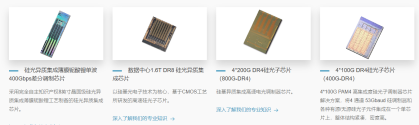
EasyLayer showcases nanosecond-level switching OCS optical chip and silicon photonic heterogeneous integration technology at the AI+Optoelectronics Intelligent Connectivity Conference​


At the 3rd AI+Optoelectronic Intelligent Connectivity Conference (OSIC 2026), Suzhou Elan Microelectronics showcased its breakthrough in optical path switching (OCS), a technology critical for future AI computing and data centers.

The company demonstrated an OCS chip capable of nanosecond-level switching speeds (<10ns) with extremely low power consumption (~10nW per switching unit). Dr. Chen Wei, Chairman of the company, highlighted their use of silicon photonic heterogeneous integration. This approach combines mature silicon photonics passive devices with high-performance materials (like thin-film lithium niobate) to maximize bandwidth and linearity while minimizing latency.

The architecture has been fully designed and verified for an 8×8 port topology layout, successfully reducing system power consumption and improving optical interconnect efficiency. Following the successful verification of the 8×8 model, the company is currently developing scalable expansion solutions supporting larger port counts (e.g., 64×64) to meet growing demand in AI computing infrastructure.

1778256924325.png

This advancement positions OCS as a pivotal direction for next-generation optical interconnects, enabling dynamic path configuration and direct node-to-node optical connections essential for high-performance computing networks.

Please, Log in or Register to view URLs content!
 

tokenanalyst

Lieutenant General
Registered Member

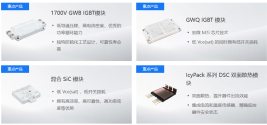
Hongwei Technology: SiC modules have passed certification by overseas AI server manufacturers and are being supplied in small batches.​


Hongwei Technology announced that its independently developed NCBSiC module has passed the system certification of major overseas AI server manufacturers and has achieved small-batch supply, entering the high-end computing power supply supply chain. In response to the power supply needs of AI servers, the company's high-voltage SST and GaN products are under joint development and sampling with leading domestic and international manufacturers. The company adjusted prices for some non-core products starting April 1st, with an average increase of approximately 10%, to cope with rising upstream precious metal costs; currently, most customers have accepted this well.

1778257286289.png

Please, Log in or Register to view URLs content!
 

tokenanalyst

Lieutenant General
Registered Member
This kind of development is what could really bring us AGI, for good or bad.

Hanxu Technology has announced a landmark breakthrough in domestic semiconductor technology by successfully completing the tape-out of an edge AI chip featuring Asia's first 8nm embedded MRAM (eMRAM). Collaborating with Samsung's ecosystem design partner, SEMIFIVE, Hanxu executed a unique development model that diverges from standard industry practices. While SEMIFIVE handled the back-end silicon implementation and MPW tape-out support, Hanxu Technology led the core R&D, designing proprietary solutions ranging from MRAM bit cells and peripheral circuits to high-bandwidth readout mechanisms and large-model inference accelerators. This partnership represents a strategic move away from relying solely on standard IP calls, establishing instead an integrated framework of "self-developed underlying architecture plus international ecosystem implementation."

On the technical front, the chip utilizes an innovative hybrid storage architecture combining MRAM with SRAM to directly address the notorious "memory wall" challenge in traditional AI computing. By replacing extensive on-chip SRAM with eMRAM, the design mitigates issues associated with low area efficiency and excessive power consumption that typically arise during process miniaturization. Furthermore, the chip integrates near-memory processing (PNM) architecture with GEMV computation to significantly accelerate critical operators within Transformer models. This sophisticated approach enables the device to run AI models with up to 2 billion parameters on edge devices, achieving performance levels comparable to international top-tier inference chips while surpassing them in storage density and energy efficiency.

The significance of this achievement lies not only in its commercial viability but also in its foundational scientific rigor. The project leverages advanced spintronic principles inherent to eMRAM, which offer non-volatility, high bandwidth, and ultra-low power consumption without the need for data refreshing—a crucial advantage for space-constrained, battery-powered edge applications. Underpinning this innovation is the robust technological foundation established by the Center for Applied Magnetism at Peking University's School of Physics, highlighting a seamless translation of academic research into commercial silicon reality. This successful tape-out marks a pivotal moment for Hanxu Technology in the fields of spintronics and in-memory computing, solidifying its position as a key player in China's autonomous AI chip development landscape.​

1778257899877.png


Please, Log in or Register to view URLs content!
 

vincent

Grumpy Old Man
Staff member
Moderator - World Affairs
Please, Log in or Register to view URLs content!

河北凯诺中星科技 has new project for 45t of photoresist photosensitizer, 430t of photoresist resin monomer and 12t of photoresist additives. It has mass produced photoresist precursors for everything from G-line to I-Line, KrF, Arf and EUV.
Wrong link
 

tphuang

General
Staff member
Super Moderator
VIP Professional
Registered Member
Wrong link
I posted the wrong story, the link is fine

Please, Log in or Register to view URLs content!

Shenzhen's 超晶热导 has produced 12-inch CVD diamond wafer product for industrial usage. Suitable for 3rd gen semi heatsink and power module packaging. Can be used in RF chip, lasers and optical communication device.
 

tphuang

General
Staff member
Super Moderator
VIP Professional
Registered Member
Please, Log in or Register to view URLs content!

Rockchip unveils new AIoT SoC RK3572 which has 8-cores (like RK35760) and 4 TOPS AI (vs 6TOPS on 3576), but note that RK3576 NPU is dual-core. I presume 3572 NPU also uses dual core architecture, which means they probably have similar performance in reality. Looks like the biggest gain here is energy consumption of < 1W. which for AI toys, is actually really good.
 

tokenanalyst

Lieutenant General
Registered Member

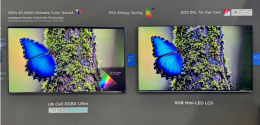
Hisense launches world's first RGBX multi-color LCD display technology.​

Hisense's RGBX multi - color LCD display technology, which debuted at SID 2026 , has been fully upgraded to an RGBC four-color panel + RGBC four-color backlight. The newly added cyan sub-pixel can achieve independent pixel-level control, completing the full-link reconstruction of true four-color display from the hardware level . This effectively solves the core pain points that have long existed in the industry, such as color crosstalk and impure colors . The technical difficulty and precision have both been improved by a significant margin .
1778272289672.png
- Features a full RGBC (Red-Green-Blue-Cyan) four-color panel + four-color backlight with independent pixel-level control, solving long-standing industry issues like color crosstalk and impure hues.
-Achieves an industry-leading 130%+ BT.2020 color gamut, monitor-level color accuracy, and significantly reduced metamerism for true-to-life image reproduction.
-Delivers low-to-zero harmful blue light output while supplementing beneficial long-wavelength blue light, supporting natural circadian rhythms.

Builds on Hisense’s 2025 global pioneer RGB-Mini LED mass production and early 2026 "Linglong Four-Core True Color Backlight" technology. Targeted for high-end TVs, professional cinema, virtual production, and medical displays, promising more realistic, purer, and healthier viewing experiences. RGB-Mini LED and multi-color LCD architectures are now widely recognized as the next generation of display technology. Hisense’s continuous iterative advances position it at the forefront of global display development.
Please, Log in or Register to view URLs content!
 
Top