Climate Change and Renewable Energy News and Discussion

Wrought

Captain
Registered Member
Paper modelling the impact of various subsidy types in the solar industry on encouraging innovation, lowering prices, and reducing pollution.

Do industrial policies that promote clean energy offer a “ray of hope”, increasing a country’s growth and welfare, whilst simultaneously reducing carbon emissions? We study the impact of Chinese solar subsidies whose implementation by city-regions went alongside massive expansion of the sector and a dramatic fall in global solar prices. We construct new city and firm panel data on solar policies, patenting and output. Using synthetic-difference-in-differences 2004-2020, we find production and innovation subsidies were more effective than demand-side (installation) subsidies in generating large and persistent increases in local innovation, net entry, production and exports. Demand policies did, however, reduce local pollution.

To examine aggregate effects, we build and structurally estimate a quantitative spatial model with endogenous innovation and heterogeneous productivity across firms and cities, which accounts for business stealing and knowledge spillovers. Counterfactual analysis shows that: (i) local effects remain substantial at the macro level explaining 40%-50% of the aggregate changes in solar innovation, prices and revenues; (ii) social benefits to Chinese citizens exceed subsidy costs by 65% (and double this when environmental benefits are included); and (iii) although all subsidy types increase welfare, innovation subsidies are the most cost-effective.

Please, Log in or Register to view URLs content!
 

Wrought

Captain
Registered Member
With a bit of luck, we'll see a boost to clean energy exports this year.

China, as the world’s
Please, Log in or Register to view URLs content!
and
Please, Log in or Register to view URLs content!
importer, would seem the most exposed, and the most likely to be hurt by this shock. Indeed, Beijing has already
Please, Log in or Register to view URLs content!
refiners to curb fuel exports to protect domestic supplies. But it would be a mistake to assume,
Please, Log in or Register to view URLs content!
, that China will be the war’s big loser. Crises often reorder energy geopolitics in unexpected ways. This one may ultimately strengthen, rather than weaken, China’s strategic position.

China’s electrification drive has been paired with a concerted push to dominate clean energy supply chains. It accounts for more than 80 percent of global
Please, Log in or Register to view URLs content!
manufacturing,
Please, Log in or Register to view URLs content!
turbines, and
Please, Log in or Register to view URLs content!
production capacity and processes the vast majority of critical minerals essential to these technologies. Rapidly expanding grids or deploying large volumes of solar, wind, and storage is exceedingly difficult without deepening reliance on Chinese firms and materials.

Please, Log in or Register to view URLs content!
 

tokenanalyst

Lieutenant General
Registered Member

Soyu Technology: Providing high-end precision equipment and precision core components for the semiconductor/LCD coating/thin film/photovoltaic industries.​


Shanghai Soyu Intelligent Technology Co., Ltd. is a high-tech enterprise specializing in the research, development, production, sales and service of high-end precision equipment and precision core components for the semiconductor, liquid crystal coating, thin film and photovoltaic fields.

Soyu adheres to the corporate philosophy of "innovation, pragmatism, integrity, and win-win cooperation," and is committed to becoming your most reliable process solution partner. We not only provide standard equipment, but also focus on providing customized professional solutions based on your specific needs, helping you stand out in the fierce market competition.

1773504093815.png

Please, Log in or Register to view URLs content!
 

Wrought

Captain
Registered Member
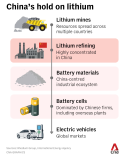
Article on the lithium supply chain and the chokepoints of Chinese refining and batteries.

But BMI estimates that China accounts for roughly 60 to 70 per cent of global lithium chemical refining capacity and output, particularly for hard rock lithium. “China thus completely dominates hard rock conversion capacity,” said Luc Braun, a research analyst at BMI specialising in lithium and the global hard rock mining ecosystem. That dominance matters because refining is where costs are set and supply reliability is determined, analysts said. “At the end of the day, it always comes down to cost,” Braun said, noting that chemical conversion is energy intensive, technically complex and difficult to scale outside China’s established industrial clusters.

China
Please, Log in or Register to view URLs content!
and around 85 per cent of battery cell manufacturing, according to BMI data - allowing batteries to move quickly from chemical plants into vehicles - often within the same industrial clusters.


1773712317380.png

Please, Log in or Register to view URLs content!
 
Top