News on China's scientific and technological development.

sunnymaxi

Colonel
Registered Member
Chinese scientists achieve millimeter-scale 3D printing in just 0.6 seconds

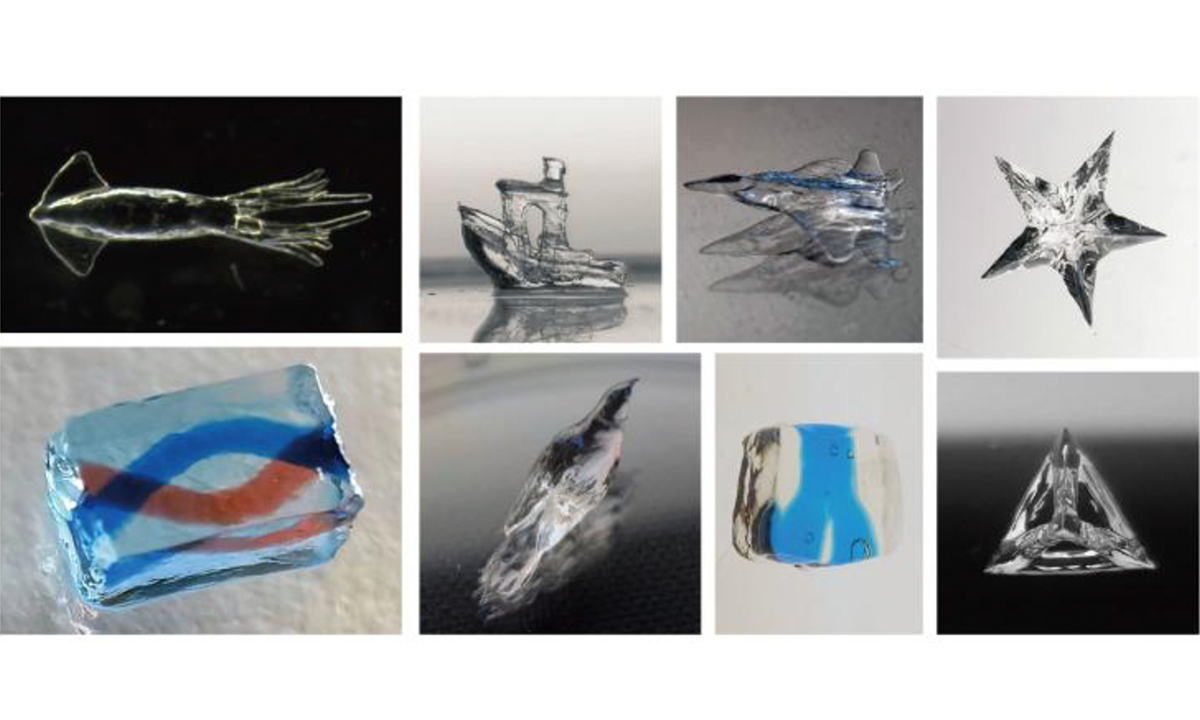
A showcase of complex 3D-printed objects Photo: Xinhua


Led by Dai Qionghai, an academician of the Chinese Academy of Engineering, the research team from the Laboratory of Imaging and Intelligent Technology at Tsinghua University drew on expertise in computational optics. They discovered that this approach can manipulate high-dimensional holographic light fields to form three-dimensional solid structures.

Experiments show that this technology can produce complex millimeter-scale structures in just 0.6 seconds, with feature sizes as small as 12 micrometers, and achieves a printing rate of up to 333 cubic millimeters per second.

This marks the fastest 3D printing speed reported to date, according to Wu Jiamin, an associate professor and member of the research team. Wu said that through an innovative optical system design, the digital incoherent synthesis of holographic light fields (DISH) technology overcomes the speed bottleneck of point-by-point or layer-by-layer scanning. It can accurately project complex 3D light intensity distributions in a short time, enabling rapid object fabrication.

Another advantage of this technology is its minimal container requirements. It requires only a single optical plane and no precise movement of the container during printing.

This advantage significantly broadens potential applications, particularly allowing printing materials to be placed directly inside ordinary fluid channels, enabling batch and continuous printing in fluid environments.

According to Dai, the DISH technology provides a new solution for advancing related technologies in related fields. For example, in engineering and manufacturing, the technology could be used to mass-produce miniature components such as photonic computing components and smartphone camera modules, as well as parts with sharp angles and complex curved surfaces. Future applications may include flexible electronics, micro-robots and high-resolution tissue models.

Please, Log in or Register to view URLs content!
 

broadsword

Brigadier
New and not incremental

New single 1.5mm sensor gives robots 180-degree vision and bionic smell power
Measuring just 1.5 millimeters, the insect-inspired sensor combines high-speed 180-degree vision with a chemical array to help robots navigate disaster zones.

By
Please, Log in or Register to view URLs content!

Please, Log in or Register to view URLs content!
Feb 12, 2026 04:11 PM EST


Scientists at the Chinese Academy of Sciences have engineered a breakthrough in robotic vision. They created an artificial compound eye inspired by the fruit fly.

This tiny device allows robots to see and smell simultaneously.
It promises to revolutionize how drones navigate tight, dangerous spaces.


The humble fruit fly possesses incredible visual capabilities. Its eyes process information much faster than human eyes.

They also provide a massive field of view. Most modern drone cameras are bulky and power-hungry.
These traditional sensors often lack peripheral vision. This creates a significant blind spot for autonomous machines.
The research team used a precise printing technique to solve this.

They employed femtosecond laser two-photon polymerization to create the structure.
This process allowed them to pack 1,027 visual units into a tiny square.

The entire sensor measures only 1.5 millimeters. Such extreme miniaturization is essential for the next generation of micro-drones.
The engineers even added tiny hairs called setae between the lenses. These mimic real biological features to keep the device clear.
These hairs prevent moisture buildup in humid environments.

They also shield the sensitive lenses from dust and debris. This ensures the robotic eye remains functional in diverse and dirty weather conditions.

Dual sensing for drones​

The researchers did not stop at vision. As reported by
Please, Log in or Register to view URLs content!
, the team added a bionic nose using an inkjet-printed chemical array.
This array changes color when it detects hazardous gases.

While real flies do not smell through their eyes, this hybrid design is efficient. It combines two vital senses into one lightweight package.
This dual-capability reduces the overall payload for small robots.
The team tested this “bio-CE system” on a miniature robot.

The machine successfully detected moving objects and avoided obstacles.
Most
Please, Log in or Register to view URLs content!
must swivel their heads to see sideways. This new system offers a full 180-degree field of vision.
The bot identified threats from the front and sides at once. This ability mimics the defensive instincts of a real insect.
“The bio-CE system achieves exceptionally high sensitivity for wide-angle moving target detection and proximity avoidance,” the team noted.

They continued to explain that the device is “showing great potential for unmanned platform navigation and bionic robot intelligence.”

Engineering safer future​

The current prototype faces some engineering hurdles. The small size results in lower image resolution.
The curved lenses also create slightly stretched images. This distortion requires complex software to correct.
Additionally, the chemical “
Please, Log in or Register to view URLs content!
” sensor reacts slower than the visual components. Bridging this speed gap is a primary goal for the researchers.

Engineers plan to refine these details in future iterations. High-definition vision and faster chemical reactions are next on the list.
Once perfected, these eyes could change emergency response operations forever.
Small drones equipped with these sensors could enter collapsed buildings. They would navigate through rubble to find survivors.
They could also detect invisible chemical leaks in disaster zones.

This fly-inspired technology could save lives by going where humans cannot.
This tiny invention represents a giant leap for autonomous machine intelligence.
 

tphuang

General
Staff member
Super Moderator
VIP Professional
Registered Member

响应速度达毫秒级:全国首套重型燃机柔性励磁系统成功投运​

2026/2/15 7:33:59 来源:
Please, Log in or Register to view URLs content!
作者:归泷 责编:归泷
Please, Log in or Register to view URLs content!

Please, Log in or Register to view URLs content!
2 月 15 日消息,据华电半山公司昨日分享,由杭州华电半山发电有限公司与国网浙江省电力有限公司联合研发的全国首套 9F 重型燃机柔性励磁系统,于 2 月 13 日在 2 号机组成功并网投运

Please, Log in or Register to view URLs content!

Looks like China is building 9F gas turbine now with domestic flexible excitation system. Once they get the full domestic supply chain into place, it will be much easier to design and build heavy GT.
 

broadsword

Brigadier
Chinese scientists achieve millimeter-scale 3D printing in just 0.6 seconds

A showcase of complex 3D-printed objects Photo: Xinhua


Led by Dai Qionghai, an academician of the Chinese Academy of Engineering, the research team from the Laboratory of Imaging and Intelligent Technology at Tsinghua University drew on expertise in computational optics. They discovered that this approach can manipulate high-dimensional holographic light fields to form three-dimensional solid structures.

Experiments show that this technology can produce complex millimeter-scale structures in just 0.6 seconds, with feature sizes as small as 12 micrometers, and achieves a printing rate of up to 333 cubic millimeters per second.

This marks the fastest 3D printing speed reported to date, according to Wu Jiamin, an associate professor and member of the research team. Wu said that through an innovative optical system design, the digital incoherent synthesis of holographic light fields (DISH) technology overcomes the speed bottleneck of point-by-point or layer-by-layer scanning. It can accurately project complex 3D light intensity distributions in a short time, enabling rapid object fabrication.

Another advantage of this technology is its minimal container requirements. It requires only a single optical plane and no precise movement of the container during printing.

This advantage significantly broadens potential applications, particularly allowing printing materials to be placed directly inside ordinary fluid channels, enabling batch and continuous printing in fluid environments.

According to Dai, the DISH technology provides a new solution for advancing related technologies in related fields. For example, in engineering and manufacturing, the technology could be used to mass-produce miniature components such as photonic computing components and smartphone camera modules, as well as parts with sharp angles and complex curved surfaces. Future applications may include flexible electronics, micro-robots and high-resolution tissue models.

Please, Log in or Register to view URLs content!

A better explanation of how it works. I wish this type of technology could be applied to our home oven so that the chicken could be cooked evenly by a combination of microwaves and infrared energy.


February 17, 2026
Please, Log in or Register to view URLs content!


Ultrafast 3D printing method creates complex objects in under a second​

by
Please, Log in or Register to view URLs content!
, Phys.org
edited by
Please, Log in or Register to view URLs content!
, reviewed by
Please, Log in or Register to view URLs content!

Editors' notes
The GIST
Please, Log in or Register to view URLs content!


Principle and illustration of DISH. Credit: Nature (2026). DOI: 10.1038/s41586-026-10114-5

High-speed 3D printing has just gotten a lot faster. Researchers from Tsinghua University in China have developed a new high-speed printing technology capable of creating complex millimeter-scale objects in just 0.6 seconds. Traditional 3D printing is often slow because it builds objects one thin layer at a time. While a newer method called volumetric printing, which uses light to shape an object, has become progressively faster in recent years, it has hit a major speed bump.

Typically, light is shone into a vat of fast-spinning liquid resin from many different angles at once. However, if you spin the liquid too fast, it can wobble or vibrate, which ruins the print. The solution has been to add thick, syrupy resins to keep the object in place. But this makes the process slower.

How the new DISH system works​

What the team has done, as they detail in a paper
Please, Log in or Register to view URLs content!
in the journal Nature, is create a method that doesn't involve spinning the liquid. Instead, DISH (Digital Incoherent Synthesis of Holographic Light Fields) uses a high-speed rotating periscope to project light from multiple angles into the resin, which stays perfectly still.

Play
00:20
00:20
Mute
Settings
PIPEnter fullscreen

Play
Successive mass 3D printing of diverse structures in flow by DISH. The video demonstrates DISH integrated with a fluidic channel for the successive mass production of diverse structures. A PEGDA–PEG–water mixture was used as the printing material, with a pump used to deliver the material at periodic intervals. Exposure and polymerization occurred during the pumping intervals, enabling successive production of the target structures. Credit: Nature(2026). DOI: 10.1038/s41586-026-10114-5

The technology relies on a chip covered with millions of tiny mirrors (a Digital Micromirror Device) that flip and change light patterns 17,000 times per second. To prevent blurring, the team developed an
Please, Log in or Register to view URLs content!
that calculates how to project the light so it builds up in exactly the right places to form the object, while keeping the rest of the resin from hardening.
This means the resulting 3D object is razor-sharp from top to bottom.

Proof-of-concept prints and applications​

In tests, the team produced complex objects such as a millimeter-scale Theodoric statue and intricate gear-like structures in 0.6 seconds. They also hooked the printer to a tube and pumped watery,
Please, Log in or Register to view URLs content!
through it, shining light on the liquid as it moved. This produced a variety of objects, including flowers and
Please, Log in or Register to view URLs content!
mimicking blood vessels, proving the printer could be turned into a high-speed assembly line to mass-produce parts almost instantly.


Play
High-speed 3D printing in low-viscosity material within 0.6 s by DISH. The video demonstrates the printing process of DISH using a low-viscosity material (20% PEGDA 1000 aqueous solution, 4.7 cP). The printed product gradually became discernible after the exposure and then it sank under gravity. Credit: Nature(2026). DOI: 10.1038/s41586-026-10114-5
This ultra-high speed technology has potential across numerous fields, as senior author Qionghai Dai notes in the paper: "With both high precision and high efficiency, we believe that DISH may open up a horizon for broad applications with ultrahigh-speed 3D printing, including biology, photonics and engineering."
These might include the mass production of customized 3D objects without the need for molds, in-situ printing of biological tissues in medical settings and creating intricate parts for tiny robots.
 
Top