TAI uses APAJ system for KAAN:
The Automated Positioning and Alignment Jig (APAJ), considered a strategic technology, is being used in the National Combat Aircraft.
As part of the KAAN project, it was commissioned on the assembly line. The APAJ system provides critical advantages to our company in integration processes.
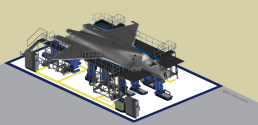
Today's 5th generation aircraft have challenging manufacturing processes due to their complex structural designs resulting from low radar cross-section, geometric precision, hybrid material integration, and high aerodynamic expectations. These levels of geometric integration and accuracy requirements push the limits of classic fixed fixture systems, necessitating new generation subcomponents and solutions that create a 5th generation assembly line offering flexibility, precision, and digital verification capabilities in manufacturing processes. In response to this requirement, the Automated Positioning and Alignment Jig (APAJ) is used in the KAAN National Combat Aircraft operational line for the automatic positioning and alignment of system-integrated components. APAJ has made its mark in Turkish aviation history as the first automation system implemented in the assembly line of original projects.
What is APAJ?
APAJ is described as an intelligent fixture system that performs automatic positioning and alignment operations of main components, consisting of structural and system parts, both before and during assembly, via a digitally controlled infrastructure. The system utilizes multi-axis servo-controlled actuators, laser-based tracking sensors, a real-time closed-loop control algorithm, and measurement feedback to automatically correct and position component geometries by comparing them to CAD models. Positioning accuracy can reach repeatability levels below ±0.1 millimeters, and the system's performance is defined by the root mean square (RMS) position error parameter. RMS, the square of the statistical average of the positional differences measured in each axis, indicates the overall alignment stability of the system. Operating in the micron range, this system ensures surface integrity and assembly precision.
Contributions of the APAJ System to Processes
During the development phase, the adaptable structure offered by the APAJ system allows for rapid adaptation to frequently changing design revisions in prototype production. Reference coordinate systems can be redefined digitally with each design update without the need for new fixture manufacturing. This shortens verification times and significantly accelerates engineering test cycles. Furthermore, the position and alignment data generated by the system can be directly transferred to the digital twin environment. This ensures complete traceability between design, production, and quality functions.
In the mass production phase, this technology enhances repeatable quality and high operational efficiency on the assembly line during the integration process. Since the positioning of each component is automatically recorded, quality control steps become digital, and the root cause of errors can be identified. This system offers critical advantages by eliminating operator control, reducing production cycle time and assembly variations, and ensuring the necessary accuracy in terms of radar visibility.
The APAJ system is considered an important step in establishing a digital transformation culture at the corporate level. Integrated with Product Lifecycle Management (PLM), Manufacturing Execution Systems (MES), and quality databases, this system enables the digital twin infrastructure to be implemented in the field, allowing for data integrity throughout the entire process from design to production.
The APAJ application, implemented on the assembly line of the National Combat Aircraft KAAN, stands out as a strategic technology providing repeatable quality, measurable accuracy, flexible production capability, and high operational efficiency in 5th generation aircraft assembly operations.
TAI Magazine 143