
You are using an out of date browser. It may not display this or other websites correctly.
You should upgrade or use an alternative browser.
You should upgrade or use an alternative browser.

Cross-posted from the PLA Navy News thread.
Said to be a 155-mm gun on a test platform ship at Liaonan Shipyard. Posted by @鼎盛大彪 on Weibo.


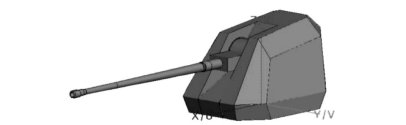
Said to be a 155-mm gun on a test platform ship at Liaonan Shipyard. Posted by @鼎盛大彪 on Weibo.

If the next gen destroyer is growing in size as rumored, the gun might grow with it. Just a hunch.
The Japanese side is getting better by the day with railgun (albeit U.S. halted). The Chinese responds with a bigger traditional naval artillery modelled after the 155mm calibre used for land warfare? Regardless how big of a calibre traditional naval artillery have, it could never compete with railguns in terms of range and rate of fire so long as the latters were provided with sufficient electricity. Additionally the PLAN already have naval artilleries in 76.2mm, 100mm (French and domestic/old Soviet models, whose munitions are not interchangeable), and 130mm. Wouldn’t the addition of another calibre further complicate supply chain and logistics?Cross-posted from the PLA Navy News thread.
Said to be a 155-mm gun on a test platform ship at Liaonan Shipyard. Posted by @鼎盛大彪 on Weibo.
View attachment 169900
View attachment 169901
View attachment 169902
Love to hear opposing views please!

Pretty sure that the Japanese railgun is exclusively for anti-air given the caliber. In that role I am not sure it is more effective than combination of laser (LY-1), Microwave, and CIWS plus HQ-10.The Japanese side is getting better by the day with railgun (albeit U.S. halted). The Chinese responds with a bigger traditional naval artillery modelled after the 155mm calibre used for land warfare? Regardless how big of a calibre traditional naval artillery have, it could never compete with railguns in terms of range and rate of fire so long as the latters were provided with sufficient electricity.
Love to hear opposing views please!
China has previously tested railgun in the late 2010s and found the accuracy left a lot to be desired at ranges where it distinguishes itself from traditional artillery.
You vastly overestimate the capability of current railguns. The projectiles are tiny, have way less energy than a conventional gun with the same footprint, and a purely kinetic strike has significantly worse terminal effects than an explosive round. In the air defense role, its prob less effective than a laser. Of course, it does have growth potential but they wont have as much ammunition flexibility for the near future.The Japanese side is getting better by the day with railgun (albeit U.S. halted). The Chinese responds with a bigger traditional naval artillery modelled after the 155mm calibre used for land warfare? Regardless how big of a calibre traditional naval artillery have, it could never compete with railguns in terms of range and rate of fire so long as the latters were provided with sufficient electricity. Additionally the PLAN already have naval artilleries in 76.2mm, 100mm (French and domestic/old Soviet models, whose munitions are not interchangeable), and 130mm. Wouldn’t the addition of another calibre further complicate supply chain and logistics?
Love to hear opposing views please!

The Japanese side is getting better by the day with railgun (albeit U.S. halted). The Chinese responds with a bigger traditional naval artillery modelled after the 155mm calibre used for land warfare? Regardless how big of a calibre traditional naval artillery have, it could never compete with railguns in terms of range and rate of fire so long as the latters were provided with sufficient electricity. Additionally the PLAN already have naval artilleries in 76.2mm, 100mm (French and domestic/old Soviet models, whose munitions are not interchangeable), and 130mm. Wouldn’t the addition of another calibre further complicate supply chain and logistics?
Love to hear opposing views please!
Please elaborate on what you mean by "The Japanese side is getting better by the day with railgun," specifically in context of the applicability of Japanese rail gun efforts on production naval ships in the near term, as well as in relation to past established PLAN rail gun efforts as well.

I suspect the calibre is simply a logical progression based on overall trends and a desire by PLAN to move to their own preference in calibre standards from the adapted Russian designs. Same dynamic as on the smaller 76 mm gun on frigates, moving (back) to 100 mm.
There may or may not be a desire to also align with ground forces on certain development standards, though the differences to naval ammunition remain substantial and have been a hindrance in Western efforts towards similar synergies.
There may or may not be a desire to also align with ground forces on certain development standards, though the differences to naval ammunition remain substantial and have been a hindrance in Western efforts towards similar synergies.

I suspect the calibre is simply a logical progression based on overall trends and a desire by PLAN to move to their own preference in calibre standards from the adapted Russian designs. Same dynamic as on the smaller 76 mm gun on frigates, moving (back) to 100 mm.
There may or may not be a desire to also align with ground forces on certain development standards, though the differences to naval ammunition remain substantial and have been a hindrance in Western efforts towards similar synergies.
I'm struggling to see the rationale for a new 155mm Naval Gun for use against land or naval targets.
So I suspect the primary reason is for better short-medium range air-defence, at very low cost.
---
We have command-guided Pantsir missiles with no seekers, so they could do something similar with 155mm artillery shells.
And I see the Mk45 can do 20 rounds per minute and the Burkes carry 680 rounds.
So they could fire a lot of rounds at very low cost.
---
I'm reminded of the guided Vulcano rounds which cost about $100K. That is expensive for an artillery shell, but cheap compared to a SAM.