Both.Anyone if hq16c use aesa or is it still pesa I know the hq16fe use aesa

You are using an out of date browser. It may not display this or other websites correctly.
You should upgrade or use an alternative browser.
You should upgrade or use an alternative browser.
PLA Anti-Air Missile (SAM) systems
- Thread starter FORBIN
- Start date

HQ17A, in fact Tor has been designed to hit cruise missile, i guess HQ17 will be no different. On that note, if the interception is to be made along its flight path, not the close in situation at the vicinity of intended strike target, then SPAAG or laser weapon will be much economical.I wonder sometimes do pla have any anti tomahawk or cruise missile ; jassm or lgm air defence like what iran war has made pla to change tactics

HQ-17A(as Tor) can do it, but it's a bit...complicated. Both are army systems, they need warning time; they're also PGM interceptors, but not dedicated LACM ones; there is difference in their search radar is at a highest point of the vehicle, but nothing much more than that. If it's ready and LOS permits - it will eat them for food(within limits of ammo capacity of course). The problem with those is they can't really sit 24/7 active.HQ17A, in fact Tor has been designed to hit cruise missile, i guess HQ17 will be no different. On that note, if the interception is to be made along its flight path, not the close in situation at the vicinity of intended strike target, then SPAAG or laser weapon will be much economical.
Actual PLA systems designed for LACM intercept are HQ-11, S-300PMU/400 batteries.
HQ-9 can do it from static installations(to my knowledge China didn't design masts for them, instead Chinese mainland positions use capital versions where radars can be elevated over local surroundings).
The likeliest dedicated candidate is HQ-20....but i don't remember seing its fire control apparatus.
Isnt HQ11 like upscaled HQ17? and you need to pair type 1130 gatling to compliment it?HQ-17A(as Tor) can do it, but it's a bit...complicated. Both are army systems, they need warning time; they're also PGM interceptors, but not dedicated LACM ones; there is difference in their search radar is at a highest point of the vehicle, but nothing much more than that. If it's ready and LOS permits - it will eat them for food(within limits of ammo capacity of course). The problem with those is they can't really sit 24/7 active.
Actual PLA systems designed for LACM intercept are HQ-11, S-300PMU/400 batteries.
HQ-9 can do it from static installations(to my knowledge China didn't design masts for them, instead Chinese mainland positions use capital versions where radars can be elevated over local surroundings).
The likeliest dedicated candidate is HQ-20....but i don't remember seing its fire control apparatus.
HQ-17 is a self-contained compact high performance system. Pro is that you have one vehicle, which does it all, you can even hide it into a random storage facility, building or cave, then pop out, go online and operate. Compromise is that its fire control is note unlike aircraft in that it has limited uptime - you can't run it 24/7; as such there's a perfect chance you'll be on position - but as warning came late or something, cruise missiles will pass by when you're going online. It's fast, but not immediate.Isnt HQ11 like upscaled HQ17? and you need to pair type 1130 gatling to compliment it?
I think you could even see this sequence once or twice in Ukraine and Armenia - when Tors get belated warning and try to get online already in drone sights.
HQ-11, on the other hand, is a purpose-made watcher. By the very design intent it should be able to remain operational day after day, likely fully automated. It comes from hardware, it comes from how control rooms are arranged(yes, comfort matters; HQ-17 is ultimately an AFV with entire SAM system stuffed in); it comes from the way unit is set up (humans don't function 24/7/365 either).

Isnt HQ11 like upscaled HQ17? and you need to pair type 1130 gatling to compliment it?
HQ-11 is this:

HQ-17 is this:
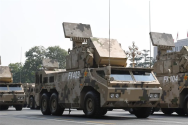
I wouldn't call HQ-11 an upscaled HQ-17 at all; the vehicle, TEL, mobility of each are so different.
It's more like HQ-11 can be seen as a more integrated (TELAR for some launchers in a battery) and slightly shorter range HQ-16, and with accompanied with 1130 gatling gun as part of its two layered "system".
HQ-17 meanwhile is a modernized Tor (size, mobility inclusive) with contemporary subsystems and networking.
Last edited:
Hq11 is air force system, designed for defense of fixed and static sites against incoming munitions (pretty much anything that is not a fast ballistic missile)
Hq16 is army system, designed for defense of static army sites near the battlefield against enemy aircraft and to some degree enemy munitions. That doesn't just mean passive defensive deployment (like hq11) but also more proactive deployments where hq16 unit changes locations and may interdict incoming aircraft before those get in position to release their weapons.
Hq16 is army system, designed for defense of static army sites near the battlefield against enemy aircraft and to some degree enemy munitions. That doesn't just mean passive defensive deployment (like hq11) but also more proactive deployments where hq16 unit changes locations and may interdict incoming aircraft before those get in position to release their weapons.
Hq11 is air force system, designed for defense of fixed and static sites against incoming munitions (pretty much anything that is not a fast ballistic missile)
Hq16 is army system, designed for defense of static army sites near the battlefield against enemy aircraft and to some degree enemy munitions. That doesn't just mean passive defensive deployment (like hq11) but also more proactive deployments where hq16 unit changes locations and may interdict incoming aircraft before those get in position to release their weapons.
Yes, but the prior question was about HQ-11 and HQ-17 (and asking if HQ-11 was an upscaled HQ-17).
HQ-11 and HQ-16 are not perfect analogues to each other obviously, but are far closer to each other than HQ-11 is to HQ-17 (and in terms of contemporary PLA AD systems, HQ-11 and HQ-16 are probably the most similar in nature)