
You are using an out of date browser. It may not display this or other websites correctly.
You should upgrade or use an alternative browser.
You should upgrade or use an alternative browser.
News on China's scientific and technological development.
- Thread starter Quickie
- Start date

A report at start of 2026 of the 6 gases for electronics industry and China's production, consumption & trade. Includes: Helium, Nitrogen Trifluoride, Tungsten Hexafluoride, Hexafluorobutadiene, Ammonia, Nitrous Oxide.
In light of the current Helium concerns, it's good to look at China's other gases.
航天增材科技 in 2026 is partnering with 天津艾德玛克科技 for a containerized 3D printing system using LBPF tech that can print outside factory. It is modular and can operate in -20 to 40C extreme weather & adverse environment. This will allow 3D printing to be done in national defense applications or in oil fields, wind farms and other places with time sensitivity. It can get power for solar energy.


broadsword
Brigadier
Because time is money...
By
Researchers in China have created one of the most precise clocks ever made – so precise, in fact, that it could soon lead scientists to .
Known as a strontium , the fancy timepiece can measure seconds to 19 decimal places. That means that if you ran it for 30 billion years – which is more than twice the current age of the Universe – the clock would only be out by one second, give or take.
This level of precision, which has been impossible until recently, is a major step towards the of a within the next decade or so.
There are a that need to be met before that can happen – firstly, at least three optical clocks based on the same type of 'tick', and with a certain level of precision and stability, need to be in use at different institutions.
This new optical clock meets those precision and stability requirements, and along with improving our timekeeping it could help scientists and measure .
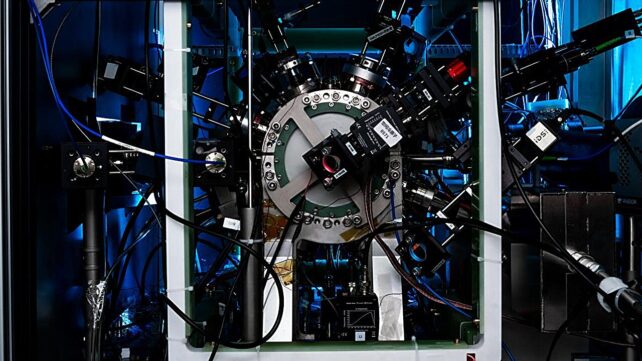 The USTC's strontium optical clock. ()
The second was originally defined as a fraction of a day – one 86,400th of a day, to be exact. That's what you get when you divide 24 hours into 60 minutes each, and then each minute into 60 seconds each.
That's fine as a rough guide, but it's not good enough for scientific and . Frustratingly, 'one day' isn't a precise measurement; the due to a whole range of factors, which would change the length of a second if it was still defined as a fraction of a day.
The creation of atomic clocks allowed scientists to measure the second independently, based on unchanging features of nature. So, since 1967 the in the (SI) as exactly 9,192,631,770 oscillations of the cesium-133 atom.
That's pretty damn precise, but there's still room for improvement. Atoms like strontium oscillate at visible light frequencies, producing some 700 quadrillion 'ticks' per second, compared to cesium's 9 billion. Optical clocks can measure these, resulting in a precision of 10-18 seconds.
In the new study, researchers from the University of Science and Technology of China (USTC) described upgrades to the facility's strontium optical clock, which reduced the uncertainty to 9.2 x 10⁻¹⁹, and stability to 6.3 x 10⁻¹⁹.
"This performance meets the 2 x 10-18 single-clock accuracy requirement for redefining the SI second, with potential applications in relativistic geodesy and high-resolution searches," the in a new paper describing the work.
Two other strontium optical clocks have already passed this milestone, the team says, as well as two others that measure . With more of these ultra-precise clocks joining forces, the criteria could soon be met for the second to be officially redefined.
These kinds of decisions are made at the (CGPM), which is held every four years. The next one is scheduled for October this year, but not enough progress has been made towards the criteria for the redefinition to be decided on at this meeting.
Addendum:
The writeup on DM , is very careful in avoiding giving credit to China, but one reader wrote, "Here's something else they don't mention in the story. This clock was developed at the University of Science and Technology of China. (USTC) Look it up."
This New Clock Is So Precise It Could Soon Redefine The Second
15 March 2026By
Researchers in China have created one of the most precise clocks ever made – so precise, in fact, that it could soon lead scientists to .
Known as a strontium , the fancy timepiece can measure seconds to 19 decimal places. That means that if you ran it for 30 billion years – which is more than twice the current age of the Universe – the clock would only be out by one second, give or take.
This level of precision, which has been impossible until recently, is a major step towards the of a within the next decade or so.
There are a that need to be met before that can happen – firstly, at least three optical clocks based on the same type of 'tick', and with a certain level of precision and stability, need to be in use at different institutions.
This new optical clock meets those precision and stability requirements, and along with improving our timekeeping it could help scientists and measure .
The second was originally defined as a fraction of a day – one 86,400th of a day, to be exact. That's what you get when you divide 24 hours into 60 minutes each, and then each minute into 60 seconds each.
That's fine as a rough guide, but it's not good enough for scientific and . Frustratingly, 'one day' isn't a precise measurement; the due to a whole range of factors, which would change the length of a second if it was still defined as a fraction of a day.
The creation of atomic clocks allowed scientists to measure the second independently, based on unchanging features of nature. So, since 1967 the in the (SI) as exactly 9,192,631,770 oscillations of the cesium-133 atom.
That's pretty damn precise, but there's still room for improvement. Atoms like strontium oscillate at visible light frequencies, producing some 700 quadrillion 'ticks' per second, compared to cesium's 9 billion. Optical clocks can measure these, resulting in a precision of 10-18 seconds.
In the new study, researchers from the University of Science and Technology of China (USTC) described upgrades to the facility's strontium optical clock, which reduced the uncertainty to 9.2 x 10⁻¹⁹, and stability to 6.3 x 10⁻¹⁹.
"This performance meets the 2 x 10-18 single-clock accuracy requirement for redefining the SI second, with potential applications in relativistic geodesy and high-resolution searches," the in a new paper describing the work.
Two other strontium optical clocks have already passed this milestone, the team says, as well as two others that measure . With more of these ultra-precise clocks joining forces, the criteria could soon be met for the second to be officially redefined.
These kinds of decisions are made at the (CGPM), which is held every four years. The next one is scheduled for October this year, but not enough progress has been made towards the criteria for the redefinition to be decided on at this meeting.
Addendum:
The writeup on DM , is very careful in avoiding giving credit to China, but one reader wrote, "Here's something else they don't mention in the story. This clock was developed at the University of Science and Technology of China. (USTC) Look it up."
Last edited:
易加增材/ePlus 3D unveils EP-M3050 with max 256 lasers (100 laser standard) for 3D printing 3058*3058*1200mm dimensions. Can be used for high speed 3D printing of high end aerospace and industrial parts. This is its largest printer.
It also has a full lineup from 300mm to 1250 to 1550 and 2050
Here is a calcium optical clock with even lower systematic uncertainty (worlds lowest in fact) by CAS. Another application would be highly precise navigation/guidance.Because time is money...
This New Clock Is So Precise It Could Soon Redefine The Second
15 March 2026
By
Researchers in China have created one of the most precise clocks ever made – so precise, in fact, that it could soon lead scientists to .
Known as a strontium , the fancy timepiece can measure seconds to 19 decimal places. That means that if you ran it for 30 billion years – which is more than twice the current age of the Universe – the clock would only be out by one second, give or take.
This level of precision, which has been impossible until recently, is a major step towards the of a within the next decade or so.
There are a that need to be met before that can happen – firstly, at least three optical clocks based on the same type of 'tick', and with a certain level of precision and stability, need to be in use at different institutions.
This new optical clock meets those precision and stability requirements, and along with improving our timekeeping it could help scientists and measure .
The USTC's strontium optical clock. ()
The second was originally defined as a fraction of a day – one 86,400th of a day, to be exact. That's what you get when you divide 24 hours into 60 minutes each, and then each minute into 60 seconds each.
That's fine as a rough guide, but it's not good enough for scientific and . Frustratingly, 'one day' isn't a precise measurement; the due to a whole range of factors, which would change the length of a second if it was still defined as a fraction of a day.
The creation of atomic clocks allowed scientists to measure the second independently, based on unchanging features of nature. So, since 1967 the in the (SI) as exactly 9,192,631,770 oscillations of the cesium-133 atom.
That's pretty damn precise, but there's still room for improvement. Atoms like strontium oscillate at visible light frequencies, producing some 700 quadrillion 'ticks' per second, compared to cesium's 9 billion. Optical clocks can measure these, resulting in a precision of 10-18 seconds.
In the new study, researchers from the University of Science and Technology of China (USTC) described upgrades to the facility's strontium optical clock, which reduced the uncertainty to 9.2 x 10⁻¹⁹, and stability to 6.3 x 10⁻¹⁹.
"This performance meets the 2 x 10-18 single-clock accuracy requirement for redefining the SI second, with potential applications in relativistic geodesy and high-resolution searches," the in a new paper describing the work.
Two other strontium optical clocks have already passed this milestone, the team says, as well as two others that measure . With more of these ultra-precise clocks joining forces, the criteria could soon be met for the second to be officially redefined.
These kinds of decisions are made at the (CGPM), which is held every four years. The next one is scheduled for October this year, but not enough progress has been made towards the criteria for the redefinition to be decided on at this meeting.
Addendum:
The writeup on DM , is very careful in avoiding giving credit to China, but one reader wrote, "Here's something else they don't mention in the story. This clock was developed at the University of Science and Technology of China. (USTC) Look it up."
Awesome. I thought China was only competitive in optical lattice clocks. Didn't realize they have reached the cutting edge on single-ion clock too.Here is a calcium optical clock with even lower systematic uncertainty (worlds lowest in fact) by CAS. Another application would be highly precise navigation/guidance.

South Korea Sends Delegation to China to Advance Autonomous Driving Push.
South Korea has dispatched an interagency delegation to Beijing from March 18–20 to study advanced autonomous driving technologies and policies, aiming to support commercialization and accelerate pilot city development.
The group will meet officials from China’s transport and public security authorities, visit a key autonomous driving demonstration zone, and tour leading firms, including test rides from Baidu and Pony. ai.
South Korea has dispatched an interagency delegation to Beijing from March 18–20 to study advanced autonomous driving technologies and policies, aiming to support commercialization and accelerate pilot city development.
The group will meet officials from China’s transport and public security authorities, visit a key autonomous driving demonstration zone, and tour leading firms, including test rides from Baidu and Pony. ai.