Miscellaneous News

Randomuser

Major
Registered Member
What do you mean by cities? How should I know? I'm speaking from my travels and observations of the differences between cities. China sorely lacks human scale and finesse in urban planning; everything boils down to mega-structures of enclosed spaces, completely destroying any mobility for pedestrians without a car or transport. The same goes for the quality of construction and urban planning. Never mind the high-rises—even with them, human scale can be maintained, rather than building 20 cities just to be bigger and taller, with no regard for quality or basic urban planning principles.
Seems unfair to say then. You're criticizing China but you don't want to give an example of what it should strive to be or can use a benchmark to properly compare against.
 

Valentine

New Member
Registered Member
Seems unfair to say then. You're criticizing China but you don't want to give an example of what it should strive to be.
So you need to ask the question correctly. How do I know? Maybe you want me to name the best city in the world?

Regarding traffic, it's enough to simply learn the basics of things like cities for people, the concept of 15-minute cities, not cluster zones like they do in China, and about a capillary road network, which is simply absent in most of China due to the fact that there are only fences and closed roads all around, along with endless highways. Speaking of which, in my understanding, China should strive for compact, non-monstrous cities designed for walking access to key areas for city residents, with minimal restrictions. And we should get rid of the concept of 12- lane roads inside the city at every intersection, because it's dangerous.

And anyway, initially, the conversation was about skyscrapers, and their endless number, and the reason why the motorway is so annoying is that instead of building them, resources should be directed toward improving infrastructure.

Tapping into the marketing and reputation. Kyoto itself isn't even all that traditional, outside of a few temples in its outskirts and one tourist neighborhood, its just like any other steel and concrete Japanese city. It's just that Japan happened to market it well through soft power.

China has many cities with a more traditional feel. In fact many Chinese say Datong is the country's Kyoto, even if many of the buildings there are modern constructions, but hey so is Kyoto. The city's most famous landmark, the Golden Temple, is a construction dated back to the 1950s after the original was burned down. (And wasn't even golden to begin with)
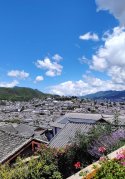
Plus, Japan has many new buildings constructed using modern technology. Visiting Lijiang, I saw numerous Qing-era buildings and columns, perhaps even earlier, and the old town there is enormous, stretching as far as the eye can see. And if there are new buildings, they're built by hand, almost using old techniques (I even saw craftsmen hand-cutting logs, carving out details; I imagine they did the same thing centuries ago). It's unlikely Kyoto can boast such scale or traditional technology. But the most annoying thing is that of all my acquaintances, no foreigners know about this city. It would be great to promote it in the media, in films, games, and anime, because the old town is very interesting and has enormous potential for tourism and soft power.

For those who don't know, I'll attach a photo so you can appreciate the scale. And this is just a small sample of the old towns accessible in Lijiang.1000026765.jpg
 

han1289

Junior Member
Registered Member
What do you mean by cities? How should I know? I'm speaking from my travels and observations of the differences between cities. China sorely lacks human scale and finesse in urban planning; everything boils down to mega-structures of enclosed spaces, completely destroying any mobility for pedestrians without a car or transport. The same goes for the quality of construction and urban planning. Never mind the high-rises—even with them, human scale can be maintained, rather than building 20 cities just to be bigger and taller, with no regard for quality or basic urban planning principles.

Human scale? Non-monstrous city? Is this even human language?

I live in Vancouver, a so called top tier Western city with only 2-3 million population and the infrastructure is already dragged to its knees. Cracks in paved roads? Uneven sidewalks? Go look around the Kerrisdale or Arbutus area where the average house is $5-$10 mil and that’s every other street. In fact there’s an entire rail road track stretching north to south across Arbutus that’s basically abandoned and overgrown with grass. The skytrain frequently breaks down, especially at first rain or first snow of the season. The car commute to suburbs takes an hour and a half in traffic and the tunnel expansion has been in approval stage for ten years. The trans-Canada highway, just to expand by two lanes for 100kms, started next year and will take five more years to complete. Don’t even get me started on the crackheads and homeless camped a block away from the business district.


You’re asking for utopian planning even the wealth here couldn’t accomplish, applied to a city of 20+ mil. The double standards are ridiculous.
 

Puss in Boots

Junior Member
Registered Member
So you need to ask the question correctly. How do I know? Maybe you want me to name the best city in the world?

Regarding traffic, it's enough to simply learn the basics of things like cities for people, the concept of 15-minute cities, not cluster zones like they do in China, and about a capillary road network, which is simply absent in most of China due to the fact that there are only fences and closed roads all around, along with endless highways. Speaking of which, in my understanding, China should strive for compact, non-monstrous cities designed for walking access to key areas for city residents, with minimal restrictions. And we should get rid of the concept of 12- lane roads inside the city at every intersection, because it's dangerous.

And anyway, initially, the conversation was about skyscrapers, and their endless number, and the reason why the motorway is so annoying is that instead of building them, resources should be directed toward improving infrastructure.
China's population size makes it impossible to achieve the "15-minute city" you described.

I think you have an unrealistic fantasy about urban planning. A slightly well-known city in China has at least several million people. If planned according to your ideas, China might not even have enough land to grow crops.
 

A potato

Junior Member
Registered Member
To educate visitors that Japanese culture (minus the modern perverted crap) is actually cloned from Tang Chinese culture, and that the natural order of Sino-Japanese relations is that of Japan as the student/tributary and China as the teacher/hegemon.
This is already being taught in China so the little Kyoto is pointless. It isn't even a musuem it's just a shopping street that recreates Kyoto city streets. How is the educational at all?

Tapping into the marketing and reputation. Kyoto itself isn't even all that traditional, outside of a few temples in its outskirts and one tourist neighborhood, its just like any other steel and concrete Japanese city. It's just that Japan happened to market it well through soft power.

China has many cities with a more traditional feel. In fact many Chinese say Datong is the country's Kyoto, even if many of the buildings there are modern constructions, but hey so is Kyoto. The city's most famous landmark, the Golden Temple, is a construction dated back to the 1950s after the original was burned down. (And wasn't even golden to begin with)
There has to be a line the Chinese government needs to draw becausing tapping into marketing and reputation shouldn't be achieved by undermining Chinese culture by rewriting history to promote whiteworshipping like in Qingdao and Shanghai. This little kyoto was set to reopen on september 18th aka the day of the Mukden incident that led to Japan invading the Dongbei which is pretty disgraceful especially since Dailan is infamous for being the most Japan Friendly (Worships Japan because Dailan was colonized by Japan)
 

DuckDuckMoose

New Member
Registered Member
To educate visitors that Japanese culture (minus the modern perverted crap) is actually cloned from Tang Chinese culture, and that the natural order of Sino-Japanese relations is that of Japan as the student/tributary and China as the teacher/hegemon.


I actually don't understand why roads in the Northeast are so bad. Roads are resurfaced with asphalt on a regular basis, yet within 2-3 years potholes begin to form again. Perhaps using reinforced concrete as is done in China would be better than using asphalt?
Snowstorms occur very often in the Northeast US and salt is deployed to prevent or mitigate freezing by lowering the freezing point of water. Salt can terrible for roads but some places are using less corrosive de-icing salts. Coming up in Virginia, many mechanics here often cautioned people about buying used vehicles from up north for that very reason due to severe rusting on frames.
 

pmc

Colonel
Registered Member
Someone said, maybe it was Scott Ritter on a podcast a couple of months ago, since he goes to Russia regularly to speak to Russians, he claims they think Trump is insane and they cannot trust him. Because he's crazy!

With this latest outburst, does not seem like the stable genius is that stable.

:oops:
Scott Ritter is i dont think capable of understanding Russia since i havent seen him in Royal Kingdoms.
Zelensky explain it and he is still on tour of Arab countries. he will get favorable treatment from Royal Kingdoms if Zelensky can convince Europe to join the fight and that treatment is those thousands people that Russia has extracted from Ukraine and since Royal Kingdoms are involved than Trump name has to involved. Just to give you a clue Russia is protecting Islam not muslims. there is a difference.

Please, Log in or Register to view URLs content!

Kadyrov says Russia remains Islam’s ‘most loyal ally and protector’​


supersnoop

Colonel
Registered Member
China's population size makes it impossible to achieve the "15-minute city" you described.

I think you have an unrealistic fantasy about urban planning. A slightly well-known city in China has at least several million people. If planned according to your ideas, China might not even have enough land to grow crops.

The concept of "15 minute city" and "human scale development" was coined by adherents of Jane Jacobs whose seminal work was "The Death and Life of Great American Cities". I read this book many moons ago, and honestly have forgotten most of it.

That being said, one of her central tenets (which I do remember) was fighting large scale top down projects (she helped kill a major highway project in Toronto after moving there, leaving a vestigial short highway), and emphasizing walking over cars.

One point to note, she was somewhat of a libertarian (not totally), and an avowed anti-communist. The politics should not be an avenue of criticism, but rather that her philosophy might naturally be opposed to China's way of governance.

A few other notes...
IMO, OP's original criticism of massive multilane streets and fenced off has some merit. It certainly makes crossing the road a more unpleasant experience. The solution to this is flyovers or tunnels, but it makes accessibility more challenging.

That being said, your point also has merit. The megacities of China simply do not exist in America, nor do they exist in Europe. Logistics alone means large numbers of roads are required for trucks and vans. Money and technology will evolve cities. 40 years ago, Chinese cities were trying to increase car ownership as a matter of economic development, bike lanes were being removed or neglected. Now they have been revived with new concerns with respect to pollution and evolving micro-mobility options.

Many road surfaces are in dismal condition, requiring major repairs or complete restructuring. These observations come from trips to Qingdao, Chongqing, Lijiang, Dali, Urumqi, Karamay, Beijing, and Linyi.

I actually don't understand why roads in the Northeast are so bad. Roads are resurfaced with asphalt on a regular basis, yet within 2-3 years potholes begin to form again. Perhaps using reinforced concrete as is done in China would be better than using asphalt?

I cannot speak for the issues with more southerly located cities, but as mentioned northern cities in any country will always have issues with road surface quality. Asphalt is highly sensitive to freeze-thaw cycles due to water penetration and will inevitably destroy the road surface within a few years. Concrete is more durable, but very, very noisy. It also takes longer to repair. You can easily patch up potholes in asphalt in minutes.

Human scale? Non-monstrous city? Is this even human language?

I live in Vancouver, a so called top tier Western city with only 2-3 million population and the infrastructure is already dragged to its knees. Cracks in paved roads? Uneven sidewalks? Go look around the Kerrisdale or Arbutus area where the average house is $5-$10 mil and that’s every other street. In fact there’s an entire rail road track stretching north to south across Arbutus that’s basically abandoned and overgrown with grass. The skytrain frequently breaks down, especially at first rain or first snow of the season. The car commute to suburbs takes an hour and a half in traffic and the tunnel expansion has been in approval stage for ten years. The trans-Canada highway, just to expand by two lanes for 100kms, started next year and will take five more years to complete. Don’t even get me started on the crackheads and homeless camped a block away from the business district.


You’re asking for utopian planning even the wealth here couldn’t accomplish, applied to a city of 20+ mil. The double standards are ridiculous.
I only visited Vancouver, so I can't speak to the day to day life. However, with respect to the property prices, they are inflated due to geography. You have mountains on one side, ocean on the other, leaving a small narrow strip where people can live. The wealth doesn't really change anything, if anything it becomes an impediment to development. Going back to the original philosophy of Jane Jacobs, this is actually somewhat the intended outcome. By having more power (which in this case is due to wealth), the people living there can dictate the terms of development over the city government which will shape the city more organically.

 

FairAndUnbiased

Brigadier
Registered Member
In terms of urban development there's huge variation between cities.

Beijing and Shanghai are actually developed on an older, more car centric model. The newer developed cities like Guangzhou, Hangzhou, Chengdu, Changsha, Chongqing, etc. that had best practice to learn from are indeed more walking and human scale friendly.
 

GZDRefugee

Senior Member
Registered Member
In terms of urban development there's huge variation between cities.

Beijing and Shanghai are actually developed on an older, more car centric model. The newer developed cities like Guangzhou, Hangzhou, Chengdu, Changsha, Chongqing, etc. that had best practice to learn from are indeed more walking and human scale friendly.
I would actually say Shanghai is actively hostile to motor vehicles. Oh my god, I fucking HATE how Shanghai's road network underneath the 高架 are designed. Awful lines of sight, unnecessary complexity and too many islands (for support columns of the highways above) that restrict movement. That's not to say the pedestrian experience is much better either.
 
Top