
You are using an out of date browser. It may not display this or other websites correctly.
You should upgrade or use an alternative browser.
You should upgrade or use an alternative browser.
Miscellaneous News
- Thread starter bd popeye
- Start date
This is the US goal for them, the longer the US waits the stronger China gets and the more likely the US might lose. But luckily China is smart and not going to war unless a major redline is crossedSo the US is now goading China to invade Taiwan. Just great.
China won’t go to war over sanctions and an embargo with China would severely hurt the US economyThe US will likely continue to ratchet up sanctions, embargos, and try to go provoke a kinetic conflict somehow. I doubt they will do it themselves directly though.
Soviets contributed probably 70% of the war effort against Germany. Against Japan? Not very much. Kwangtung army in 1945 was third string for IJA. Their best troops had died in Burma and Southern China by that point, and their second best in the islands of the Pacific. NRAs best division were on their way back from victory in Burma and NRA had air superiority at that point. Despite all the KMTs shortcomings, the NRA was by far the army that did the most damage to IJA during WW2.
True but without the Russian's massive Operation August Storm to dislodge and destroy and evict the Imperial Japanese Forces plus their large civilian/political infrastructure set in place for nearly 50 years -it would be impossible for China at that time to do so and the real danger of a permanent Japanese colony of military men settling in Manchuria/Korea /even Philippines with Japanese /local women and becoming "nicer peaceful"settlers was a distinct danger for a nascent China which still had to fight the Chinese Civil War.

The US had never stopped trying to provoke an armed conflict in the Taiwan Straits since the 1990s. China had been better at managing conflict escalation than many countries.So the US is now goading China to invade Taiwan. Just great.
....
...
...
Last edited:

plawolf
Lieutenant General
While it may be difficult to quantify manufacturing output using a single metric, 4x industrial output sounds exaggerated to me. The most widely cited figures for global manufacturing, which measures industrial value add, puts China at just over 30% of the global total and the US at around 15%. During WW2, US had more than 5x the Japanese GDP and 10x the industrial output. US produced over 15x more steel, 10x more coal. Most importantly, the US produced the majority of the world's oil at the time, while Japan was critically hamstrung by lack of access to oil. I would argue that Japan's oil shortage in WW2 was a more significant limiting factor to Japan's warfighting and industrial capabilities than rare earths would be for the US today.
Using monetary values to measure industrial output is fundamentally flawed because that equates price to quantity.
A bullet is a bullet in a war. An American made bullet that costs 10-100 times as much as a Chinese made bullet does not give America 10-100 more firepower in a firefight as a monetary comparison would suggest.
To do a proper like for like comparison would be impossible without a stupidly complex analysis of core strategic industries with direct wartime application.
But you can do some basic comparisons with easily available statistics. This is why the ship tonnage figures are so much more relevant than value added.
Similar comparison of things like car production, steel tonnage production, electricity generation and consumption, solar installation, industrial robot installations, the picture is consistent and overwhelming in just how dominant Chinese manufacturing prowess is.
And that is still underestimating Chinese industrial potential. Because even in fields like civilian aviation that the US has a dominating lead in terms of units output, if you drill down to components, you will find that Chinese suppliers play a massive role.
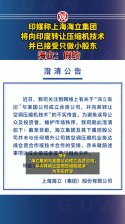
Accdg to this douyin news, the indian claim of Highly willing to transfer tech and small shareholdong, was "not true" accdg to Highly. See attached snapshot.google translated.
...
Subject article from india(?)
....
Though highly seem to have plant in lndia?
...
lndia seem to be promoting this narrative
Recently, our company has noticed false rumors on the Internet that "Haili Group has established a joint venture with a company in a certain country and transferred air conditioning compressor technology to it." In order to avoid misleading the public and investors and maintaining market order, our company clarifies the following: As of now, Haili Group and its subsidiaries have not reached joint venture cooperation or technical cooperation with any overseas company on the air-conditioning compressor business, nor have they reached an agreement or signed relevant documents on the aforementioned matters.
...
Subject article from india(?)
....
Though highly seem to have plant in lndia?
...
lndia seem to be promoting this narrative
India-China electronics firms turn to tech tie-ups as JV rules delay deals
With regulatory curbs stalling Chinese investments in India, electronics firms like Voltas and PG Electroplast are exploring technology partnerships
Attachments
-
 Screenshot_20250624_223312.jpg840 KB · Views: 8
Last edited: