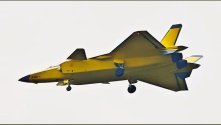
The direction does matter, because when viewed from the front, all that's seen are the height of those tails, and not so much the surface area. The F-22 when viewed from the front only has 4 planar surfaces, while the J-20 has 8 due to ventral fins and canards not being co-planar with the delta wings. The F-22 also has better edge alignment. Carets are indeed worse for stealth than DSIs, but this will also have to tie into your claim about better kinematics. Keep in mind that carets are better for higher speeds which allows the F-22 to push to at least mach 2.25, while the J-20 with DSIs is unlikely to have a higher top speed because DSIs severely lose efficiency past mach 2. Granted top speed isn't as important as super cruise speed in westpac
I don't think the difference in stealth capabilities between the J-20 and the F-22 is significant enough to affect their ability to complete their missions.
Stealth fighter jets are not designed for one-on-one combat against enemy stealth fighter jets.
In the mission to strike at the key operational points of the enemy,the J20, which is equipped with more advanced electronic devices and has excellent supersonic capabilities, is a better air superiority fighter compared to the F22.
Of course, even in a one-on-one scenario, I believe that the J20, which has more advanced detection equipment, would have certain advantages in medium to long-range aerial combat over the F22.
If it's a close-range air battle, the F22 might have some advantages over the J20.
However, according to the internal exercise results of the PLAAF, the Su-35, despite its strong mobility, did not demonstrate the dominance that was expected.