Chinese semiconductor thread II

tphuang

General
Staff member
Super Moderator
VIP Professional
Registered Member
Please, Log in or Register to view URLs content!

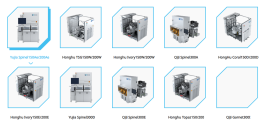
Shinry showcased its various OBC (on board charging) solutions for NEVs. Uses highly integrated and compact modules with 20% higher power density than previous generation. And can handle high heat and vibration.

It offers the full charging architecture with OBC+DCDC+Inverter for the charging, power supply & CAN web for data link
and single DSP + MCU full display
 

tokenanalyst

Lieutenant General
Registered Member

Luwei Optoelectronics plans to raise no more than 1.38 billion yuan to increase its production capacity of high-generation photomasks.​


After deducting issuance expenses, the funds raised will be mainly used for two purposes: first, to invest RMB 1.07 billion in the construction of the Xiamen Luwei Optoelectronics high-generation high-precision photomask production base project (Phase I); and second, to allocate RMB 310 million to supplement working capital and repay bank loans.

As the only domestic company capable of mass-producing G11 photomasks, Luwei Optoelectronics has accumulated profound technical expertise and high-quality customer resources in the field of high-generation, high-precision photomasks. Currently, the downstream market is accelerating its upgrade to next-generation display technologies such as AMOLED and LTPO. Demand for high refresh rate, low-power panels is growing rapidly in applications such as smartphones, automotive displays, and high-end IT, and the company's existing production capacity is nearing saturation. Upon completion of this fundraising project, the company will significantly enhance its large-scale production capacity for G8.6 and below high-precision photomasks, effectively meeting the incremental demand from downstream industries, while reducing downstream panel manufacturers' reliance on imported materials and contributing to the self-reliance and controllability of the industry chain.

1769178854132.png
Furthermore, the photomask industry is both capital- and technology-intensive, requiring long-term and stable investment in process upgrades, capacity expansion, and technological research and development. This equity financing will effectively broaden the company's financing channels, optimize its capital structure, alleviate the capital pressure brought about by business expansion, and enhance the company's risk resistance and sustainable operating level.​

Please, Log in or Register to view URLs content!
 

tokenanalyst

Lieutenant General
Registered Member

Zefeng Semiconductor's advanced packaging and testing materials mass production base project will be put into operation.​

The Zefeng Semiconductor Advanced Packaging and Testing Materials Mass Production Base Project has a total investment of RMB 1.16 billion and covers a total area of 28 mu. The main structure of the production plant was completed in July 2025, and the project was completed and put into operation in 2026. It is expected to reach full production capacity in 2028. Upon completion, the project will become the largest production base for stacked HBM chip probe cards and memory chip probe cards in China, and will also have the production and R&D capabilities for large-size ceramic substrates , HTCC/LTCC ceramic substrates , and 3DMEMS probes , filling the gap in the field of advanced packaging and testing materials in China across the entire chain. Founded in 2015, Shanghai Zefeng Semiconductor Technology Co., Ltd. currently focuses on semiconductor test boards, MEMS probe cards, and advanced packaging based on ceramic substrates. Through independent research and development, production, and sales, the company provides highly competitive high-end products and high-quality services to global integrated circuit chip design companies, packaging and testing plants, and wafer manufacturing plants.​

Please, Log in or Register to view URLs content!
 

tokenanalyst

Lieutenant General
Registered Member

Shanghai Bangxin Semiconductor has shipped 200 semiconductor manufacturing tools.​


Shanghai Bangxin Semiconductor Technology Co., Ltd. successfully concluded its " 200 Units Shipped " celebration. At this special moment of bidding farewell to the old year and welcoming the new, all Bangxin employees and numerous partners gathered together to review their journey and look forward to a new chapter.

Since its inception, Bondchip Semiconductor has consistently focused on the R&D and domestic substitution of semiconductor equipment, achieving a breakthrough from scratch and continuing to accelerate its development. It is a source of pride that in 2025 alone, Bondchip achieved the milestone of shipping 100 units , bringing its cumulative total shipments to over 200 units. This is not merely a numerical leap, but a powerful testament to its technological strength and market trust, embodying the wisdom and hard work of every Bondchip employee in R&D, manufacturing, sales, and service.

1769180288173.png

At the celebration, Wang Zhaoxiang, Chairman and General Manager of the company, reviewed the growth path of Bangxin and outlined the company's strategic layout in the fields of compound semiconductors and silicon-based special processes. Representatives from several partners also attended and delivered speeches, fully affirming Bangxin's positive contributions to industry chain collaboration and technological innovation.

Please, Log in or Register to view URLs content!
 

tokenanalyst

Lieutenant General
Registered Member

Hyper-reduction-accelerated data assimilation method in thermal deformation analysis of lithography masks​

Abstract​

Thermal deformation of the mask is a major contributor to imaging errors in extreme ultraviolet lithography (EUVL), with uncertainty in the coefficient of thermal expansion (CTE) curve playing a critical role. Rapid and accurate prediction of mask thermal deformation from limited measurements in industrial production is essential to ensure lithographic imaging quality. Therefore, this study proposes an accelerated data assimilation framework for thermo-mechanical analysis of EUVL masks to inversely predict the CTE curve, and thus improve the accuracy of the thermal deformation online. By employing thermo-mechanical hyper-reduced-order models (HROMs), the computational process of the Ensemble Kalman filter is significantly accelerated. The influences of sensor density and measurement noise on the accuracy of CTE curve estimation are also investigated, demonstrating good robustness. Compared with the full-order model, the HROM achieves a relative error of only 1 × 10⁻⁴ while improving computational efficiency by 3 to 4 orders of magnitude. Moreover, the estimated CTE curve exhibits a relative error of just 1 × 10⁻² compared with the true curve. Using the predicted CTE curve, online monitoring of the mask can reduce displacement field errors by ∼20 %. The proposed model, is effective for online monitoring of mask thermal deformation and enhancing lithographic imaging quality.

Please, Log in or Register to view URLs content!
 

Phead128

Major
Staff member
Moderator - World Affairs
Please, Log in or Register to view URLs content!

Chinese semiconductor industry gears up for domestic HBM3 production by the end of 2026 — CXMT to produce chips, while Naura, Maxwell, and U-Preseason design tools for assembly
@huemens @Weaasel and others, can you provide context as to why this important for Ascend or China or in general to a lay person.

For example, I know HBM in general is critical to AI GPU for transfer speed of data? Is China behind on this, and how competitive is HBM3? Does China have HBM4 in the works?
 

antiterror13

Brigadier
@huemens @Weaasel and others, can you provide context as to why this important for Ascend or China or in general to a lay person.

For example, I know HBM in general is critical to AI GPU for transfer speed of data? Is China behind on this, and how competitive is HBM3? Does China have HBM4 in the works?
In general China is behind in HBM state of the art, the global leaders are SK Hynix, Samsung, Micron, they are already mass-producing HBM4 (the 6th generation). These chips are integrated into the latest AI powerhouses like Nvidia’s "Rubin" architecture.

China will produce HBM3 this year, but there are HBM3E and HBM4 already. So China is currently roughly 1.5 generations behind in terms of current mass production capability
 
Last edited:

huemens

Junior Member
Registered Member
@huemens @Weaasel and others, can you provide context as to why this important for Ascend or China or in general to a lay person.

For example, I know HBM in general is critical to AI GPU for transfer speed of data? Is China behind on this, and how competitive is HBM3? Does China have HBM4 in the works?

HBM is important because it provides higher bandwidth and lower latency. On a normal gaming GPU, RAM chips sits on the PCB. So there's physical distance between compute dies and the RAM and they also have much fewer data transfer pins, hence lower bandwidth. HBM has lots of IO pins and on AI chips HBM dies are directly packaged on to the same silicon interposer with the compute dies, providing extremely low latency. Otherwise compute circuits will be idling, waiting for enough data to process.

As for China status on HBM, Huawei currently uses HBM2E for Ascend 910C. Based on the specs of the cards revealed in the Huawei roadmap (they didn't exactly spell out which HBM class they will use) they are likely using HBM2E class for Ascend 950 inference version releasing this quarter and HBM3 class for the training version of Ascend 950 releasing in 4Q of 2026. So it's reasonable to assume China will have HBM3 by the end of the year as these articles claim.
 
Last edited:
Top