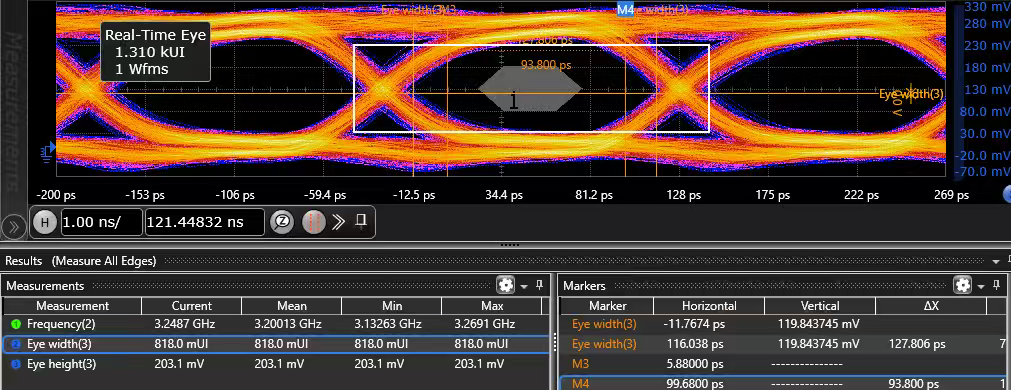
The National Innovation Center for Information Optoelectronics has successfully developed a 250GHz ultra-wideband photonic chip.
The National Innovation Center for Optoelectronics (NOEIC) recently successfully developed an ultra-wideband photonic chip. Despite being less than 1 cm long and 1 mm wide, this chip boasts a record-breaking 250 GHz bandwidth, setting a new world record for similar devices and providing new underlying hardware support for the development of optical communication and 6G technology.
In fiber optic communication networks, photonic chips act like "translators" and "postmen" in the physical world. Our everyday devices, such as mobile phones and computers, process electrical signals, while data needs to be converted into optical signals to reduce loss and increase speed during long-distance transmission. Photonic chips are the key components responsible for the "electro-to-optical" and "optical-to-electrical" conversions. The larger the chip's bandwidth, the more data it can carry and transmit per unit of time.
In fiber optic communication networks, photonic chips act like "translators" and "postmen" in the physical world. Our everyday devices, such as mobile phones and computers, process electrical signals, while data needs to be converted into optical signals to reduce loss and increase speed during long-distance transmission. Photonic chips are the key components responsible for the "electro-to-optical" and "optical-to-electrical" conversions. The larger the chip's bandwidth, the more data it can carry and transmit per unit of time.

Based on this ultra-wideband photonic chip, the project team successfully achieved cross-network integration of optical fiber communication and wireless communication systems, reaching a world-leading level in transmission rate.
Official data shows that the single-channel speed of fiber optic wired transmission exceeds 512Gbps, which is equivalent to downloading more than a dozen high-definition movies in one second; the single-channel speed of terahertz wireless transmission reaches 400Gbps, which is enough to provide 8K ultra-high-definition video streams for 86 users at the same time.
Zhang Hongguang, manager of the Future Technology Department at the center, explained that based on the underlying technology of this chip, the R&D team has developed the world's first 170 GHz intensity modulator, which has been successfully applied to domestically produced optoelectronic measurement equipment. In the future, this chip will serve as a core technology component, providing underlying support for 6G "space-air-ground integrated" communication networks, and is expected to be extended to spaceborne communication equipment, further contributing to the development of domestically produced satellite communication.
Official data shows that the single-channel speed of fiber optic wired transmission exceeds 512Gbps, which is equivalent to downloading more than a dozen high-definition movies in one second; the single-channel speed of terahertz wireless transmission reaches 400Gbps, which is enough to provide 8K ultra-high-definition video streams for 86 users at the same time.
Zhang Hongguang, manager of the Future Technology Department at the center, explained that based on the underlying technology of this chip, the R&D team has developed the world's first 170 GHz intensity modulator, which has been successfully applied to domestically produced optoelectronic measurement equipment. In the future, this chip will serve as a core technology component, providing underlying support for 6G "space-air-ground integrated" communication networks, and is expected to be extended to spaceborne communication equipment, further contributing to the development of domestically produced satellite communication.