
Chinese Economics Thread

Wrought

Captain
Registered Member
Please, Log in or Register to view URLs content!

Related article to the recent discussion. They’re saying that China’s approach is actually very similar to Japan’s approach to addressing domestic demand which while making them competitive in new technologies at the time, didn't work to address demand.


“In fact, most economic historians would
Please, Log in or Register to view URLs content!
that Tokyo in the late 1980s and 1990s, like Beijing today, found it politically difficult to address its deep, demand-side imbalances and instead hoped to accelerate supply-side reforms by focusing on the development of new technology.

At the time, Tokyo expected that technological advancement would lead to large enough technological breakthroughs and productivity gains for the overall economy that Japan would be able to rebalance its economy towards a greater role for domestic demand without slowing the growth of the supply side. It would be growth in supply that would drive even faster growth in demand.”

thoughts? I think there’s something missing here.

What's missing is that when Japan's property bubble burst, its growth collapsed to ~1% and stagnated there. Meanwhile, Chinese growth post-bubble bursting is still ~5%. Even the author concludes by pointing out the differences between Japan and China. There's also a parallel track on the politics of it all which is not captured by headline growth numbers, but I digress. Suffice to say Japan's political context, and therefore options, in the 90s were completely different from Chinese analogues today.

I am not arguing that an intense supply-side focus on developing new technology won’t make a difference for China and will fail. It is certainly possible that such a focus could help China avoid—or at least reduce—a long and difficult adjustment associated with boosting a very weak demand side of the economy. But it is foolish to suggest that such a focus must inevitably work, and even more foolish to claim that China is the first country to try this approach. Many countries have tried to resolve demand imbalances with technology-driven supply-side measures—most notoriously the Soviet Union in the 1960s and Japan in the late 1980s and early 1990s—but it has always proved far more difficult than expected. The important lesson is that ignoring the problems of its historical precedents won’t make China’s success any more likely.

At the end of the day, Japan is not China. Comparing apples and oranges only gets you so far. Time will tell, as it always does, but for the time being all the ongoing whining from countries opposed to Chinese success is quite telling as a metric of continued Chinese success.
 

GiantCanofWater

Junior Member
Registered Member
Japan in 80s had higher GDP per capita then the US. No catch up growth left. China is 6 times poorer. Somehow every China japan analogy by these so called western experts forget to think about that.

China can keep growing without any technology innovation just by catchup growth alone.
but the point was to fix domestic consumption which it failed to do. Japan was already high income so atleast they were not stuck in middle income. South Korea and Taiwan still had a growth rate of 7-9% when they became high income countries. China’s not at high income yet and its growth rate is already down to 5%. Doesn’t it need to fix domestic consumption to drive growth more than Japan did? And on top of this they have the United States coming after them with everything they have and global instability.
 
Last edited:

fishrubber99

Junior Member
Registered Member
Please, Log in or Register to view URLs content!

Related article to the recent discussion. They’re saying that China’s approach is actually very similar to Japan’s approach to addressing domestic demand which while making them competitive in new technologies at the time, didn't work to address demand.


“In fact, most economic historians would
Please, Log in or Register to view URLs content!
that Tokyo in the late 1980s and 1990s, like Beijing today, found it politically difficult to address its deep, demand-side imbalances and instead hoped to accelerate supply-side reforms by focusing on the development of new technology.

At the time, Tokyo expected that technological advancement would lead to large enough technological breakthroughs and productivity gains for the overall economy that Japan would be able to rebalance its economy towards a greater role for domestic demand without slowing the growth of the supply side. It would be growth in supply that would drive even faster growth in demand.”

thoughts? I think there’s something missing here.

Japan's GDP share of investment shrunk after the asset bubble burst in the late 80s and never recovered (from a peak of 35% of GDP in the 80s to 25% at the start of the 2000s to 20% at the start of the 2010s). So they were never able sustain the investment necessary to continue increasing their economic productivity.

This is not really the case for China, the government owns the five biggest banks and has total control of their financial system and capital account. They can direct as much money through financing to any venture which could increase productivity in China, so China's investment intensity will not shrink like Japan's did.
 

tamsen_ikard

Captain
Registered Member
but the point was to fix domestic consumption which it failed to do. Japan was already high income so they’re not stuck in middle income. South Korea still had a growth rate of 8-9% when it became a high income country. China’s not at high income yet and its growth rate is already down to 5%. It needs to increase domestic consumption.
Increasing consumption is the easiest thing to solve. Just print more money, loosen up monetary policy. As the economy starts to overheat, consumption will boost automatically.

For some reason, China is refusing to do that for the last 4 years. They are saving their shot for whatever imagined crisis coming.
 

fishrubber99

Junior Member
Registered Member
Increasing consumption is the easiest thing to solve. Just print more money, loosen up monetary policy. As the economy starts to overheat, consumption will boost automatically.

For some reason, China is refusing to do that for the last 4 years. They are saving their shot for whatever imagined crisis coming.
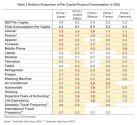
The reality is that Chinese consumption is not low at its level of economic development. Looking at GDP myopically won't give you that understanding, you have to look at the actual material quantities being consumed. When a decent EV costs a little less than $10000 USD and average cost of housing and cost of essentials is relatively low, you are going to be put in a situation where households have a surplus that they can choose not to spend immediately.

You can see in the below graph a physical quantities consumed ratio between China/other country, and look at how much higher this ratio is for most categories of products/services than the reported final consumption per capita ratio which just looks at monetary quantities.

6675.jpg

Please, Log in or Register to view URLs content!

The only way to sustainably maintain economic growth is by improving productivity and making sure the gains of the productivity improvements are equitably distributed, that's basically the only path. You have to reduce the human labor per worker necessary to reproduce a modern existence for the country's population. Japan became a primarily private consumption based economy and could not sustain their level of investment intensity after the asset bubble burst and thus could not continue increasing their productivity per worker, which is why they have been stagnant for 3 decades+ now.
 

antiterror13

Brigadier
Another point is that Japan in the early '90s and China today are completely different beasts. Japan was (and is) practically a US vassal state that buckled to whatever Washington wanted. That's exactly why the Plaza Accord happened, which is still a major factor in Japan's economic stagnation today.

China is entirely different. They are geopolitically independent, they can say "No," and they can actively fight back.

Also, as @tamsen_ikard pointed out, China's GDP per capita is still way lower than the US. In PPP terms, it's only about a third of the US level, whereas Japan’s GDP per capita actually surpassed the US in the '90s. This means China still has massive room to grow.

When you factor in that China is roughly 25x larger geographically and has 11–12x the population of Japan (while Japan was only about half the population of the US in the '90s), the comparison falls apart. The original analysis is just cherry-picking data to suit a specific narrative while ignoring major structural facts.
 

vincent

Grumpy Old Man
Staff member
Moderator - World Affairs
but the point was to fix domestic consumption which it failed to do. Japan was already high income so atleast they were not stuck in middle income. South Korea and Taiwan still had a growth rate of 7-9% when they became high income countries. China’s not at high income yet and its growth rate is already down to 5%. Doesn’t it need to fix domestic consumption to drive growth more than Japan did? And on top of this they have the United States coming after them with everything they have and global instability.
China produces vast majority of cigarettes lighters of the world yet no one complained Chinese aren't buying enough of them themselves. China consumes majority of the passenger vehicles she produces and only export a small portion of them, yet you hear the West's endless bitching. That should tell you about the nature of the "overcapacity"/"weak consumption" narratives.
 

vincent

Grumpy Old Man
Staff member
Moderator - World Affairs
Please, Log in or Register to view URLs content!

Related article to the recent discussion. They’re saying that China’s approach is actually very similar to Japan’s approach to addressing domestic demand which while making them competitive in new technologies at the time, didn't work to address demand.


“In fact, most economic historians would
Please, Log in or Register to view URLs content!
that Tokyo in the late 1980s and 1990s, like Beijing today, found it politically difficult to address its deep, demand-side imbalances and instead hoped to accelerate supply-side reforms by focusing on the development of new technology.

At the time, Tokyo expected that technological advancement would lead to large enough technological breakthroughs and productivity gains for the overall economy that Japan would be able to rebalance its economy towards a greater role for domestic demand without slowing the growth of the supply side. It would be growth in supply that would drive even faster growth in demand.”

thoughts? I think there’s something missing here.
You should mention the author of the article is Michael Pettis, the China Collapse Forever man
 

Wrought

Captain
Registered Member
It seems Hong Kong is adopting its first-ever FYP.

The city’s blueprint will synchronize with and serve the national development plan while upholding a free-market economy, Tse said. “Aligning with the national 15th five-year plan does not replace the free market,” she said. “Rather, it channels a clear vision and strategic planning through major policies, and that allows the market to develop more stably and clearly.”

Under the plan, Hong Kong will strengthen its position as an international financial, maritime and trade center, Tse said. Hong Kong officials have proposed accelerating the development of the
Please, Log in or Register to view URLs content!
, an ongoing project that envisions building a new IT hub and a university town near the Chinese tech hub of Shenzhen just across the border. They also hope to deepen development of the Greater Bay Area, which is Beijing’s plan to form an integrated business and economic hub including Hong Kong, Macao and nine other mainland Chinese cities. Hong Kong leader John Lee said on June 9 that the five-year plan would better integrate a “capable government” with “an efficient market” as the government plays a leading role in stimulating the market’s competitiveness. The plan also will help residents understand their personal development opportunities and ease business planning, Lee said.

Please, Log in or Register to view URLs content!
 
Top