Chinese Economics Thread

kentchang

Junior Member
Registered Member
That is probably not gonna for atleast 50-60 years cause China will remain laser focused on first island chain. And even if China developed a large navy with 20 aircraft carriers, it will still not match US power projection capability.

Why? Because you need bases and allies. US is an empire and has literal vassals all over the world. China does not have that.

US has so much power because it has established itself literally on the world system. China is still an outsider.

60 years is way too pessimistic and plainly wrong. Your views are quite outdated as you assume a much more static world 60 years from now. How different are the people in 2026 vs 1966? We all have Baby Duck Syndrome to a degree and our world view is shaped by what we learned in our formative years. All surveys show American and European teenagers today have no issue accepting East Asians as equals or even superior if they had Asian kids in their schools. 20 to 30 years from now, these kids will be the dominant voice while the older generation will have faded away, especially the ones brought up in the 1950s to the 1970s. Elections in South Korea for the past couple decades show a clear trend towards reconciliation with the North. Same with the rising nationalism/militarism in Japan. Perceptions are always generational and that explains why China's fantastical rise has not translated into comparable soft powers YET.

US does have lots of bases and 'allies' today. 20 to 30 years from now, probably much less bases and even less dependable 'allies'. These 'vassal' state leaders don't act blindly and they are all highly educated and genuinely want the best for their own countries (Marcos aside). The Iran War clearly showed bases near conflict area are more hostages/liabilities than assets. It won't take 20 to 30 years for US to drastically reduce that number for both financial and political reasons. The new generation of voters will question and ask what they are for when US is no longer the premier economic power and thus nothing to protect. The British people went through the same exercise after the Suez Canal Crisis and the American people will do the same. Common people are quite practical/realistic and the liberal democratic systems they have will guarantee their voices to be heard. A Win by the Sword, Die by the Sword situation.

China never wanted to be part of the current world order. China could have but refused to be part of the G2 because China wants to define and shape a new world order to the detriment of the current beneficiaries. Judging by the huge wealth disparity in the world, not a bad idea. The current one, just like the concept of G7, is gradually losing its grip. Gradual transition is good. Soft power is derived from perceived trickle-down sharing of the hegemon wealth. Africa and to a lesser degree, Latin America show what happens if the perceived benefits from being friends with America are no longer there. Lula's recent defiant speech is a good example.

Europe has already faded into irrelevance in the bigger picture. Europeans love to fight so just confine them to Europe and leave them alone. Signs of US fading is getting clearer and clearer. Just like the Qing Dynasty, US is desperately trying to isolate itself but we all know how badly things turned out for the Qing Dynasty. US will be no different. So many parallels. You cannot have a powerful country without a strong unified and well-funded central government. The immense accumulated private wealth of the Southern Song Dynasty could not save the Dynasty. Both US and Europe are fading away because the nations have no direction and that is not going to change. The rising of the extreme-right is a clear warning sign but the same liberal democratic process will ensure chaos rather than the beginning of a new direction.

You seem to want the current world order to stay. You will be disappointed. Things change and we are at that cusp in history to have a country willing and able to do so. Taking a snapshot of today to conclude the future is silly. You have to look at the mega-trends otherwise you are just expressing your fantasies.
 

Wrought

Captain
Registered Member
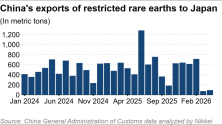
HREE exports to Japan have fallen off a cliff in recent months.

Exports of the seven rare earths for the January-April period fell 34% on the year, with steeper declines of 88% for March and 82% for April. Dysprosium and terbium, used in magnets for electric vehicle motors, saw exports fall to zero since January. Yttrium exports for the January-April period dropped more than 90%. The rare-earth element is crucial in laser-equipped medical devices and chipmaking equipment, as well as in the aircraft and space fields. Magnets that use restricted rare earths are also facing hurdles, with an executive at a Japanese company saying that "hardly any export authorizations have been granted for high-performance magnets with dysprosium."

Yet alternatives are not easy to find. An executive at a major Japanese manufacturer expressed concern, saying that "production in Japan will be disrupted with factories stopping operations if current conditions continue." The Japanese government is carefully monitoring whether companies struggling to source rare earths are shifting production to China.

1780863960393.png

Please, Log in or Register to view URLs content!
 

Wrought

Captain
Registered Member
May trade figures came in very strong again, both imports and exports.

Overall exports rose 19.4% from a year earlier in U.S. dollar value terms,
Please, Log in or Register to view URLs content!
, accelerating from the 14.1% gain in April. Economists polled by Reuters had pegged growth at 15%. Shipments to the U.S. soared nearly 35.4% in May from a year earlier, the highest growth since March 2021, according to Wind Information, extending a rebound following a long streak of double-digit declines for the most of last year, pressured by President Donald Trump’s tariffs.

Imports growth momentum continued to build, expanding 27.4% in May, the outpacing from 25.3% in April, beating economists’ forecast for a 25% growth. That boosted the trade surplus to $105.4 billion in May. In the first five months this year, China’s import growth has accelerated sharply, rising 24.5% from a year earlier, outpacing 15.5% exports over the same period,
Please, Log in or Register to view URLs content!
from a year earlier.

Please, Log in or Register to view URLs content!
 

madhusudan.tim

New Member
Registered Member
I have these questions in my mind, about the global trade and economy. Why do we trade? Isn’t it done to collect coins by selling some stuffs that you have in abundance, so later use that coin to purchase some other stuff that you lack from others? Ultimate aim: have a higher quality of life for a sustained period of time while insuring the population against potentially adverse events. But what I see is, China is selling so much to others and also collecting coins, but it is not being used and is being stored in a vault owned by its adversary. And it does not has that much to buy from others, or at the moment is not buying that much from others. So the question is, whats the point of working so hard, and selling everyday commodities to the world and generating record surplus , when you know that the surplus has to be kept in USD, has not made life of citizens meaningfully better? I know it needs semiconductors, crude oil, minerals and foods, and few others. But in this geopolitical environment, every passing day, these vulnerable needs are being constrained. Constrained crudes, constrained semiconductor supply, attempt to constrain mineral supply as well, and potentially food grain supply as well. So in this environment isn’t it the best economic choice to create massive stockpiles of things that you don’t dont have, even at the elevated purchase prices? Isn’t it to develop capacity to ensure that it continues to get the supplies that it needs and thwart attempts to sabotage it? Selling ultra cheap goods to Europe and US through Temu makes little strategic sense given that it has directly indirectly improved the quality of life there while earning so little, and even that can’t be used to get what you sorely need, ASML NVIDIA products. To me, the best economic choice for the optimal usage of money from surplus is to invest in creating ultra massive multi year buffers of essentials, and developing capacity to ensure the integrity of its trade networks and allies.
 

fishrubber99

Junior Member
Registered Member
To me, the best economic choice for the optimal usage of money from surplus is to invest in creating ultra massive multi year buffers of essentials, and developing capacity to ensure the integrity of its trade networks and allies.
You are describing the Belt and Road initiative, it's basically a massive scheme in recycling China's trade surplus into tangible infrastructure which benefits China's commodity and trade networks with the rest of the planet. They are also building up very large reserves of commodities of precious minerals, oil, certain kinds of agricultural products like soybeans, etc. They are generally doing what you're suggesting already.

Another thing you are missing is that China has a big trade surplus, but also a relatively big service deficit. Chinese people are still vacationing abroad, attending schools in foreign countries, IP royalties, etc. So a large trade surplus facilitates this.

And one more thing is that you want a sufficient amount of foreign reserves to manage the value of your currency, you want enough "ammunition" to fend off currency short sellers and rapid currency depreciation.
 

siegecrossbow

Field Marshall
Staff member
Super Moderator
I have these questions in my mind, about the global trade and economy. Why do we trade? Isn’t it done to collect coins by selling some stuffs that you have in abundance, so later use that coin to purchase some other stuff that you lack from others? Ultimate aim: have a higher quality of life for a sustained period of time while insuring the population against potentially adverse events. But what I see is, China is selling so much to others and also collecting coins, but it is not being used and is being stored in a vault owned by its adversary. And it does not has that much to buy from others, or at the moment is not buying that much from others. So the question is, whats the point of working so hard, and selling everyday commodities to the world and generating record surplus , when you know that the surplus has to be kept in USD, has not made life of citizens meaningfully better? I know it needs semiconductors, crude oil, minerals and foods, and few others. But in this geopolitical environment, every passing day, these vulnerable needs are being constrained. Constrained crudes, constrained semiconductor supply, attempt to constrain mineral supply as well, and potentially food grain supply as well. So in this environment isn’t it the best economic choice to create massive stockpiles of things that you don’t dont have, even at the elevated purchase prices? Isn’t it to develop capacity to ensure that it continues to get the supplies that it needs and thwart attempts to sabotage it? Selling ultra cheap goods to Europe and US through Temu makes little strategic sense given that it has directly indirectly improved the quality of life there while earning so little, and even that can’t be used to get what you sorely need, ASML NVIDIA products. To me, the best economic choice for the optimal usage of money from surplus is to invest in creating ultra massive multi year buffers of essentials, and developing capacity to ensure the integrity of its trade networks and allies.
we trade because some countries are more efficient at producing certain goods and services than others.
 

HighGround

Senior Member
Registered Member
I have these questions in my mind, about the global trade and economy. Why do we trade?

We trade because it's more efficient.

Ultimate aim: have a higher quality of life for a sustained period of time while insuring the population against potentially adverse events. But what I see is, China is selling so much to others and also collecting coins, but it is not being used and is being stored in a vault owned by its adversary.

It's a tradeoff decision. China chooses to store its surplus in US treasuries (amongst other securities) because it's extremely easy to liquidate if you need to, and it also earns you a small return throughout the life of the bond. In an event of seizure, the entire global economy would freeze anyway because China is an enormous economic heavyweight.

So you're not entirely wrong to be skeptical, and indeed, there are many people who would argue that China should have a different mixture of assets, but it is what it is.

And it does not has that much to buy from others, or at the moment is not buying that much from others.

This is false. China is the second largest global importer. It buys an enormous quantity of products and will continue to do so.

So the question is, whats the point of working so hard, and selling everyday commodities to the world and generating record surplus , when you know that the surplus has to be kept in USD, has not made life of citizens meaningfully better?

Working this hard is what has generates enormous benefits to Chinese workers. Companies sell things to foreigners, the generated cash is used to improve the factory, pay higher wages, etc. Taxes on companies generate more and more money as you export more, this allows local provinces to spend directly and borrow to improve hospitals, roads, housing, etc.

Export-led growth is what generated the cash and allowed you to import the necessary technology to educate yourself and build the country. The more you do this, the more money cycles through creating a virtuous cycle.

I know it needs semiconductors, crude oil, minerals and foods, and few others. But in this geopolitical environment, every passing day, these vulnerable needs are being constrained. Constrained crudes, constrained semiconductor supply, attempt to constrain mineral supply as well, and potentially food grain supply as well. So in this environment isn’t it the best economic choice to create massive stockpiles of things that you don’t dont have, even at the elevated purchase prices? Isn’t it to develop capacity to ensure that it continues to get the supplies that it needs and thwart attempts to sabotage it?

What you have to understand is that China doesn't like this. In fact most countries don't. If you ask Russia what was the best economic environment in recent history, it's early 2000s.

Russia didn't need to stockpile anything, it sold all the oil it could, and it used that money to invest into its own economy, buy things it needed to, and generally improve the lives of its citizens.

China wants the same thing.

This whole thing of needing to stockpile resources and equipment, building warehouses to store those reserves, creating redundant supply chains, etc. It didn't want to do that. At least not to this extent.

Every "extra" resource you buy is money that could've been used to buy something you'd consume today. Every warehouse you build to store it is space that could've been used for something else. So yes, redundancy protects you, but it also incurs a cost. So this situation isn't ideal. The most ideal situation is one where the world is entirely peaceful, people compete peacefully, and everybody's basic needs are met.

Selling ultra cheap goods to Europe and US through Temu makes little strategic sense given that it has directly indirectly improved the quality of life there while earning so little, and even that can’t be used to get what you sorely need, ASML NVIDIA products.

Temu earns billions from these sales. Temu workers get paid and spend their money on whatever it is they need or want. Why would China shun this money? Yeah, it can't buy ASML machines or Nvidia products, but they can buy whisky, foreign beef, foreign movies. Whatever.

You might think these luxuries are silly or unnecessary. I say, luxuries are fun, and having fun with your family is the entire point of living. Once your basic needs are met, spoil yourself a little, and you can't do that without earning as much money as you can.

To me, the best economic choice for the optimal usage of money from surplus is to invest in creating ultra massive multi year buffers of essentials, and developing capacity to ensure the integrity of its trade networks and allies.

No. The best economic choice is one that wastes the least amount of economic output. Why would you needs multi year buffer of essentials if you never use them?

Imagine what you could've done with all that money you invested. You could've spent it on getting a lead somewhere else. On building more schools, colleges, etc.

An economy needs to be more efficient, not less. In this charged geopolitical environment, governments need to be cautious, but not wasteful.
 

tokenanalyst

Lieutenant General
Registered Member
I have these questions in my mind, about the global trade and economy.
ok
Why do we trade?
Because you have things my people want and I have things you people want. We can kill each other in endless wars for resources, we can exchange the things I have in excess for the things you have in excess or I can get your stuff and I would give you a worthless piece of paper, but wait a minute you said that is NOT FAIR why a piece of paper. That piece of paper is backed by a gigantic amount of gold (used to be backed), until some humans find out that wars and keeping global footprint is expensive and to pay for them we cannot rely on gold alone, so humans made a deal with Centrals Banks that will promise you, wink wink, that the piece of paper will have some value.

Isn’t it done to collect coins by selling some stuffs that you have in abundance, so later use that coin to purchase some other stuff that you lack from others? Ultimate aim: have a higher quality of life for a sustained period of time while insuring the population against potentially adverse events. But what I see is, China is selling so much to others and also collecting coins, but it is not being used and is being stored in a vault owned by its adversary. And it does not has that much to buy from others, or at the moment is not buying that much from others.
China is buying a lot from others, given is the second largest importer in the world. I dont see why they will buy stuff that they can make cheaper. China will not solve Europe energy problem, they can, but Europeans dont want to import it. Also is not going to buy things that US doesn't want to sell like GPUs.
So the question is, whats the point of working so hard, and selling everyday commodities to the world and generating record surplus , when you know that the surplus has to be kept in USD, has not made life of citizens meaningfully better? I know it needs semiconductors, crude oil, minerals and foods, and few others. But in this geopolitical environment, every passing day, these vulnerable needs are being constrained. Constrained crudes, constrained semiconductor supply, attempt to constrain mineral supply as well, and potentially food grain supply as well. So in this environment isn’t it the best economic choice to create massive stockpiles of things that you don’t dont have, even at the elevated purchase prices? Isn’t it to develop capacity to ensure that it continues to get the supplies that it needs and thwart attempts to sabotage it? Selling ultra cheap goods to Europe and US through Temu makes little strategic sense given that it has directly indirectly improved the quality of life there while earning so little, and even that can’t be used to get what you sorely need, ASML NVIDIA products. To me, the best economic choice for the optimal usage of money from surplus is to invest in creating ultra massive multi year buffers of essentials, and developing capacity to ensure the integrity of its trade networks and allies.
China buys if you wants to sell, if you don't want to sell, they move to whatever want to sell, is your loss, If you dont want to sell GPUs they will make their own and sell it to you back, you dont want to lithography machines they will make their own and sell it you back. The buy food from countries that with good willing want to sell their food. They could move their entire park to electrics including trucks and container ships which could be the biggest loss for the Middle East as China reduce their oil consumption that mean less revenue.

At the end trade is about convenience and because is easier than some alternatives.
 

madhusudan.tim

New Member
Registered Member
we trade because some countries are more efficient at producing certain goods and services than others.
My whole question was, whats the point of all this being efficient and innovative when you cannot buy what you need yourself, while having massive surplus? Why is the primary beneficiary of this efficiency and innovation, an European, Arab or North American, and not a regular Chinese? Increasing the minimum wages of workers and massive quantitative easing should have been done, given the lower impact of
ok

Because you have things my people want and I have things you people want. We can kill each other in endless wars for resources, we can exchange the things I have in excess for the things you have in excess or I can get your stuff and I would give you a worthless piece of paper, but wait a minute you said that is NOT FAIR why a piece of paper. That piece of paper is backed by a gigantic amount of gold (used to be backed), until some humans find out that wars and keeping global footprint is expensive and to pay for them we cannot rely on gold alone, so humans made a deal with Centrals Banks that will promise you, wink wink, that the piece of paper will have some value.


China is buying a lot from others, given is the second largest importer in the world. I dont see why they will buy stuff that they can make cheaper. China will not solve Europe energy problem, they can, but Europeans dont want to import it. Also is not going to buy things that US doesn't want to sell like GPUs.

China buys if you wants to sell, if you don't want to sell, they move to whatever want to sell, is your loss, If you dont want to sell GPUs they will make their own and sell it to you back, you dont want to lithography machines they will make their own and sell it you back. The buy food from countries that with good willing want to sell their food. They could move their entire park to electrics including trucks and container ships which could be the biggest loss for the Middle East as China reduce their oil consumption that mean less revenue.

At the end trade is about convenience and because is easier than some alternatives.
I know its little obnoxious, but I see the future with ever increasing hostilities, ever increasing irrational wars and irrelevance of existing global order. You cannot assume to the leeway to have multiple options for resource purchase. Take Iran war for example, or add Ukraine war, the reason why they continue abated with huge sums of money invested is they are keys resource suppliers with antagonistic foreign policy. And they will end only when there is an alternate regime in place which just folds like Venezuela. At some point China has to decide, if it is content being a peaceful, culturally uniform, hardworking, nation with citizens having good enough life, just like a better Japan, or if it wants to be truly great , the one, with the drive to achieve with all the means it has. I think it has become too much cautious, too much inward looking, too much risk averse, both politically, socially, and economically. It has tendency to scale the things which has been validated elsewhere, take EV, reusable rockets, internet constellations, humanoid robots, evtols, etc., despite having all the ingredients in place for it to bring the innovation itself. Take the IPO of SpaceX vs upcoming CXMT, the relative value proposition of CXMT is enormous given it gives China the ability to have semiconductor self sufficiency and thus more geopolitical freedom. But SpaceX was able to do daylight robbery with terrible ROI, with government contracts being the only meaningful revenue source. But, it will give them enough capital to build strategic infrastructure and capability. I would have rather, CXMT or YMTC given this freedom to raise substantial capital and build the necessary capacity.
 
Top