Wouldn’t look much into those figures, since Chinese government often prefers to under promise and over deliver .I looked into this more. It appears China's definition of 粮食 includes grains as well as soybeans, potatos, etc. So I stand corrected, the planned increase in total 粮食 production from 715 Mt to 725 Mt is indeed somewhat conservative.

You are using an out of date browser. It may not display this or other websites correctly.
You should upgrade or use an alternative browser.
You should upgrade or use an alternative browser.
Chinese Economics Thread
- Thread starter Norfolk
- Start date

Inflation readings came in quite strong last month, thanks to CNY holiday spending.
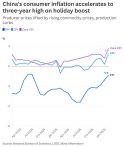
China’s consumer inflation recorded the biggest jump in more than three years, as an extended holiday bolstered spending while deflation in factory-gate prices moderated. The consumer price index rose 1.3% in February from a year earlier, China’s National Bureau of Statistics data showed Monday, beating economists’ forecasts for a 0.8% increase in a Reuters poll. The increase, following a 0.2% rise in January, marked the strongest rebound since January 2023, according to LSEG data. On a monthly basis, prices gained 1% in February, above economists’ expectations for a 0.5% rise. Core CPI, which strips out volatile food and energy prices, climbed 1.8% last month from a year earlier, matching the pace last seen in March 2019, according to official data compiled by Wind Information.

Customers select goods at a supermarket in Mengzi, southwest China's Yunnan Province, on March 9, 2026. China's consumer price index (CPI), a main gauge of inflation, rose 1.3 percent year on year last month, driven by the effects of the Spring Festival holiday, official data showed on Monday. The core CPI, which excludes food and energy prices, increased 1.8 percent year on year, according to data released by the National Bureau of Statistics (NBS). On a month-on-month basis, CPI went up 1 percent in February from the 0.2-percent gain in the previous month, the highest in nearly two years, the data revealed. (Photo by Xue Yingying/Xinhua)
A customer buys mushrooms at a market in Nanjing, east China's Jiangsu Province, on March 9, 2026. (Photo by Shi Jun/Xinhua)
A customer selects fruits at a supermarket in Wuxi, east China's Jiangsu Province, on March 9, 2026.(Photo by Huan Yueliang/Xinhua)
A customer buys vegetables at a market in Yuhuatai District of Nanjing, east China's Jiangsu Province, on March 9, 2026. (Photo by Fang Dongxu/Xinhua)
BEIJING, March 9 (Xinhua) -- China's consumer price index (CPI), a main gauge of inflation, rose 1.3 percent year on year last month, driven by the effects of the Spring Festival holiday, official data showed on Monday.
The core CPI, which excludes food and energy prices, increased 1.8 percent year on year, according to data released by the National Bureau of Statistics (NBS).
Monday's data also revealed that the producer price index (PPI), which measures costs for goods at the factory gate, went down 0.9 percent year on year last month, with the decline narrowing continuously, the NBS noted.
This narrowing was driven by a rise in global commodity prices, rapid demand growth in certain domestic industries, and the continued effectiveness of macroeconomic policies, NBS statistician Dong Lijuan explained.
Compared with the same period last year, affected by the shift of the Spring Festival and the recovery of consumption demand, the rise of CPI in February expanded to 1.3 percent from the 0.2-percent gain recorded in the previous month, marking the highest increase in nearly three years, Dong pointed out.
A closer look shows that service prices rose by 1.6 percent in February, with the growth rate expanding by 1.5 percentage points from the previous month, contributing approximately 0.75 percentage points to the year-on-year CPI increase.
In the service sector, prices of airline tickets, transportation rentals, travel agency fees and hotel accommodation respectively increased by 29.1 percent, 19.8 percent, 12.5 percent and 5.4 percent in February.
Prices of pet services, vehicle repair and maintenance, household services and food deliveries rose by 13 percent, 12 percent, 6.3 percent and 5.6 percent, respectively, last month.
Prices of fresh vegetables, beef, mutton and fresh fruits increased by 5.9 percent to 10.9 percent in February, with the increase wider than that seen in the previous month. Together, these food price increases contributed roughly 0.41 percentage points to the year-on-year rise in the CPI.
On a month-on-month basis, CPI went up 1 percent in February from the 0.2-percent gain in the previous month, the highest in nearly two years, the data revealed.
Industrial consumer goods prices rose by 0.4 percent, an increase of 0.1 percentage points compared with the previous month.
Notably, domestic gold jewelry prices increased by 6.2 percent due to an upward trend in international gold prices. The impact of international geopolitical conflicts on energy prices also became evident in February, leading to a 3.1-percent rise in domestic gasoline prices. Together, these two factors contributed about 0.12 percentage points to the month-on-month increase in the CPI.
Compared with the same period last year, China's PPI declined by 0.9 percent, with the rate of decrease narrowing by 0.5 percentage points from the previous month, marking three consecutive months of reduced decline.
The integrated effects of domestic macroeconomic policies continued to manifest last month, with prices in certain industries showing positive changes, Dong said.
The "AI Plus" initiative developed vibrantly, as prices of electronic components and specialized electronic materials manufacturing rose by 4.9 percent, prices of micro-motor control machines increased by 1.6 percent, and prices of service consumption robot manufacturing grew by 0.7 percent.
The green transition advanced steadily, with biomass fuel processing prices up by 3.2 percent and prices of environmental protection specialized equipment manufacturing rising by 0.6 percent.
High-end equipment maintained robust growth, seeing aircraft manufacturing prices increasing by 7.7 percent in February.
The PPI, meanwhile, increased by 0.4 percent month on month, according to the NBS data.
China's PPI has increased on a monthly basis for five consecutive months, Dong said, noting that this trend has been fueled, in particular in February, by the upward trend of international non-ferrous metal and crude oil prices that drove up prices of related domestic industries, and the growth of computing power which also increased demand in some industries and resulted in corresponding price increases.
Soybean is a legume, not a grain!
Your numbers actually prove my point. China's biggest agricultural import dependence by far is soybeans, not grains. As a country with very limited arable land for the size of its population, should China prioritize reducing its massive soybean dependence on imports or use its limited land resources to increase production of grains that it's essentially already self-sufficient on?
Soybeans are also significantly more expensive than grains and require far less fertilizer input (with crop rotation, growing soybeans will even reduce fertilizer use for other crops). So even completely ignoring food self-sufficiency concerns, it is far more economical to use limited land resources to increase high margin soybean production instead of low margin grains.
Soybeans are predominantly used as feed for livestock (pork), it's not an essential import. Pork production can reduce in times of war, but aside from that, you can also just use other feed which will just be a bit less efficient (less protein content).

FriedRiceNSpice
Major
Meat is extremely inefficient compared to plant based food. Copious amounts of meat is a peacetime luxury and completely unnecessary. In fact current levels of meat consumption already exceeds ideal amount for East Asian metabolism.Soybeans are predominantly used as feed for livestock (pork), it's not an essential import. Pork production can reduce in times of war, but aside from that, you can also just use other feed which will just be a bit less efficient (less protein content).
Last edited:
Meat is extremely inefficient compared to plant based food. Copious amounts of meat is a peacetime luxury and completely unnecessary. In fact current levels of meat consumption already exceeds ideal amount for East Asian metabolism.
Oh for sure. I mean, you're converting plant protein to animal protein before consuming it, so much is lost in the conversion. And like you said, it's not healthy either the amount even the Chinese consume these days.
Yes. Also look up feed conversion ratio for different kinds of meat. Chicken is over twice as efficient as pork and five time as beef at converting feed to meat protein. The current meat production in China is optimized for taste preference not efficiency. In times of soybean shortages, consumers would simply switch from pork and beef to chicken and eggs. Also don’t forget about 5% of China’s grain production is used for making alcoholic beverages, which is about equivalent to a third of China’s total soybean importSoybeans are predominantly used as feed for livestock (pork), it's not an essential import. Pork production can reduce in times of war, but aside from that, you can also just use other feed which will just be a bit less efficient (less protein content).

FriedRiceNSpice
Major
Beef is mostly imported, isn't it? The cattle industry is also a major source of green house gas emission. Beef has the largest carbon footprint out of any meat by far. Beef is not even a traditional Chinese food and doesnt even taste good. For the average American, a year of beef consumption has a carbon footprint roughly equivalent to ~3 months of driving an ICE vehicle. Beef consumption is responsible for around 6-8% of global greenhouse emissions.Yes. Also look up feed conversion ratio for different kinds of meat. Chicken is over twice as efficient as pork and five time as beef at converting feed to meat protein. The current meat production in China is optimized for taste preference not efficiency. In times of soybean shortages, consumers would simply switch from pork and beef to chicken and eggs. Also don’t forget about 5% of China’s grain production is used for making alcoholic beverages, which is about equivalent to a third of China’s total soybean import
Last edited:
Trade boom: China’s exports surge 21.8% in first 2 months of year
Imports for the first two months also rose by 19.8%
Imports for the first two months also rose by 19.8%
Exports to the United States fell 11 per cent, year on year, in the first two months of 2026, the data showed, compared with a 30 per cent decline in December and a 20 per cent drop for all of last year. Despite the slump, the US remained China’s largest single-country export market in 2025.
Meanwhile, shipments to members of the Association of Southeast Asian Nations – China’s largest trading partner by bloc – jumped 29.4 per cent in the first two months of this year, following growth of 11.2 per cent in December and 13.4 per cent for all of last year.
Exports to the European Union surged by 27.8 per cent in the first two months of the year, compared with an 11.6 per cent rise in December and 8.4 per cent growth for all of last year, with shipments to Germany, France and Italy seeing 31.3, 31.9 and 36.4 per cent growth, respectively.
Exports to Latin America climbed 16.4 per cent in the first two months of the year after growing by 9.8 per cent in December, while shipments to Africa jumped nearly 50 per cent after expanding by 21.8 per cent in December.
Last edited: