0.85m diameter might refer to the longest diagonal for a rectangular or trapezoidal shaped cross sectional profile. That might be doable for the J-20/J-35’s weapons bay.To be honest if the specifications are accurate and able to be achieved I would be mightily impressed -- a 1.3t weapon, 4m or lesser in length, and 0.85m or lesser in diameter, actually seems somewhat beyond what J-20/35's IWB would be able to accommodate in terms of diameter.
Keep in mind 0.85m is the same diameter of the UVLS canister, and the diameter of an equivalent IWB ALCM like JSM is 0.48m in diameter...

You are using an out of date browser. It may not display this or other websites correctly.
You should upgrade or use an alternative browser.
You should upgrade or use an alternative browser.
Chinese air to ground weapons (missiles, PGMs, etc)
- Thread starter AssassinsMace
- Start date

0.85m diameter might refer to the longest diagonal for a rectangular or trapezoidal shaped cross sectional profile. That might be doable for the J-20/J-35’s weapons bay.
That is true, I suppose it depends on how it is measured.
I do wonder whether the rear V tails would be capable of folding in a more compact manner, as they would likely increase its horizontal footprint somewhat. Though I suppose in theory it may still permit carriage of a likely PL-16 sized BVRAAM adjacent to each ALCM such as two PL-16s with two of these ALCMs. Though folding tails may permit for even carriage of four such ALCMs.
The benefit of such a weapon for the likes of GJ-11/21 also cannot be ignored.
==
In any case it seems like there must be an original paper that this is from. It's a shame that whenever these sort of study pics are posted by people on the Chinese side they seem reluctant to link to the title of the original study.

The benefit of such a weapon for the likes of GJ-11/21 also cannot be ignored.
Do we know the exact length and width of the internal weapons bay of the GJ-11 or GJ-21?

The term eluded me when I first wrote the message - staggered arrangement.What we do know is that such a weapon (IWB compatible ALCM) has long been rumoured to be either in development or (and in recent years, in service) with the PLA.
Whether it is this specific weapon depicted in the study is a different matter. After all, not everything in an academic paper is necessarily representative of what is actively developed for PLA use.... but also, it is true that what we see in academic papers published in a given time period is not necessarily indicative of the stage of development it is at. (E.g. a paper for a system might only be published years after it is in service)
Longitudinal clearance is important. In fact I would say a sub-4m length is exactly what one would expect for a ALCM sized for J-20/35 family IWBs.
To be honest if the specifications are accurate and able to be achieved I would be mightily impressed -- a 1.3t weapon, 4m or lesser in length, and 0.85m or lesser in diameter, actually seems somewhat beyond what J-20/35's IWB would be able to accommodate in terms of diameter.
Keep in mind 0.85m is the same diameter of the UVLS canister, and the diameter of an equivalent IWB ALCM like JSM is 0.48m in diameter...
For a weapon of this category, you don't really need something like an A2G sensor capability. This sort of weapon is generally well beyond visual range, well beyond over the horizon, and acquires targeting data from offboard sources and is guided by satellite/INS/midcourse offboard sensors before terminal seeker/s take over.
Fitting inside the weapons bay won't have any bearing on a J-20/35 family IWB being able to "stack" more missiles? Longitudinally there obviously won't be any length for any weapons in "front" or "behind" such a weapon, and of course they can't stack weapons vertically above or below it for obvious reasons.
If you mean fitting weapons alongside (horizontally alongside) this ALCM in the IWB, that has no relation to the length of the weapon -- instead it is relevant to its diameter.
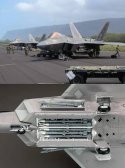
Notice how the missile needs a pretty significant gap length wise compared with the bay size for this to work. The mounting point on the missile does not change so when you shift the hard point, so must the missile.
Assuming the diagram provided in the paper represents an accurate profile I did some measuring of the cross sectional dimensions of the missile body ignoring the tails. Assuming a 0.85 meter diagonal, the width of the longest base for the missile cross section was 0.8 meters and the height was 0.5 meters. Off the top of my head the J-20’s weapons bay width is about 2 meters so it seems you’d only be able to fit one of these on each side of the bay. The most you’re mounting is 2 per plane if I measured correctly.The term eluded me when I first wrote the message - staggered arrangement.
View attachment 174271
Notice how the missile needs a pretty significant gap length wise compared with the bay size for this to work. The mounting point on the missile does not change so when you shift the hard point, so must the missile.
Last edited:
Assuming the drawings in the paper are correct, and assuming 4 meter length, the missile the paper talks about has a body that is 52 cm wide and 33 cm tall. Rear fin span is 88 cm. Sadly not measured to a pixel as i am on my phone, but should still be somewhat precise.
Jassm has sort of the same body shape, 168 inches long, 21 inches tall and 25 inches wide. 427x53x63 cm.
Actually, if true, all those figures makes me somewhat suspicious of that paper's content.
It is one thing to get so much range out of such a compact weapon. Jassm is bigger and more voluminous and yet it does something like 950 kg. But lets assume that smaller warhead and more advanced features produce more range.
But on top of that, the whole missile is described as weighing 1300 kg.
While jassm, which is bigger in every dimension, reportedly weighs 1000 to 1200 kg.
Again i am talking solely about the paper missile, not any actual plaaf system.
Jassm has sort of the same body shape, 168 inches long, 21 inches tall and 25 inches wide. 427x53x63 cm.
Actually, if true, all those figures makes me somewhat suspicious of that paper's content.
It is one thing to get so much range out of such a compact weapon. Jassm is bigger and more voluminous and yet it does something like 950 kg. But lets assume that smaller warhead and more advanced features produce more range.
But on top of that, the whole missile is described as weighing 1300 kg.
While jassm, which is bigger in every dimension, reportedly weighs 1000 to 1200 kg.
Again i am talking solely about the paper missile, not any actual plaaf system.
Some additional images from the paper with some other figures which contradict the <4m length, conveyed to me by a friend


Seems like overall total length is a combination/total of Lb3, Lh, and LtL for a total length of 4.673m, which makes a bit more sense for its size/weight, but would be too large for the J-20/35 family IWB.
Via here (additional pictures and discusison in the thread):
To be honest I don't really know what to make of it, seems like overall the paper is missing some details and I cannot capture what is the final recommended specs for this study.
Oh right. Ehhh in the case of a staggered arrangement the more important factor is the positioning of the fins and the missile body width in the weapons bay.
I'm not sure if the ALCM in this case is sufficiently narrow (especially its tail fins) enable a staggered carriage of the ALCMs itself, and for something like PL-16 we don't know its dimensions to make a call.
Seems like overall total length is a combination/total of Lb3, Lh, and LtL for a total length of 4.673m, which makes a bit more sense for its size/weight, but would be too large for the J-20/35 family IWB.
Via here (additional pictures and discusison in the thread):
To be honest I don't really know what to make of it, seems like overall the paper is missing some details and I cannot capture what is the final recommended specs for this study.
The term eluded me when I first wrote the message - staggered arrangement.
View attachment 174271
Notice how the missile needs a pretty significant gap length wise compared with the bay size for this to work. The mounting point on the missile does not change so when you shift the hard point, so must the missile.
Oh right. Ehhh in the case of a staggered arrangement the more important factor is the positioning of the fins and the missile body width in the weapons bay.
I'm not sure if the ALCM in this case is sufficiently narrow (especially its tail fins) enable a staggered carriage of the ALCMs itself, and for something like PL-16 we don't know its dimensions to make a call.
Last edited:
Some additional images from the paper with some other figures which contradict the <4m length, conveyed to me by a friend
Seems like overall total length is a combination/total of Lb3, Lh, and LtL for a total length of 4.673m, which makes a bit more sense for its size/weight, but would be too large for the J-20/35 family IWB.
Via here (additional pictures and discusison in the thread):
To be honest I don't really know what to make of it, seems like overall the paper is missing some details and I cannot capture what is the final recommended specs for this study.
Oh right. Ehhh in the case of a staggered arrangement the more important factor is the positioning of the fins and the missile body width in the weapons bay.
I'm not sure if the ALCM in this case is sufficiently narrow (especially its tail fins) enable a staggered carriage of the ALCMs itself, and for something like PL-16 we don't know its dimensions to make a call.
The one who posted these additional photos, @Crosshairs十字线, actually clarified in a discussion with @兰墨飞花_星海入梦日出烟燧 (who is the first one to post the excerpts of this academic paper on Weibo) that the listed specifications and performances with the <4 meters of length and <0.85 meters of diameter (which is from Segment 6.1 of the academic paper) are actually parameters from the base variant.
On the other hand, the specifications and performances listed by @Crosshairs十字线 in his Weibo post (~4.67 meters long, 600 mm wide, 400 mm high) are the parameters of the new variant, which was enhanced/upgraded from the base variant and is found in Segment 6.2 of the same academic paper (but not posted by him).
TL; DR - If this missile does exist (instead of being just a technical research/study model), then this missile would likely be a Chinese counterpart to the JASSM/LRASM.
Last edited:

Yep, though if infographic of J-20/35 bay is to be believed, it'll only fit into 35. J-20 has limitations going beyond sensors.For a weapon of this category, you don't really need something like an A2G sensor capability. This sort of weapon is generally well beyond visual range, well beyond over the horizon, and acquires targeting data from offboard sources and is guided by satellite/INS/midcourse offboard sensors before terminal seeker/s take over.
P.s. and tbh count me doubtful for 4m weapon bay-wide 1300kg weapon with this range. Something doesn't add up - to get this weight within this size, it should have a really, really heavy warhead. But it also flies to 1300?
Kh-69/jsm/som scream in agony.
I guess the 4 meters version is for J-20,J-35 and J-XDS, While the 4.67 meters version is for J-36 and H-20.The one who posted these additional photos, @Crosshairs十字线, actually clarified in a discussion with @兰墨飞花_星海入梦日出烟燧 (who is the first one to post the excerpts of this academic paper on Weibo) that the listed specifications and performances with the <4 meters of length and <0.85 meters of diameter (which is from Segment 6.1 of the academic paper) are actually parameters from the base variant.
On the other hand, the specifications and performances listed by @Crosshairs十字线 in his Weibo post (~4.67 meters long, 600 mm wide, 400 mm high) are the parameters of the new variant, which was enhanced/upgraded from the base variant and is found in Segment 6.2 of the same academic paper (but not posted by him).
TL; DR - If this missile does exist (instead of being just a technical research/study model), then this missile would likely be a Chinese counterpart to the JASSM/LRASM.