
You are using an out of date browser. It may not display this or other websites correctly.
You should upgrade or use an alternative browser.
You should upgrade or use an alternative browser.
China's Space Program Thread II
- Thread starter Blitzo
- Start date





China is falling more and more behind US in commercial space capacity. Being fair even if this worked, Chinese rockets for some reason have abysmal payload fractions especially compared to US counterpart with similar configuration. Point is, if it worked, there still is a very long road ahead to improve payload fraction and capacity to where SpaceX is right now and it didn't even work while SpaceX is still pushing ahead fast.
Its just disappointing, yesterday was the 10th anniversary of F9 FT's first flight and recovery.
That's sort of why it isn't a big deal, because a first launch successful landing wouldn't really mean much except for bragging rights.
The fact that they attempted a landing for the first maiden launch of this new rocket (like for ZQ-3) was impressive enough, and it shows that they had both the urgency and the will to attempt it.
The rest of the other commercial and state players will all be making re attempts and first attempts over the next half year or more, and it's the cumulative effect knowing most of them will end up being successful eventually, which is more important.
CZ-12A was a bit of a "bragging right" rocket, kinda, there's a reason CZ-12B is being worked on in parallel, or why SAST and CACL rushed to build a new launch pad just to have a launch in 2025 when the Wenchang site suffered delays to its adaptation, and SAST clearly defined the goals as Launch and Landing success, so yes it failed.
Definitely surprised it went worse than Landspace however, it seems it couldn't even restart the engines for the landing burn.
Anyway, CZ-12B, CZ-10B, Zhuque-3 Y2 and maybe CZ-12A Y2 & Nebula 1 should have a landing attempt in the first half of 2026.

Definitely surprised it went worse than Landspace however, it seems it couldn't even restart the engines for the landing burn.
Anyway, CZ-12B, CZ-10B, Zhuque-3 Y2 and maybe CZ-12A Y2 & Nebula 1 should have a landing attempt in the first half of 2026.
It has been reported that 1/3rd of the rocket engines on the first stage of CZ-12A have failed to relight during the re-entry burn.
Last edited:

Two payloads are being tracked, so the other stages succeeded as expected.
There should be some level of collaboration between these companies doing reusable rockets. Multiple space companies are all trying to individually do the same thing and you can’t have each one fail repeating the same mistakes. It just seems to waste time and resources when they are repeating each other’s mistakes. Some level of knowledge sharing so they can learn off each other will be better for China. The longer the delay for an operational reusable rocket, the further China will fall behind Starlink.
There's that Beijing Yizhuang Reusable Rocket Technology Innovation Center Co., Ltd. cooperation on RLV tech between CALT, CAS Space, Landspace and Galactic Energy, but ultimately you can't avoid some competition (even within CASC), and not all companies have made the same technical choices.There should be some level of collaboration between these companies doing reusable rockets. Multiple space companies are all trying to individually do the same thing and you can’t have each one fail repeating the same mistakes. It just seems to waste time and resources when they are repeating each other’s mistakes. Some level of knowledge sharing so they can learn off each other will be better for China. The longer the delay for an operational reusable rocket, the further China will fall behind Starlink.
Edit: "Long March 12A first flight test fundamentally/basically/rudimentary successful" official confirmation
Official picture:
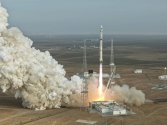
The Long March 12A is a medium-lift liquid oxygen-methane launch vehicle with "reusable first stage" as its core feature. The rocket is approximately 70.4 meters long, with both the first and second stages having a diameter of 3.8 meters, a fairing diameter of 4.2 meters, and a liftoff weight of approximately 437 tons.
Although this mission did not achieve the predetermined goal of first-stage recovery, it obtained crucial engineering data under actual flight conditions, laying an important foundation for subsequent launches and reliable stage recovery. The development team will conduct a comprehensive review and technical re-evaluation of the test process as soon as possible, thoroughly investigate the cause of the failure, continuously optimize the recovery plan, and continue to advance reusability verification
Last edited:
Oh yeah, and I can't edit it, but this was the 89th launch attempt of 2025.
Two payloads are being tracked, so the other stages succeeded as expected.

Starlink style sats can be launched just fine through "disposable" rockets. There's currently 2/2 countries on this planet even attempting reusability and 1/2 succeeding. Need to calm your horses man. Going numbers wise, China and the States are the only ones in the race, all others haven't even started off the line yet for this style of rocket.The longer the delay for an operational reusable rocket, the further China will fall behind Starlink