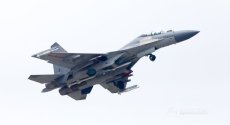
China Flanker Thread III (land based, exclude J-15)

tphuang

General
Staff member
Super Moderator
VIP Professional
Registered Member
presumably that means power generation was way overkill from the get go such that they don't need to upgrade upon it despite constantly increasing electricity requirements
That is unlikely. Today's expanding requirement for power consumption was hard to foresee even J-11B was being developed (let along when Su-27 was developed in 80s). Could I have imagined MW level power generation requirement even 5 years ago?

And even 10 years ago, was the technology mature enough to support the high voltage & cooling needed for today.

Remember, power = voltage x flow. High voltage means lower flow for given power rating. Heat generated is a function of flow and resistance in your electrical platform. You can see the availability of 1200V & 750V SiC chips now and the resistance on them. From generation to generation, power chips are both shrinking in size & seeing lower resistance for the same voltage. As such over the past 10 years, we've seen huge changes in terms of miniaturization of electrical system as well as higher voltage platform. All of which allow us to push through more power for the same real estate.

In the end of the day, amount of interior space can't change too much. In the case of J-16D and J-15DT, they sacrificed size of radar antenna in order to have more interior space, but that was necessary to support all the EW pods and antenna across the aircraft. But you really can't do that with the fighter jet, because the main radar is the most important part for electronic warfare and detection. Those passive array along the aircraft on traditional fighter jet is never going to consume as much power as the EW pods on J-16D.
Power generation is given top priority during upgrades. Radar/avionics are useless if you can’t power them properly.
Just to clear up something that when I use the phrase "power generation", I'm referring to all that's needed, not just generator itself.

Clarifying something that confused me a little when reading your post: are you saying that J16 production has stopped as of now (Feb 2026)? Maybe I missed something but I haven’t heard any discussion or news on the matter. That or you meant “when J16 eventually stop being produced” and I just suck at reading comprehension
I'm not sure. I don't really follow the production side of things as close as others here, but I'm under the impression that J-16 production has stopped, but J-16D is still ongoing.

Please don't take my word for that. Others would know better.
 

Wrought

Captain
Registered Member
I'm not sure. I don't really follow the production side of things as close as others here, but I'm under the impression that J-16 production has stopped, but J-16D is still ongoing.

Please don't take my word for that. Others would know better.

It was discussed last month in this very thread.

As a piece of supporting rumour (and I am really just mentioning this as support), a couple days ago 约克 said that production for the J-16 has already stopped, and only J-16Ds are still in production.

https:// youtu.be/C7HqYH2VJRw?t=4214

The video is members-only right now. They'll upload that part publicly in a couple of days.


Blitzo

General
Staff member
Super Moderator
Registered Member
Were original al-31f generators ever changed? This may have happened, but to my knowledge Russian OEM never demonstrated stronger ones for vanilla engine, only for al-41f.

I won't do a conclusive statement from what we see (absence of evidence), but tbh from what we see, I'd be rather surprised there's extreme power involved there.

On both AN/ALQ-99 and NGJ series(both MB and LN), power source is self-contained (though that visibly comes at expense of volume).

My understanding is that gensets are a separated component/system from the engine itself, like how a radar or an API or a ESM suite is a separate system.
 

latenlazy

Brigadier
My understanding is that gensets are a separated component/system from the engine itself, like how a radar or an API or a ESM suite is a separate system.
They are not necessarily “separate” but they are relatively modular. It’s basically the same deal as the alternator in a car in principle.
 

tphuang

General
Staff member
Super Moderator
VIP Professional
Registered Member
They are not necessarily “separate” but they are relatively modular. It’s basically the same deal as the alternator in a car in principle.
so I haven't looked into this deeply, but my impression is that the engine drives the generator, which to be means part of the thrust from the engine is used to generate electricity. So there is probably some negative effect on the engine thrust when you use a higher powered generator without having a more powerful engine.

Let's say a AL-31F has 80kN of dry thrust and you want this to power a 80 kW generator.

Using what google tells me Kp = 0.002 N/W. Using 80000 x 0.002 = 160 N. That seems like very manageable load.

according to Gemini, 80kN engine produces equivalent of 15000 to 25000 hp at high speeds. 80kW would be a little over 100 hp. So this seems to not be a big deal.
 

Blitzo

General
Staff member
Super Moderator
Registered Member
They are not necessarily “separate” but they are relatively modular. It’s basically the same deal as the alternator in a car in principle.

Well, when I say separate I mean that it is not something that needs the engine to be replaced for the genset itself to be replaced (or vice versa), and is appropriately viewed as its own subsystem.
 

latenlazy

Brigadier
Well, when I say separate I mean that it is not something that needs the engine to be replaced for the genset itself to be replaced (or vice versa), and is appropriately viewed as its own subsystem.
I suspect but can’t say for sure that you may have to modify some auxiliary systems on the engine too but those auxiliary systems should be modular enough that they shouldn’t involve a significant amount of design rework engineering or risk. Specifically what I’m thinking about here is all the components that go into the coupling mechanism between the generator and the turbine axel.
 
Last edited:

Blitzo

General
Staff member
Super Moderator
Registered Member
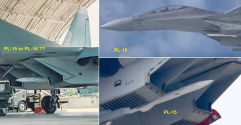
It doesn't look like PL-15 or PL-17. So what is this, PL-XX or PL-16?

View attachment 171367
View attachment 171366

Tbh it looks fairly consistent with PL-15, the forward fins would not be visible from this angle and PL-15 has that distinctive ventral protrusion/conformal antennae housing/whatever it is.

Of course it might be something else as well given we don't have a lot of other identifying details but it may just be PL-15 as well.

E.g.
J-16-with-PL-15-and-PL-10-3.jpg
 
Last edited:
Top