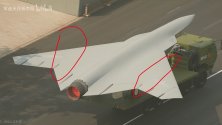
I'm not so sure the 2 6th gens are meant to operate in tandem as you suggest and at any rate the doctrine for them are probably not fully developed yet. Further I'm not really convinced that J-XDS really needs a larger partner on carriers (assuming for the moment it does make it onto carriers) for strike when it is already pretty large.
Typically when you design something intended for mass production, you know what you want it to do and how it is supposed to function.
These are not the Chinese equivalent of X-planes where you play around with cool new tech and ideas. These are meant to be the future backbone for Chinese air power, so the Chinese will have very purposeful and deliberate design specifications that both the jets would have been build from the ground up to achieve.
To suggest they are not meant to operate together is frankly bizarre and flies in the face of logic and Chinese historical practices where they are extremely detailed and forward looking.
Sure both can function perfectly fine independently, but it’s when they are brought together than the whole vision of future air combat is brought to life and the new whole becomes far greater than the sum of its parts.
The PLAN could do it but then again PLAN could navalize J-20 yet it's pretty clear that's not happening. This decision doesn't seem to be driven by some insurmountable technical barrier but because they don't think it is worth it. I think J-36 will wind up being in basically the same situation.
Again this is down to planning. It’s far easier to make a fighter carrier capable if it’s designed that way from the start, as opposed to being adapted to do so later. Of course it can be done, but it’s a whole lot smoother, quicker and more effective if it was designed that way from the start. You can just look at the J15 and J35 as examples of the contrast between the two.
When the J20 was in its initial design phase, Chinese carrier ambitions were still just that. The Chinese would also have known that they would have been limited to the Kuznetsov class baseline even if they were considering the applicability of navalising the J20, which is far too small a platform to make best use of J20s.
But now, the J36 not only benefits from having the knowledge that Chinese carriers are going to be a mainstay of the future, but also that future Chinese carriers can be clean sheet designs that also takes into consideration the size of the kind of combat aircraft it wants to deploy.
In short, it’s a completely different ball game, where instead of redesigning an existing fighter to shoehorn it into existing carriers that are manifestly ill suited to its use; the Chinese can design both the J36 and future carriers to facilitate best fit for each other if they so choose.
And it would make a hell of a lot of sense for them to choose to do that since the J36 looks very much to be shaping up to be the force multiplier of the future air combat philosophy, with the JXDS and future unmanned drones providing the bulk of the force element. In that sense, having J36s onboard carriers could easily prove to be as pivotal as having carrier AWAC and J15Ds combined. And just like KJ600s and J15Ds, you don’t need to bring that many of them to get the full benefit, which further mitigates the size issue.