News on China's scientific and technological development.

GulfLander

Brigadier
Registered Member

Harvard loses decade-long lead to China's Zhejiang University in global academic rankings​

China’s Zhejiang University has surpassed Harvard University to take the top spot in the 2026 Nature Index academic rankings.
Chinese institutions occupied all 10 positions in both applied sciences and chemistry. They also held nine of the top 10 places in Earth and environmental sciences.

The China Meteorological Administration, the country’s national weather service, rose to second place in Earth and environmental sciences from sixth in 2024.

In biological sciences, Chinese institutions secured five of the top 10 positions, while U.S. institutions claimed three.

In health sciences, historically an area of strength for the U.S., Harvard ranked first in 2025, but Chinese institutions accounted for seven of the top 10 places, led by the Chinese Academy of Sciences.

The U.S. remained dominant in social sciences, where American institutions occupied nine of the top 10 positions. China's Tsinghua University ranked fifth.

In physical sciences, Chinese institutions held five of the top 10 places. The remaining positions went to European institutions and the University of Tokyo, which recorded Japan's only top-10 appearance across the subject rankings.

Please, Log in or Register to view URLs content!
 
Last edited:

anzha

Captain
Registered Member
Sorry, if this is already been posted.

An all-optical signal processor enabling terabit-per-second real-time equalization

Abstract:

Large-scale artificial intelligence training demands ultralow-latency, energy-efficient interconnects for massive graphics processing unit clusters. In intensity-modulation/direct-detection links, digital signal processing (DSP) equalization is limited by nonideal equalization caused by phase loss as well as tight power and latency budgets. We present an integrated, programmable optical signal processor (OSP) that functions as a nonlinear universal equalizer and performs all-optical, DSP-free, real-time equalization. A deep reservoir with all-optical readout enables a Vernier scheme with ~1-picosecond (ps) sampling resolution and a tunable memory window. The OSP simultaneously equalizes eight wavelength-division–multiplexing (WDM) channels, delivering 1.6-terabits/second aggregate throughput with <60-picoseconds latency and tens of femtojoules/bit energy consumption. Operating before detection, it provides superior chromatic dispersion compensation, mitigates transceiver bandwidth limits and fiber nonlinearity, and expands the usable WDM window by a factor of 6.8.

Please, Log in or Register to view URLs content!
 

tokenanalyst

Lieutenant General
Registered Member

Another breakthrough in solid-state battery technology from the Chinese Academy of Sciences​


According to the official website of the Chinese Academy of Sciences (CAS), a research team from the Dalian Institute of Chemical Physics, CAS, has recently made progress in the research of key materials for high-energy-density all-solid-state batteries. The team proposed an inorganic-phase-induced in-situ chemical reconstruction strategy for the organic phase, developing a novel organic-inorganic composite solid-state electrolyte material, providing a new technical path for improving the cycle life of solid-state batteries. The relevant research results have been published in the *Journal of Colloid and Interface Science*.

The team utilized Lewis base active sites on the surface of lithium oxychloride (Li₃OCl ) to induce an in-situ defluorination reaction of polyvinylidene fluoride (PVDF) at the interface, generating an unsaturated carbon-carbon double bond structure. This reaction transforms the traditional weak physical or chemical bonding at the organic-inorganic interface into a strong chemical bond, constructing a continuous lithium-ion conduction pathway with low transport energy barriers.

This strategy achieves interfacial chemical reconstruction, combining the high ionic conductivity and stability of inorganic materials with the high flexibility and interfacial compatibility of polymers. Based on this strategy, the team prepared a PVDF-Li3OCl composite solid electrolyte. This electrolyte exhibits good electrochemical performance, mechanical stability, and single-ion conductivity. An NCA ternary solid-state battery equipped with this electrolyte and its separator can stably cycle 350 times at 1C rate with a capacity retention of 84.2%, demonstrating high cycle stability.

Professor Ma Cheng's team at the University of Science and Technology of China has proposed a low-cost solution to the problem of all-solid-state batteries being overly reliant on external pressure to maintain good interfacial contact during cycling, thus hindering their practical application. This solution is a novel oxychloride solid electrolyte, 1.4Li₂O - 0.75ZrCl₄ -0.25AlCl₃ ( LZACO ). The production cost has been reduced to $43.70/L, significantly lower than the commercialization threshold of $93.50/L, providing a new path for the practical application of all-solid-state batteries.

The research team led by Jianfei Wu at the Qingdao Institute of Bioenergy and Bioprocess Technology, Chinese Academy of Sciences, proposed a "pre-lithiation-fortress" synergistic strategy of "basalt-like porous silicon + Li13Si4 , " achieving significant progress in improving the performance of silicon anode sulfide all-solid-state batteries. In the field of silicon anode research for sulfide all-solid-state batteries, the core performance indicators achieved in this work surpass most previously reported results.

Guangzhou Rongjie Energy has successfully developed a new generation of "high-rate 5C discharge solid-state battery," which represents a comprehensive upgrade in core material systems and manufacturing processes. The team successfully solved the long-standing problem of interfacial contact stability in solid-state batteries through a novel process combining electrolyte and active materials, achieving ultra-low charge transfer resistance between the electrode and electrolyte membrane, and significantly improving the overall reaction efficiency of the battery.

Please, Log in or Register to view URLs content!
 

supercat

Colonel
China didn't hide it because it's a private project. Imagine how good the undisclosed ones are potentially.
China takes back top spot in latest supercomputer ranking
LineShine' beat the USA's El Capitan system and exceeded 2 exaflops for the first time.
  • China's new machine was able to beat its US counterpart despite technology embargoes because it doesn't rely on GPUs like other leading models.
  • LineShine was developed without public funding, so its designers felt that they could submit it to Top500's tests without issue
Please, Log in or Register to view URLs content!
 

tokenanalyst

Lieutenant General
Registered Member

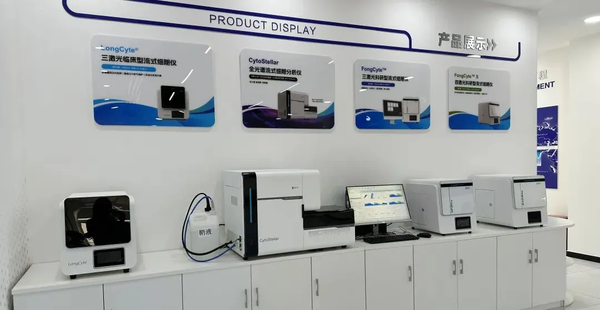
Breakthrough in Domestic Full-Spectrum Flow Cytometer Development


  Recently, the domestically produced "5-laser full-spectrum flow cytometer" was successfully installed and debugged at the Beijing Institute of Life Sciences, marking a significant breakthrough in the successful entry of domestically produced high-end spectroscopic flow cytometers into top domestic research institutions and achieving domestic substitution! Behind this achievement is the research and development result of Beijing Cenglang Biotechnology Co., Ltd. (hereinafter referred to as "Cenglang Biotechnology").

In 2025, Layerwave Biotech launched China's first domestically produced 5-laser 78-channel full-spectrum flow cytometer. Leveraging its 78-channel full-spectrum hardware capabilities, it can achieve parallel detection of up to 50 colors per tube, significantly reducing the number of experimental tubes required. This conserves valuable and scarce experimental samples and significantly reduces the consumption of fluorescent antibodies, achieving overall performance at an internationally advanced level.

  In the same year, with the support of the Beijing Municipal Science and Technology Commission and the Zhongguancun Management Committee, the team led by Wang Peng from Tsinghua University and Layerwave Biotech undertook the "Development of a Full-Spectrum Flow Cytometer" project under the Beijing Municipal "Sensor and Scientific Instrument Innovation Special Project." This collaborative innovation focused on the full-spectrum flow cytometer chain, accelerating the industrialization of research results.​

1.png


Please, Log in or Register to view URLs content!
 
Top
