
You are using an out of date browser. It may not display this or other websites correctly.
You should upgrade or use an alternative browser.
You should upgrade or use an alternative browser.
Miscellaneous News
- Thread starter bd popeye
- Start date

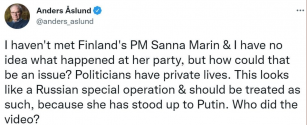

The west "stop blaming putin" challenge....Although I am worry about China economy, I think EU should check whether their professors are eligible
Such as this Sweden economist below
View attachment 95838
Didn't western news agencies predict the Russian economy to drop by 30% this year? 10% seems like a win!—Russia is more dependent on oil becoming a Petrostate if it hasn’t already. Meanwhile Deindustrialization is actually happening in other important sectors.
—Russian Central Bank expects an 8-10% drop in GDP this year. Year on year GDP dropped 4% already in the 2nd quarter. Consumer demand dropped by more than 10%. Manufacturing slumped by 4%. Third quarter 2022 is likely to be even worse.
—Putin has nothing to smile about except oil prices. Even here he’s likely to face competition as the Iran Nuclear Deal is likely to be signed; opening up another source of Oil for Europe.
The war started in February, most companies left in March and April. Time will tell if third quarter will be worse. Why are you so pessimistic?
Europe is desperate for the Iran deal. But even with the deal, it will just shift supply from one to another. Oil prices will likely never go back to levels of 2020. Inflation is here to stay. Russia will still have income. Not just from oil but other raw materials and natural gas.
And it’s not the first time mining giant BHP has accepted payment in yuan.
In May 2020, it delivered a cargo of Brazilian iron ore to China’s Baowu Steel Group – the world’s biggest steelmaker.
“The fear of China sourcing alternative supplies of iron ore from Brazil and Peru is a real threat,” said Dr De Melo.
“BHP’s move with iron ore is certainly a good one.”
Nor was it alone. At the same time, Baowu said it had struck similar deals with iron-ore firms Vale, from Brazil, and Australia’s Rio Tinto and Fortescue Metals Group.
“Australia’s iron ore is the best in the world, and China will be dependent on it for many decades,” he said.
“
Thanks good read.
Aside from a few things that article claimed. Like the real threat to completely cut off Australia ore and replace it from south America. That's has been the case for ages. If it was real, China would have done it at the height of the trade dispute. Something else about iron ore from Australia that's hard to ditch. I wish it was easy but seems like it's not. There's talk of China developing something in new guinea that might rival Australia though. Here's hoping it will be ready soon.
And the article claim about China making no secret to replace the US dollar. I think that's overstating things. China never been open about trying to replace the dollar. In fact I think Chinese officials have stated in the past they are not trying to do that.
Im sure Putin will actually keep on smiling when Iran gets world market access again.Didn't western news agencies predict the Russian economy to drop by 30% this year? 10% seems like a win!
The war started in February, most companies left in March and April. Time will tell if third quarter will be worse. Why are you so pessimistic?
Europe is desperate for the Iran deal. But even with the deal, it will just shift supply from one to another. Oil prices will likely never go back to levels of 2020. Inflation is here to stay. Russia will still have income. Not just from oil but other raw materials and natural gas.
There are plans for Russia to invest $40 billion worth into Iranian energy infrastructure im sure a bit of profit sharing is part of the deal.
The question is will Iran even sell on the global market would you really trust the west not to take your money again.
If they do Iran deserves to just be poor here's an old dutch proverb as advice that goes something like this "Even a donkey doesn't bump into the same stone twice".

—Russia is more dependent on oil becoming a Petrostate if it hasn’t already. Meanwhile Deindustrialization is actually happening in other important sectors.
—Putin has nothing to smile about except oil prices. Even here he’s likely to face competition as the Iran Nuclear Deal is likely to be signed; opening up another source of Oil for Europe.
German industry is grinding to a halt
For the first time in a generation, the country has an export deficit.
The Soviet Union had only just collapsed. The world was a very different place when Germany last posted a trade deficit way back in 1991. But on Monday, the country recorded that imports outstripped exports for more than 30 years. True, other countries are recording huge deficits, not least the UK. For Germany, though, it matters more. Its entire economy has been built around creating an industrial machine that dominates global markets. That machine is now grinding to a halt.
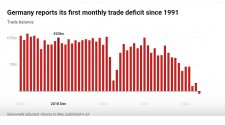
By the standards of Britain, the United States, or indeed France, the €1 billion deficit that Germany announced today might seem like a mere accounting error. Exports unexpectedly fell, while imports surged as the cost of energy spiked. It is not as if the country is about to go bust or call in the IMF to pay its bills. But here’s the catch. Germany is almost uniquely an export-based economy. Until recently it was racking up surpluses of 8 or 9 per cent of GDP, or €20 billion a month, the biggest in the world. And there are three big problems with that disappearing.
First, the German economy is based on selling high-end industrial goods to the rest of the world. Unlike many other countries, it doesn’t have huge service industries to take up the slack if that goes into decline, nor does it have a major financial centre to bring in invisible earnings if the container ships start to go elsewhere. Take the big exporters out of the German economy and it is a little hard to figure out what is left.
What follows a fall in exports is a fall in those well-paid manufacturing jobs that are the backbone of the German economy. True, given a little time Germany should be able to create jobs in services and retail as many other countries have done. But they won’t be paid as much, nor will they necessarily suit blue collar workers. A whole generation of skilled Germans will have little else to do.
Finally, it is going to mean a massive eurozone deficit as well. Of all the countries within the zone, Germany was the only major surplus country. The result? The currency will weaken and weaken.
In truth, the German industrial export machine was fuelled by cheap energy from Russia – and that fuel could soon run dry, as Wolfgang Münchau in last week’s magazine. For most of the post-war era, Germany has prided itself on very low inflation, a stable currency, and a huge trade surplus. Right now, it has a very Italian or Greek mix of 8 per cent inflation, a crumbling currency, and a rising trade deficit. Many other countries are used to that, but for Germans it will come as a shock.

Germany having to undergo austerity?
Meanwhile, Greeks are celebrating kicking out Berlin
Expansion Of Greek Economy Will Likely Exceed Forecast: Patelis
August 19th, 2022, 11:50 PM GMT+0800
It may seem counterintuitive, but a drop in exports is a good thing for Germany. It mostly has a trade surplus with other poorer European countries. Countries like Greece import German products and pay with borrowed money. It's sort of like what is emerging from trade between China and America.German industry is grinding to a halt
For the first time in a generation, the country has an export deficit.
The Soviet Union had only just collapsed. The world was a very different place when Germany last posted a trade deficit way back in 1991. But on Monday, the country recorded that imports outstripped exports for more than 30 years. True, other countries are recording huge deficits, not least the UK. For Germany, though, it matters more. Its entire economy has been built around creating an industrial machine that dominates global markets. That machine is now grinding to a halt.
By the standards of Britain, the United States, or indeed France, the €1 billion deficit that Germany announced today might seem like a mere accounting error. Exports unexpectedly fell, while imports surged as the cost of energy spiked. It is not as if the country is about to go bust or call in the IMF to pay its bills. But here’s the catch. Germany is almost uniquely an export-based economy. Until recently it was racking up surpluses of 8 or 9 per cent of GDP, or €20 billion a month, the biggest in the world. And there are three big problems with that disappearing.
First, the German economy is based on selling high-end industrial goods to the rest of the world. Unlike many other countries, it doesn’t have huge service industries to take up the slack if that goes into decline, nor does it have a major financial centre to bring in invisible earnings if the container ships start to go elsewhere. Take the big exporters out of the German economy and it is a little hard to figure out what is left.
What follows a fall in exports is a fall in those well-paid manufacturing jobs that are the backbone of the German economy. True, given a little time Germany should be able to create jobs in services and retail as many other countries have done. But they won’t be paid as much, nor will they necessarily suit blue collar workers. A whole generation of skilled Germans will have little else to do.
Finally, it is going to mean a massive eurozone deficit as well. Of all the countries within the zone, Germany was the only major surplus country. The result? The currency will weaken and weaken.
In truth, the German industrial export machine was fuelled by cheap energy from Russia – and that fuel could soon run dry, as Wolfgang Münchau in last week’s magazine. For most of the post-war era, Germany has prided itself on very low inflation, a stable currency, and a huge trade surplus. Right now, it has a very Italian or Greek mix of 8 per cent inflation, a crumbling currency, and a rising trade deficit. Many other countries are used to that, but for Germans it will come as a shock.
A drop in exports effectively means less handouts for the EU.
Thats true. Would Iran really trust the West again. Whoever wins 2024 could break the deal again. What guarantee does Iran have this time.Im sure Putin will actually keep on smiling when Iran gets world market access again.
There are plans for Russia to invest $40 billion worth into Iranian energy infrastructure im sure a bit of profit sharing is part of the deal.
The question is will Iran even sell on the global market would you really trust the west not to take your money again.
If they do Iran deserves to just be poor here's an old dutch proverb as advice that goes something like this "Even a donkey doesn't bump into the same stone twice".
As for Russia, wouldn't increased global supply coming from Iran result in lower oil prices?
Russia’s economy shrank by 4 percent year-on-year over the second quarter, according to data published by Russian federal statistics service Rosstat. The plunge, though significant in absolute terms, was not as drastic as expected by Russian and some Western observers. “June data suggests the contraction in the Russian economy seems to have bottomed out as the situation in some industries is stabilizing,” Sergey Konygin, an economist at Sinara Investment Bank, told Reuters.
Hungarian prime minister Viktor Orban claimed in a speech last month that the European Union’s sanctions strategy against Russia has failed. “A new strategy is needed which should focus on peace talks and drafting a good peace proposal … instead of winning the war,” he said. Orban said the West’s strategy was built on four pillars—that Ukraine can win a war against Russia with NATO backing, that sanctions will hurt Russia more than Europe, that the rest of the world will support Western punitive measures against Russia, and that sanctions will critically weaken Russia. “We are sitting in a car that has a puncture in all four tires. It is absolutely clear that the war cannot be won in this way,” Orban said.
The latter three “tires” have created a constellation of unexpected challenges for the Western sanctions regime.
Russia’s Central Bank took swift measures in the wake of the Ukraine invasion to shield the ruble from a flurry of U.S. and EU financial restrictions. Far from being reduced to “rubble,” as President Joe Biden in March, the ruble became one of the world’s strongest performing currencies this year.
Even as Moscow takes unprecedented macroeconomic steps to contain the damage from sanctions, Russian policymakers are honing their tools to evade or otherwise mitigate specific punitive measures. Citing a maintained by Yale University’s Chief Executive Leadership Institute (CELI), proponents of the sanctions regime have noted that over 1,000 companies have “curtailed operations” in Russia.
Though the Western-led financial pullout from Russia appears overwhelming in sheer scale, the reality on the ground is rather more complicated. Russian authorities have enabled a wide range of “parallel import” schemes, according to a recent report by DW. From Levi’s jeans to Apple iPhones, numerous common and luxury products continue to be available for purchase in Russia’s metropolitan centers despite the fact that these manufacturers are no longer directly supplying Russian markets. Such goods typically arrive in Russia by way of unauthorized imports from entities based in former Soviet countries including Kazakhstan, Belarus, and Armenia.
Moscow has opened the floodgates to such activities by lifting restrictions on the resale of many types of goods purchased abroad. These transactions, also known as gray market sales, have totaled $6.5 billion since May, and are expected to reach $16 billion by the end of the year, according to Deputy Prime Minister and Minister of Industry and Trade Denis Manturov. Other products and services also continue to be available through rebranding and knockoff ventures. and , both of which ceased operations in Russia in the months following the invasion of Ukraine, have been replaced by successor companies that offer nearly-identical products with similar branding. Courts would normally put a swift end to such obvious copycat enterprises, but Russia’s legal system is in no mood to lend a sympathetic ear to the patent and infringement claims of Western companies at a time of unprecedented hostility between Russia and the West.
Perhaps the greatest long-term challenge to the West’s campaign to squeeze Russia over its invasion of Ukraine is the fact that the world’s great economic powers have not only refused to join the Washington-led sanctions regime but continue to deepen their trade and financial ties with Moscow. Both and have intensified the pace of their energy imports from Russia over the past half year. There have been of the former selling refined Russian oil to European and U.S. importers. Russian earnings from energy exports skyrocketed following the West’s sanctions barrage earlier this year.
Experts say the effects of sanctions on Russia could take years to fully manifest. Even then, there is no guarantee that the forecasted economic stagnation will occur on a sufficient scale to starve the Kremlin war machine or otherwise produce meaningful, positive changes in Russia’s foreign policy. Moscow, driven by the conviction that its existential interests hinge on victory in Ukraine, believes it can outlast the West economically and on the battlefield. Russia has so far largely managed to mitigate the pain from sanctions and is shifting its strategy in Ukraine from trying to quickly seize major cities to bleeding Ukrainian forces white in a grinding war of attrition.
European consumers, meanwhile, are and electricity bills as officials scramble to contain the energy crisis unleashed by what experts have described as the EU’s poorly conceived plan to transition away from Russian energy imports. With Germany on the verge of a recession, Europe’s mounting economic challenges have reignited concerns that EU states could start peeling away from the Western sanctions regime. Even before Russian energy giant Gazprom to cut European customers off from gas supplies, that a majority of Europeans—including 49 percent of Germans—favored policies aimed at facilitating a negotiated settlement rather than Russia’s clear defeat. As the war drags on with no end in sight, these growing trends risk splintering the West’s united front on Ukraine sooner than the sanctions regime manages to take a decisive toll on Russia’s economy.