This year marks the start of the 15th Five-Year Plan period. The State Council Information Office will hold a series of press conferences titled "Strivers on the New Journey" for Chinese and foreign journalists, inviting outstanding grassroots representatives from various fields to share their inspiring stories of hard work and relentless endeavor. On the afternoon of April 21, at the first session of the series, five representatives from the science and technology sector shared their memorable experiences. During the session, Wang Qiong, Deputy Chief Designer of the Chang'e-6 mission, also revealed some highly anticipated new deep space exploration missions planned for the 15th Five-Year Plan period.
There will be many highlights in planetary exploration. Tianwen-2 is scheduled to arrive at the near-Earth asteroid 2016 HO3 later this year—an asteroid that orbits the sun almost synchronously with Earth. Tianwen-2 will conduct accompanying flight observations and attempt a sample return mission from this asteroid, marking China's first endeavor of this kind. Tianwen-3 is planned to carry out two launches around 2028 and is expected to return to Earth with Martian samples sometime after 2030. Studying and analyzing these Martian samples will help address major scientific questions, such as whether traces of life ever existed on Mars. Tianwen-4 is scheduled for launch around 2030 to explore Jupiter and its moons, aiming to uncover the mysteries of the solar system's largest planet.
In the field of lunar exploration, the Chang'e-7 probe has already been transported to the Wenchang Spacecraft Launch Site and is scheduled for launch in the second half of this year at an appropriate time.
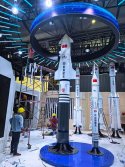
In terms of launch vehicles, China will develop the heavy-lift Long March 9 carrier rocket and conduct its maiden flight, significantly enhancing the nation's capacity to access space. These missions will further improve our spacecraft's ability to reach deeper into space and explore extraterrestrial bodies, while also advancing human understanding of the formation and evolution of the solar system, as well as the origins of life.
Wang Qiong also mentioned another intriguing project: he and his team are planning to conduct research on a lunar surface greenhouse. They hope to use lunar construction technology to build a greenhouse that could help lunar rovers and robots better withstand the extreme environment of the lunar night. "As we know, the lunar night lasts for 14 days, with temperatures plunging as low as minus 200 degrees Celsius—an incredibly harsh environment," he said. "I believe that as lunar exploration enters a phase of long-term presence, such a lunar surface greenhouse will prove highly useful."