China's Space Program Thread II

charles18

Junior Member
Registered Member
In regards to the "Low resolution" of GEO satellites...
lets assume it can measure: the speed, position, and size of an object but not good enough to get a satisfactory image for identification.
Despite this limitation this may still be "good enough" to identify an aircraft carrier.

If something on the water is traveling at 30 knots, measures 333 meters in length and is being escorted by half a dozen other "objects" moving at the same speed but are 155 meters in length each than that's "most likely"
a Nimitz carrier being escorted by 6 Arleigh Burke destroyers.
Regardless of the "Low resolution" of the image What else could it be?
Civilian ships usually do not hit 30 knots.

The beauty of GEO satellites is only 3 is needed to provide full coverage of the entire planet.
I'm of the opinion that, contrary to their supporters, aircraft carriers are actually not that hard to find and track.
 

Asug

Junior Member
Registered Member
This is not a floor lamp, it’s a scientific instrument!
The Russian instrument “Lunar Dust Monitoring” (PmL-Ch7), developed at the Space Research Institute of the Russian Academy of Sciences, is installed onboard the Chang’e 7 lunar lander.
The instrument consists of a unit with piezoceramic sensors and a Langmuir probe. When a dust particle strikes a sensor, its mechanical impulse is measured. From its magnitude, the size and velocity of the particle can be inferred. The Langmuir probe measures the density and temperature of the surrounding plasma.

Please, Log in or Register to view URLs content!
 

Attachments

  • Без имени-1.jpg
    Без имени-1.jpg
    64.2 KB · Views: 56

TheRathalos

Junior Member
Registered Member
This year marks the start of the 15th Five-Year Plan period. The State Council Information Office will hold a series of press conferences titled "Strivers on the New Journey" for Chinese and foreign journalists, inviting outstanding grassroots representatives from various fields to share their inspiring stories of hard work and relentless endeavor. On the afternoon of April 21, at the first session of the series, five representatives from the science and technology sector shared their memorable experiences. During the session, Wang Qiong, Deputy Chief Designer of the Chang'e-6 mission, also revealed some highly anticipated new deep space exploration missions planned for the 15th Five-Year Plan period.

There will be many highlights in planetary exploration. Tianwen-2 is scheduled to arrive at the near-Earth asteroid 2016 HO3 later this year—an asteroid that orbits the sun almost synchronously with Earth. Tianwen-2 will conduct accompanying flight observations and attempt a sample return mission from this asteroid, marking China's first endeavor of this kind. Tianwen-3 is planned to carry out two launches around 2028 and is expected to return to Earth with Martian samples sometime after 2030. Studying and analyzing these Martian samples will help address major scientific questions, such as whether traces of life ever existed on Mars. Tianwen-4 is scheduled for launch around 2030 to explore Jupiter and its moons, aiming to uncover the mysteries of the solar system's largest planet.

In the field of lunar exploration, the Chang'e-7 probe has already been transported to the Wenchang Spacecraft Launch Site and is scheduled for launch in the second half of this year at an appropriate time.

In terms of launch vehicles, China will develop the heavy-lift Long March 9 carrier rocket and conduct its maiden flight, significantly enhancing the nation's capacity to access space. These missions will further improve our spacecraft's ability to reach deeper into space and explore extraterrestrial bodies, while also advancing human understanding of the formation and evolution of the solar system, as well as the origins of life.

Wang Qiong also mentioned another intriguing project: he and his team are planning to conduct research on a lunar surface greenhouse. They hope to use lunar construction technology to build a greenhouse that could help lunar rovers and robots better withstand the extreme environment of the lunar night. "As we know, the lunar night lasts for 14 days, with temperatures plunging as low as minus 200 degrees Celsius—an incredibly harsh environment," he said. "I believe that as lunar exploration enters a phase of long-term presence, such a lunar surface greenhouse will prove highly useful."

Please, Log in or Register to view URLs content!
lgtONutr.jpg


71b65b9c-0be8-471e-a3c1-69f41bf719c3.jpg04122531-771c-4079-aabf-c4bad66ed568.jpg
I wonder if they could extend the rotation stay to up to 2 weeks, since that was already unintentionally proven during the SZ-20/21 rotation...

Zhuque-3 Y2 is on its way to Jiuquan, it will reportedly arrive in a few days.
1776889309051.png
 

siegecrossbow

Field Marshall
Staff member
Super Moderator
Please, Log in or Register to view URLs content!
View attachment 173811


View attachment 173809View attachment 173810
I wonder if they could extend the rotation stay to up to 2 weeks, since that was already unintentionally proven during the SZ-20/21 rotation...

Zhuque-3 Y2 is on its way to Jiuquan, it will reportedly arrive in a few days.
View attachment 173812
Any chance they can get PAF pilots in the program? Imagine if they can get one of the Swift Retort or May 7th pilots in space!
 

sunnymaxi

Colonel
Registered Member

TheRathalos

Junior Member
Registered Member
Any chance they can get PAF pilots in the program? Imagine if they can get one of the Swift Retort or May 7th pilots in space!
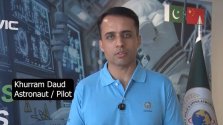
The selection was open to everybody (" army, navy, air force, and ordinary citizen") ; I can confirm Khurram Daud was Tactical coordinator officier on a Pakistani Navy P-3C Orion, I'm much less certain about Zeeshan Ali, but there are homonymous officiers in the pakistani air force, so good odds he's a pilot from there.


so LM-9 has approved.
Yes that's obvious given the construction work ongoing at Wenchang and its development is listed as a national 5YP goal. It's a bit of a "boy who cried wolf" situation, since CASC and CNSA have been talking about the CZ-9 for 15 years now, it feels a bit unreal that its full development is actually going ahead now.

However formal approval is probably a couple years away: remember that CZ-10 was only "formally approved" in 2023, for example, even though there's been hardware developped for it since at least 2018.
 

sunnymaxi

Colonel
Registered Member
Yes that's obvious given the construction work ongoing at Jiuquan and its development being listed as a national 5YP goal. It's a bit of a "boy who cried wolf" situation, since CASC and CNSA have been talking about the CZ-9.

However formal approval is probably a couple years away: remember that CZ-10 was only "formally approved" in 2023, for example, even tho there's been hardware developped for it since at least 2018.
yeah. Aerospace and civil aviation will be top priority in this Five year plan as per the State council.
 
Last edited:

Tomboy

Captain
Registered Member
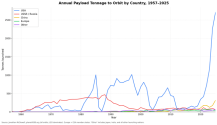
launch-capacity-getting-quite-lopsided-v0-yltq7hvwnswg1.png
Despite having a good percentage of global orbital attempts, China remains massively behind the US with actual up mass.

IMO, orbital attempts doesn't really mean much alone while the more important and direct metric would be actual up mass. China right now has a huge amount of small/medium lift rockets while the US is launching consistently reusable heavy lift rockets at a higher cadence.

I'm unsure to whether China will be capable of catching up by even the 2030s as US is still rapidly scaling larger reusable vehicles like NG and Starship while China still lacks a single mass usable reusable heavy lift rocket in 2026. Ideally they'll scale up as soon as 2027 with reasonably high launch cadence of reusable LVs with competitive payload.
 
Last edited:
Top