Russian Military News, Reports, Data, etc.

Tam

Lieutenant General
Registered Member
Russians battle testing a new ZALA loitering drone, the KUB-10ME. This one has a range of 100km and has optics. Typicality early KUBs are GPS guided and flown towards predetermined locations like generic Gerans. The addition of optics means it can strike like Lancets.


We are seeing more and more Yelkas in the battlefield as technical success leads to production ramping up in scale.

 
Last edited:

pmc

Brigadier
Registered Member
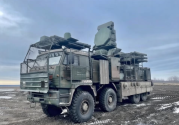
It has some new info about Pantsir. The Naval version is more complex and they tested against intercepting Kornet anti tank missile to simulate low altitude cruise missile. Pantsir has become more verstitle. smallest UAV to high altitude ATACMS go unmann boats.
This itself innovation that small corvette are capable of intercepting ballistic and hypersonic missiles.

Please, Log in or Register to view URLs content!

"Shell" on the waves​

To demonstrate the diversity of the Pantsir family, the "Military Acceptance" film crew visited the Kaliningrad region and the Baltic Sea, aboard the small missile ship "Burya," a Project 22800 Karakurt class ship. It is armed with the naval version of the Pantsir—the Pantsir-ME anti-aircraft missile and artillery system.

In general, demonstrating the operation of the Pantsir in real combat conditions is very difficult. On the one hand, this concerns secrecy issues, and on the other, the system's missiles engage targets so far away and high up that it's difficult to see. Therefore, exercises are the ideal way to demonstrate the system's operation.

A Kornet anti-tank missile, converted into a target, was chosen as the target. This is a more challenging target for the Pantsir, as the missile flies close to the surface, in this case, at sea, unlike other missiles, which fly overhead.
According to the commander of the Burya's missile and artillery warhead unit, the naval Pantsir differs only slightly from the land-based version, borrowing all the best features. The Pantsir-ME effectively shoots down low-flying, small-size targets, including for this purpose, thanks to its two six-barreled 30mm anti-aircraft guns. The precision-guided barrels fire at a rate of fire that can literally cut an enemy to pieces—over 10,000 rounds per minute.
The sea-based Pantsir, like the land-based version, has two radars. The radar module, integrated into the ship's conning tower, detects targets. The multifunctional radar, the MRLS, provides target guidance and destruction.
As the combat unit commander noted, target designations can also be received visually, rather than via a radar. The system is equipped with a state-of-the-art optoelectronic system that enables the autonomous detection of small targets, undetectable by radar, in both day and night mode, including unmanned boats and drones.
The naval Pantsir's radar has the most complex configuration, as searching for and intercepting air targets at sea is inherently more difficult than on land. Firstly, a ship is never level, rocking on the waves; secondly, in combat, it is constantly and quite rapidly moving.

This version dealing with small UAVs
Please, Log in or Register to view URLs content!

The Pantsir-S1 air defense missile and gun system has received integrated electronic warfare protection against unmanned aerial vehicles (UAVs).​

1772955472796.png

Rusi report says S-500 and A-235 will be able to intercept UK/France quantity of SLBMs.
I doubt any other country has demonstrated salavo lunches of SLBMs like Russia/Soviets.
Please, Log in or Register to view URLs content!
A report by the Rusi think tank said Europe would have to acquire or build hypersonic missiles to ensure Moscow’s air defences can be defeated

Russia’s new air defences could soon intercept UK nuclear missiles​

The report said that as Russian missile-defence systems, such as the A-235 and S-500, around Moscow improve, the longstanding assumption that a limited number of submarine-launched ballistic missiles from Britain’s and France’s nuclear deterrent will penetrate layered defences may no longer hold.
Russia’s ground-based A-235 anti-ballistic missile system is designed to deflect a nuclear attack on Moscow. The S-500 is an advanced missile-defence shield capable of intercepting intercontinental-range ballistic missiles.
 

pmc

Brigadier
Registered Member
Russia has now introduced Hermes missile into SVO zone and Aljazeera put its long history of various version.. They are expecting 100km range from Air and 40 to 50km from ground with Mach 4 speed. .
but they still referring to old system specifications not the current one.
this truly age of Hypersonics and Attack choppers. this is the conclusion of Ukraine conflict.
Please, Log in or Register to view URLs content!

Last updated: 16/2/2026 10:15 (Mecca time)Last updated: 16/2/2026 10:15 (Mecca time)

Russian Hermes multi-platform missile system​

The system is characterized by an operational range of up to one hundred kilometers when launched from the air and between 40 and 50 kilometers if launched from ground platforms, which makes it superior to traditional systems. Its superior speed also gives it an advantage over traditional systems and makes it difficult for enemy air defense systems to intercept it
Russian news agency TASS reported that the airborne version of the Hermes system entered service in the Russian war on Ukraine in early February 2026 to test it in combat conditions
The missile's high speed—reaching approximately 1300 meters per second (around Mach 4)—enhances the effectiveness of the warhead and expands its
The project came as part of an effort to develop a long-range guided missile capable of bridging the gap between traditional tactical missile systems and long-range battlefield missiles

Please, Log in or Register to view URLs content!
02-02-2021 10:39

Version 2.0: The Hermes rocket's power will be increased by 2.5 times.​

High Precision Systems emphasized that the possibility of such modifications was built into the Hermes from the very beginning.
Experimental design work is planned that will increase the missile's combat power by two to two and a half times and increase its flight speed. This will be the Hermes 2.0 version of the system," Ozdoyev noted.
As a reminder, the characteristics of the baseline missile that need to be improved include a speed of up to 1.3 kilometers per second and a warhead weighing 28 kilograms.

Please, Log in or Register to view URLs content!

Upgraded Khrizantema-M antitank missile accelerates to hypersonic speed — Rostec​

"Firstly, the missile’s flight range has been extended, allowing the crew to stay out of the kill zone; secondly, it has hypersonic speed," the company said, adding that this version is used not only on ground-based anti-tank systems but also on helicopters.


pmc

Brigadier
Registered Member
Do you know what is the reason for that
Soviet/Russia has amazing talent in mechanical engineering and they have long tradition of state run large scale projects that span generation of experience people. now you add Robotics and advancements in computer. This long life expectancy is very important.
This is 90 year old Ilyushin Aviation Complex Chief Advisor who worked on IL-76 that Putin is awarding in 2016.
Please, Log in or Register to view URLs content!
 

Soldier30

Captain
Registered Member
The first technical data and launch of the Russian Yolka interceptor drone have been released. It is currently in active use by Russia's mobile air defense forces. The Yolka interceptor drone is manufactured by the Moscow-based company Nashe Nebo. It operates on a "fire and forget" principle. Upon locking on to a target, the Yolka drone's engines fire. The Yolka drone's dual-channel optoelectronic module is capable of identifying enemy drones with a 100-centimeter wingspan in the visible optical spectrum at a range of 700-1000 meters. The Yolka drone can also engage maneuvering FPV drones.

There are two versions of the drone: a civilian version, without a warhead, performs kinetic interception of UAVs. The second version contains a 360-gram fragmentation warhead. The Yolka drone can be launched from handheld devices or a tripod. The Yolka drone can also be mounted on the Impulse-PVO tracked robotic chassis.
The Yolka interceptor drone reaches speeds of up to 200 km/h. Its rate of climb is 40 m/s. The drone can fly 2.5-3 km away from the operator and ascend to an altitude of up to 2,000 meters. The maximum target speed is 115 km/h.

 
Top