Indian Military News, Reports, Data, etc.

sequ

Colonel
Registered Member

Gloire_bb

Colonel
Registered Member
Not enough to outrange PL-15.
RBE2 certainly outranges PL-15 seeker. Otherwise, it isn't relevant; it serves Meteor v combat-equipped non-LO targets at all combat ranges, which is the point. What it does badly is Rafale doesn't have 2nd channel for 2-way datalink for Meteor. But this isn't RBE, it's aircraft itself(receiver array is separate from radar).
Same size and older.
It isn't same, it's good 30% less TRMs; 800 something v 600 something. And while yes, older (air cooled fighter AESA are a rather new solution in the first place), range(as concern was range) is determined very bluntly by radar equation. Which is, array and power in it.
It's actually even more, as power agility for fighter aircraft always favours twin engine aircraft.
It's one of their most prominent problems among others.
For general volume scan among 4th gen competition, in 2010s Rafale had probably 2nd best radar in the world fighter market.
AN/APG-79 is more or less comparable, Russian PESAs are rather medium in scan, Chinese AESAs and CAPTOR E weren't even available.

Indian AF largest problems are:
-incomprehensible failure to keep MKIs up to date (even more astonishing after 2019); Like, Russians proposed them RVV-BDs, but until 2025 India didn't even buy RVV-SDs. Was it to protect Rafales with their Micas?
-falling MWF numbers;
-Tejas delays.

RBE2 performance, especially v. Pakistan(not China) is somewhere on a 2nd A3 page. And against China right now all of it is sort of delusional.
 

Aval

Junior Member
Registered Member
Russian fighters are too dated electronically. Su-35 purchase instead of Rafale is sure to be a dud unless it receives some modernisation. Su-57 is about as expensive and why they don't practically see the Su-57 as a better fighter for IAF is unknown. Maybe it's as simple as they've dropped out of FGFA long ago and buying Su-57 is sort of like trying to get back together with a girl you jilted at the alter.

Lets assume India's highest-level geopolitical leaders (above the military command) are rational actors. Not a far-fetched assumption given that its a huge nation that hasn't disintegrated yet, even if they usually only have an array of bad and worse options to pick from due to systemic political issues.

In that case, India probably knows that the greatest geopolitical threat is China, a massive nation it shares a long land border with it. Pakistan is supported by China. Therefore, at the current state of the IAF and wider Indian MIC, the objective is to keep China uninvolved and deter Pakistan from offensive military operations. This buys time for India to (try to) industrialise and Pakistan's economic woes to bite. Countering China directly is only possible if India fully industrialises.

China has never suggested the sale of J-35AE to Pakistan. Even the J-10CEs sold were on loans so favourable they were purely geopolitical rather than profit-driven. The May 2025 skirmish proved that J-10CEs are sufficient to deter Indian offensive military operations. Therefore, there's no need for Pakistan to get J-35AE unless its to counter overmatch by India getting Su-57E. After May 2025, India is afraid that the current IAF can't even win vs PAF in a total war, which means they lack escalation dominance and consequently leaves them vulnerable to Pakistani offensive operations including skirmishes. If they aren't able to deter this, any random Pakistani attack (for whatever reason: Nationalism? Religious terrorism? Chinese proxy attack?) would severely interrupt their peacetime industrialisation.

By buying a large amount of Rafales, India ensures it has escalation dominance to win a total war (sans MAD) vs Pakistan while not attaining overmatch in skirmishes (May 2025 was a skirmish), which prevents China from selling J-35AE to Pakistan and thereby establishing deterrence across the board. This way, neither Pakistan nor India would be able to entertain offensive military operations. China wants a stable local environment, and for that it needs Pakistan to be strong enough to deter Indian offensive operations while being unable to conduct offense on its own. Altogether, this means buying Rafales could be an overture to China, signalling that India doesn't want war but also won't tolerate war. This is a marked improvement over the pre-2025 era where India was willing to go on the offensive against Pakistan.

In that sense, its actually safer and more logical to buy lots of Rafales than buy Su-57E and risk China selling J-35AE to Pakistan (or directly intervening with PLAAF).

Rafale still easily is better than everything in PAF except J-10CE and PAF only has a handful of J-10CE. With over 100 Rafales, IAF absolutely has superiority. What is Pakistan going to do? Ask China for more J-10CE based on soft loans? China can't quite afford this because it's actually quite a significant force. 24 units sure but spare 100? China has much more need for J-10C production line unless Pakistan can pay handsomely like India does for France, but it does not.

I don't see why the PLAAF needs newbuild J-10C(/E) anymore. It already has a sizeable extant fleet for its cheapest mission needs, and furthermore has the premier J-20 + second-line J-35A/J-16 (and even legacy J-11s) for the Hi/Lo mix. The real cost of J-10C production line is that its holding factory space and resources that could instead go into a new CAC production line for J-20A/S or J-36. I can even see China selling used PLAAF J-10C to Pakistan at a further discount and favourable loans if they're concerned 114 Rafales gives India significant overmatch against just 36 J-10CE.

 

Gloire_bb

Colonel
Registered Member
If Russia could, they'd be equipping the Su-35 with such a radar. Why they don't take the Byelka and iterate for Su-35 is a wonder. Irbis was okay to maybe good but it's 2026 not 2016.
Fighter radars aren't accesories - if nothing is wrong with them, you let them work their service life; if you can extend it - you extend it.
Same reason for example Su-30SM2s don't use Irbis, but rather updated Bars.
N035 Irbis was available sooner - before N036 (late 2000s rather than ~2015). For Su-35s second number is obviously late. It also used existing 1990s tech(from MFI program), rather than requiring something that was only developed and was a significant technological risk(NIIP itself wasn't sure it'll manage N036).
You also can fit into flanker nose, as it's a single main radar - You can't install (and power/cool) 7/8 separate arrays into airframe which isn't designed with it in mind. Yes, Su-35 also has IFFs in leading edges, but this is a relatively light installation, nothing close to N036L.

Other thing is purpose. 2010s problem for VKS was relatively few, very high performance VLO jets, which if uncountered could be devastating. GBAD without effective mobile element can spot, but can't reliably counter them, and thus becomes vulnerable to destruction. Su-35s was designed for this specific task.

N035, by itself, gives significantly longer acquisition/tracking ranges in a mode (quite likely still longer than any fighter radar, and most certainly much longer back then), which is centerpriece of this fighter. Provided someone can guide it - it has better chances v VLO bogey. It still does, and you guess it - in 2020s it's meant to operate together with Su-57, which can cue them(before it was GCI).

Furthermore, there's hinge. Before just about now, it was very troublesome to install full array on a hinge mount - too thick and heavy. Either single axis swivel (a-la Bars), or swashplate. As such, N035 can use its full power focused mode in most of its incredible 270 deg AoR. Byelka gets to use its full power, for obvious reasons, only within frontal sphere.

Su-35s(m) will likely receive AESA array in the coming few years, it's MLU time is coming in a few years (it is in service since 2011). But overall Irbis is still quite relevant, at least in force mix with S-35/40/500 and Su-57.

TLDR: N035 is a solid, well understood radar with special focus(VLO targets), but also providing reasonable broad performance. Not a world beater, but within the pack for 2010-2020s.
 

ougoah

Brigadier
Registered Member
Lets assume India's highest-level geopolitical leaders (above the military command) are rational actors. Not a far-fetched assumption given that its a huge nation that hasn't disintegrated yet, even if they usually only have an array of bad and worse options to pick from due to systemic political issues.

In that case, India probably knows that the greatest geopolitical threat is China, a massive nation it shares a long land border with it. Pakistan is supported by China. Therefore, at the current state of the IAF and wider Indian MIC, the objective is to keep China uninvolved and deter Pakistan from offensive military operations. This buys time for India to (try to) industrialise and Pakistan's economic woes to bite. Countering China directly is only possible if India fully industrialises.

China has never suggested the sale of J-35AE to Pakistan. Even the J-10CEs sold were on loans so favourable they were purely geopolitical rather than profit-driven. The May 2025 skirmish proved that J-10CEs are sufficient to deter Indian offensive military operations. Therefore, there's no need for Pakistan to get J-35AE unless its to counter overmatch by India getting Su-57E. After May 2025, India is afraid that the current IAF can't even win vs PAF in a total war, which means they lack escalation dominance and consequently leaves them vulnerable to Pakistani offensive operations including skirmishes. If they aren't able to deter this, any random Pakistani attack (for whatever reason: Nationalism? Religious terrorism? Chinese proxy attack?) would severely interrupt their peacetime industrialisation.

By buying a large amount of Rafales, India ensures it has escalation dominance to win a total war (sans MAD) vs Pakistan while not attaining overmatch in skirmishes (May 2025 was a skirmish), which prevents China from selling J-35AE to Pakistan and thereby establishing deterrence across the board. This way, neither Pakistan nor India would be able to entertain offensive military operations. China wants a stable local environment, and for that it needs Pakistan to be strong enough to deter Indian offensive operations while being unable to conduct offense on its own. Altogether, this means buying Rafales could be an overture to China, signalling that India doesn't want war but also won't tolerate war. This is a marked improvement over the pre-2025 era where India was willing to go on the offensive against Pakistan.

In that sense, its actually safer and more logical to buy lots of Rafales than buy Su-57E and risk China selling J-35AE to Pakistan (or directly intervening with PLAAF).


I don't see why the PLAAF needs newbuild J-10C(/E) anymore. It already has a sizeable extant fleet for its cheapest mission needs, and furthermore has the premier J-20 + second-line J-35A/J-16 (and even legacy J-11s) for the Hi/Lo mix. The real cost of J-10C production line is that its holding factory space and resources that could instead go into a new CAC production line for J-20A/S or J-36. I can even see China selling used PLAAF J-10C to Pakistan at a further discount and favourable loans if they're concerned 114 Rafales gives India significant overmatch against just 36 J-10CE.

Honestly I don't see J-10C being so quickly phased out of PLAAF. It needs a cheaper single engine fighter.

Unless UADFs (single WS-10 engine powered) can replace J-10's role, there is always a need for a fighter with a fraction of the operational cost as J-16 and twin engined 5th gens. UADFs are slightly smaller than J-10 (they're roughly JF-17/Gripen sized) and designed to be stealthy. I mean they went to the trouble of making them tailless and supersonic capable. I don't think hanging larger SOWs will be done for UADFs for ground strike role and doubt they're able to fly as far as J-10C with drop tanks.

It'll be some years before China can totally phase out of single engine and go full high end only for PLAAF due to range and payload requirements while logistics for supporting an entirely twin engine manned fighter fleet is doable.
 

ougoah

Brigadier
Registered Member
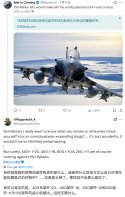
Deino's retort against Jai Hinds has become so famous that it made it onto Weibo as well XD

View attachment 168333

lol that class of Jai Hind is something else.

It's remarkable to think how far ahead China is. Even ignoring J-20 and J-35, PLAAF has close to 1000 4.5 gen fighters in J-16 series, J-10C and J-15B/T. This is also all in service today, trained up, weaponised and tactics formed long ago.

By the time IAF receives 150 Rafales, PLAAF will have over 1500 4.5 gen fighters and well over 1000 5th gen fighters. Since it'll take France and India over 10 years to complete delivery of 150 new Rafales. It's likely PLAAF will be flying at least two 6th gen fighters in active service in 10 years time.

As for today, it's 1000+ 4.5 gens in PLAAF service with a great portion of that fleet able to fire PL-17 missiles which greatly outranges anything Rafale has and has got planned. PL-15 and PL-16 hold their own against Meteor. India pays through the nose for each Meteor and the money and time taken for every Meteor reaching IAF service, China puts dozens of PL-15/16 and dozens of PL-17. It's not even a comparison. May as well compared USA with New Zealand in depth and production rate.

IAF is collectively about the strength of 1/50 PLAAF if even that. Right now, IAF only has less than 36 Rafales and not that many Meteors to spare. PLAAF has 1000 4.5 gens and approaching 500 5th gens which are multiple times the effectiveness of 4.5 gens. If we factor in airborne support units, the comparative ratio isn't even 1/50 it would be 1/100 if not worse for IAF.
 
Last edited:

Aval

Junior Member
Registered Member
Honestly I don't see J-10C being so quickly phased out of PLAAF. It needs a cheaper single engine fighter.

Unless UADFs (single WS-10 engine powered) can replace J-10's role, there is always a need for a fighter with a fraction of the operational cost as J-16 and twin engined 5th gens. UADFs are slightly smaller than J-10 (they're roughly JF-17/Gripen sized) and designed to be stealthy. I mean they went to the trouble of making them tailless and supersonic capable. I don't think hanging larger SOWs will be done for UADFs for ground strike role and doubt they're able to fly as far as J-10C with drop tanks.

It'll be some years before China can totally phase out of single engine and go full high end only for PLAAF due to range and payload requirements while logistics for supporting an entirely twin engine manned fighter fleet is doable.

Fair enough, that rules out transferring second-hand J-10C from PLAAF stock, although even so I'd presume the extant J-10 fleet is sufficient for PLAAF's needs until the end of J-10 service life.

J-10 A/B could be upgraded to near J-10C standard, so long as a minimal amount of production capability (say, at least one line) is left open. That single J-10C production line could be sufficient to cover domestic J-10C maintenance, J-10A/B upgrades, and J-10CE for exports all at once. I don't see the PLAAF inducting any newbuild J-10C airframes unless they expect significant attrition (which shouldn't be happening if your 1st and 2nd line units are doing their job properly).
 

Puss in Boots

Junior Member
Registered Member
lol that class of Jai Hind is something else.

It's remarkable to think how far ahead China is. Even ignoring J-20 and J-35, PLAAF has close to 1000 4.5 gen fighters in J-16 series, J-10C and J-15B/T. This is also all in service today, trained up, weaponised and tactics formed long ago.

By the time IAF receives 150 Rafales, PLAAF will have over 1500 4.5 gen fighters and well over 1000 5th gen fighters. Since it'll take France and India over 10 years to complete delivery of 150 new Rafales. It's likely PLAAF will be flying at least two 6th gen fighters in active service in 10 years time.

As for today, it's 1000+ 4.5 gens in PLAAF service with a great portion of that fleet able to fire PL-17 missiles which greatly outranges anything Rafale has and has got planned. PL-15 and PL-16 hold their own against Meteor. India pays through the nose for each Meteor and the money and time taken for every Meteor reaching IAF service, China puts dozens of PL-15/16 and dozens of PL-17. It's not even a comparison. May as well compared USA with New Zealand in depth and production rate.

IAF is collectively about the strength of 1/50 PLAAF if even that. Right now, IAF only has less than 36 Rafales and not that many Meteors to spare. PLAAF has 1000 4.5 gens and approaching 500 5th gens which are multiple times the effectiveness of 4.5 gens. If we factor in airborne support units, the comparative ratio isn't even 1/50 it would be 1/100 if not worse for IAF.
There is no comparison between purchased aircraft and domestically manufactured aircraft. The strength of a regional hegemon cannot be obtained solely through military purchases!
 

sheogorath

Colonel
Registered Member
Russian fighters are too dated electronically. Su-35 purchase instead of Rafale is sure to be a dud unless it receives some modernisation
There is a reason the PLAF bought Su-35's and it wasn't for a love of outdated/non-performing tech, though.
With AESA upgrade and R-37M, a "Super MKI" Would be pretty much equal in BVR air superiority as Rafale. Where Rafale would be stealthier than MKI, the MKI carries more and flies further/longer.
I doubt the R-37M will be exported(India claims Algeria MKA got them but there is no evidence of it) and it will be depedent on whatever radar the Indians chose to upgrade the MKI. If it doesn't have enough range, it doesn't make sense and there is a reason why the Russians didn't bother to integrate R-37's on the original Su-30SM.

And I don't think the RVV-BD is a thing outside of mock-ups for now. They'll probably try to force things with the Astra
 
Top