
China's Space Program Thread II

Tomboy

Senior Member
Registered Member
Starlink style sats can be launched just fine through "disposable" rockets. There's currently 2/2 countries on this planet even attempting reusability and 1/2 succeeding. Need to calm your horses man. Going numbers wise, China and the States are the only ones in the race, all others haven't even started off the line yet for this style of rocket.
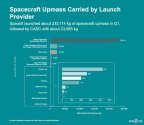
spacemassq12023.jpeg
(Q1 2023)
This should give a sense of the huge gap between US and China in terms actual mass launched. Number of launches is a deceptive metric as right now most of Chinese launches are medium or small lift rockets while basically every US launch is a reasonably fully loaded F9 B5 and even then China still lags behind the US in total launch by a good amount.

Chinese rockets right now lack turn around time and payload capacity to compete with SpaceX and the gap is huge even if their launch prices can compete.
 
Last edited:

klagla026

Just Hatched
Registered Member
Out of the first 10 Falcon 9 first-stage landing attempts, 9 failed to achieve a successful landing. So don't expect everything to work flawlessly the first time.

  • Sep 29, 2013 (Flight 6): – Failure (uncontrolled spin during descent).
  • Apr 18, 2014 (Flight 9): – Semi-failure (soft touchdown but destroyed by waves).
  • Jul 14, 2014 (Flight 10): – Semi-failure (soft touchdown but tipped over, hull breached).
  • Sep 21, 2014 (Flight 13): – Failure (descent controlled but insufficient propellant for full landing burn).
  • Jan 10, 2015 (Flight 14): – Failure (hard impact due to grid fin issue).
  • Feb 11, 2015 (Flight 15): – Semi-failure (soft touchdown achieved, but no recovery due to conditions).
  • Apr 14, 2015 (Flight 17): – Failure (hard impact due to valve malfunction).
  • Dec 21, 2015 (Flight 20): – Success (intact vertical landing and recovery).
  • Jan 17, 2016 (Flight 21): – Semi-failure (soft touchdown but landing leg failed, booster tipped and exploded).
  • Mar 4, 2016 (Flight 22): – Failure (hard impact from high-velocity reentry).

Meanwhile China already has extremely efficient rockets for satellite constellations like the Long March 8A and Long March 6A.
But once China figures out this landing properly, expect them to flood low earth orbit with their megaconstellations like they are doing with electric vehicles.
 

doggydogdo

Junior Member
Registered Member
I know reuseable rockets are important for national security but what does it do for the economy? China's internet is already faster and cheaper than what satellite constellations can provide, if China doesn't need it for internet will Chinese rockets ever scale up like Spacex did with starlink?
 

Nevermore

Junior Member
Registered Member
I know reuseable rockets are important for national security but what does it do for the economy? China's internet is already faster and cheaper than what satellite constellations can provide, if China doesn't need it for internet will Chinese rockets ever scale up like Spacex did with starlink?
This is essentially a bet on whether the next technological revolution will take place in space. Consider NVIDIA, which started out solely as a gaming graphics card manufacturer but gradually evolved into the world's leading AI computing card company.
 

Blitzo

General
Staff member
Super Moderator
Registered Member
I know reuseable rockets are important for national security but what does it do for the economy? China's internet is already faster and cheaper than what satellite constellations can provide, if China doesn't need it for internet will Chinese rockets ever scale up like Spacex did with starlink?

Beyond the benefits of a global internet network that one can control themselves (i.e.: think bigger than "China's internet within its own borders"), the longer term benefits of orbital/space based resource extraction cannot yet be understated or underestimated.

Right now it is the equivalent of biplane to monoplane transitions in aircraft in the early 20th century -- staying competitive means that if the future leads to the equivalent of high end jet aircraft (with the potential economic benefits it may bring), then one will not remain grossly behind.


In short, don't think about reusable rockets as reusable rockets, but think of it as large scale access to earth orbit, and space at large, in the same way that aircraft and ships give access to the air and sea respectively.
It would be prudent to assume that there are ways in which long term economic potential may exist in ways and scales that people have yet to even imagine, and thus it would be prudent to not be too far behind.
And this is all ignoring the national security/geopolitical angle, which by itself would be more than enough reason to remain competitive as well.
 

enroger

Senior Member
Registered Member
There should be some level of collaboration between these companies doing reusable rockets. Multiple space companies are all trying to individually do the same thing and you can’t have each one fail repeating the same mistakes. It just seems to waste time and resources when they are repeating each other’s mistakes. Some level of knowledge sharing so they can learn off each other will be better for China. The longer the delay for an operational reusable rocket, the further China will fall behind Starlink.

I believe there are already some level of collaboration, likely state coordinated. This is just the very early stage of development, got to remember this is not an easy endeavor, people need to have have more patient and not agonize over every failures
 

Tomboy

Senior Member
Registered Member
I believe there are already some level of collaboration, likely state coordinated. This is just the very early stage of development, got to remember this is not an easy endeavor, people need to have have more patient and not agonize over every failures
I can't see private companies sharing data as it'll be directly helping their competition for 0 gain but state backed projects apparently do share data and experience with other private companies.
 

enroger

Senior Member
Registered Member
I can't see private companies sharing data as it'll be directly helping their competition for 0 gain but state backed projects apparently do share data and experience with other private companies.

I don't think a purely private corporation mentality is entirely accurate, especially considering a lot of those companies are funded with public capitals. It is in the interest of government to coordinate some level of collaboration among these companies.
 

sunnymaxi

Colonel
Registered Member
View attachment 166700
(Q1 2023)
This should give a sense of the huge gap between US and China in terms actual mass launched. Number of launches is a deceptive metric as right now most of Chinese launches are medium or small lift rockets while basically every US launch is a reasonably fully loaded F9 B5 and even then China still lags behind the US in total launch by a good amount.

Chinese rockets right now lack turn around time and payload capacity to compete with SpaceX and the gap is huge even if their launch prices can compete.
2023 report card is not appropriate..

double the payload.jpg

not comparing with USA.. but China's space payload has been more than doubled since 2023. look at the 2025 chart and it will continue to increase further.

but yeah we have two failures so far in reusable category.. but at least we get the working rocket and can be used to send payload in orbit. reusability is very critical but payload capacity is important too. we have more reusable rockets coming . just need one success then door will open. finger crossed.
 
Top